QUESTION IMAGE
Question
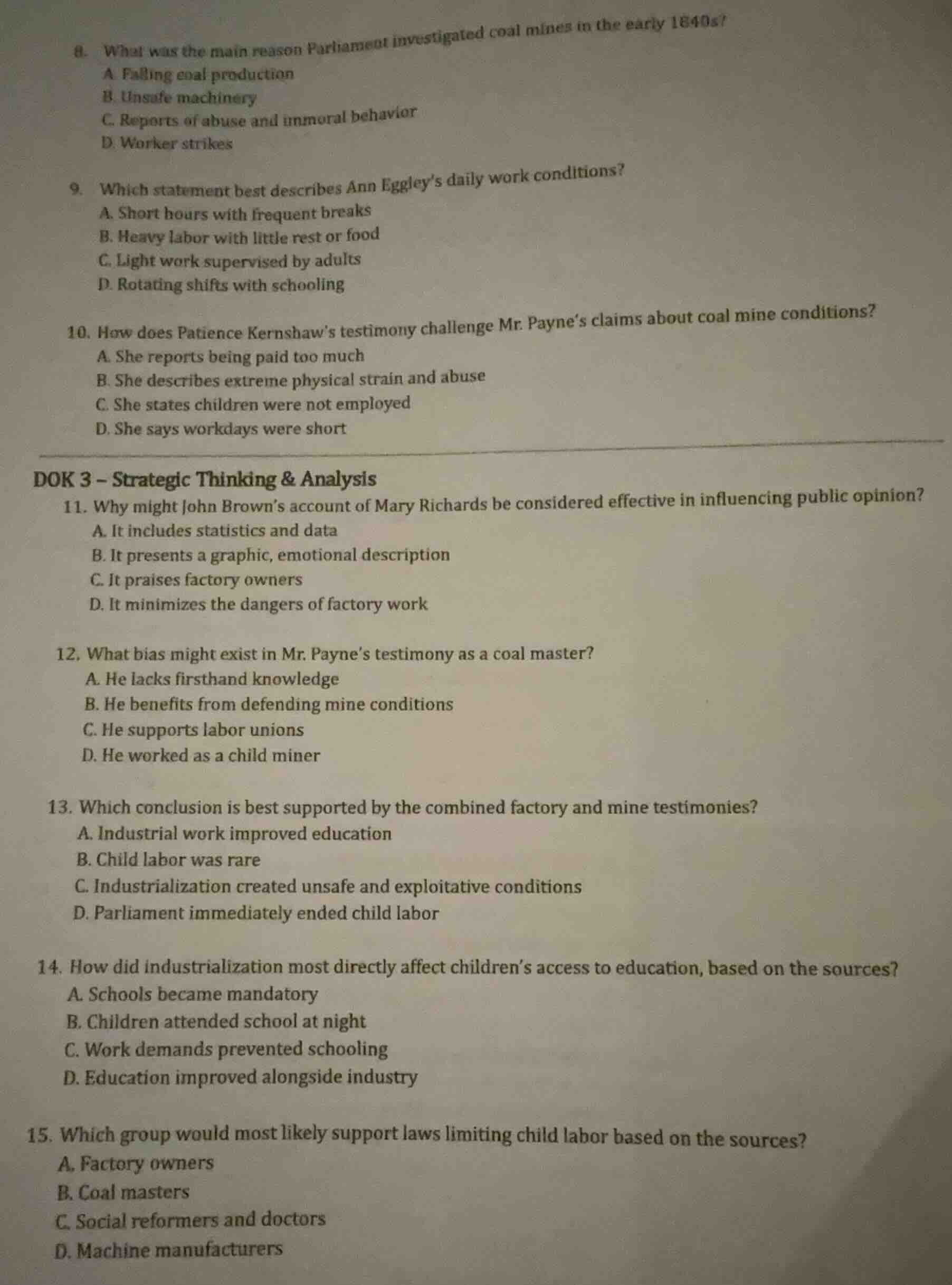
- what was the main reason parliament investigated coal mines in the early 1840s?
a falling coal production
b. unsafe machinery
c. reports of abuse and immoral behavior
d. worker strikes
- which statement best describes ann eggley’s daily work conditions?
a. short hours with frequent breaks
b. heavy labor with little rest or food
c. light work supervised by adults
d. rotating shifts with schooling
- how does patience kernshaw’s testimony challenge mr. payne’s claims about coal mine conditions?
a. she reports being paid too much
b. she describes extreme physical strain and abuse
c. she states children were not employed
d. she says workdays were short
dok 3 – strategic thinking & analysis
- why might john brown’s account of mary richards be considered effective in influencing public opinion?
a. it includes statistics and data
b. it presents a graphic, emotional description
c. it praises factory owners
d. it minimizes the dangers of factory work
- what bias might exist in mr. payne’s testimony as a coal master?
a. he lacks firsthand knowledge
b. he benefits from defending mine conditions
c. he supports labor unions
d. he worked as a child miner
- which conclusion is best supported by the combined factory and mine testimonies?
a. industrial work improved education
b. child labor was rare
c. industrialization created unsafe and exploitative conditions
d. parliament immediately ended child labor
- how did industrialization most directly affect children’s access to education, based on the sources?
a. schools became mandatory
b. children attended school at night
c. work demands prevented schooling
d. education improved alongside industry
- which group would most likely support laws limiting child labor based on the sources?
a. factory owners
b. coal masters
c. social reformers and doctors
d. machine manufacturers
Question 8
In the early 1840s, Parliament investigated coal mines mainly due to reports of abuse (like child labor abuse) and immoral behavior. Falling production (A) isn't the main reason, unsafe machinery (B) is more about safety but the investigation was driven by abuse reports, and worker strikes (D) weren't the primary trigger.
Ann Eggley’s work in coal mines (typical of child labor in industrial era) involved heavy labor, little rest, and poor food. Short hours (A), light work (C), and rotating shifts with schooling (D) don't match the harsh child labor conditions.
Mr. Payne likely downplayed mine harshness. Patience Kernshaw’s testimony challenges this by describing extreme physical strain (like hard work) and abuse, contradicting his claims. Being paid too much (A) is wrong, children were employed (so C is wrong), and workdays were long (so D is wrong).

Snap & solve any problem in the app
Get step-by-step solutions on Sovi AI
Photo-based solutions with guided steps
Explore more problems and detailed explanations
C. Reports of abuse and immoral behavior