QUESTION IMAGE
Question
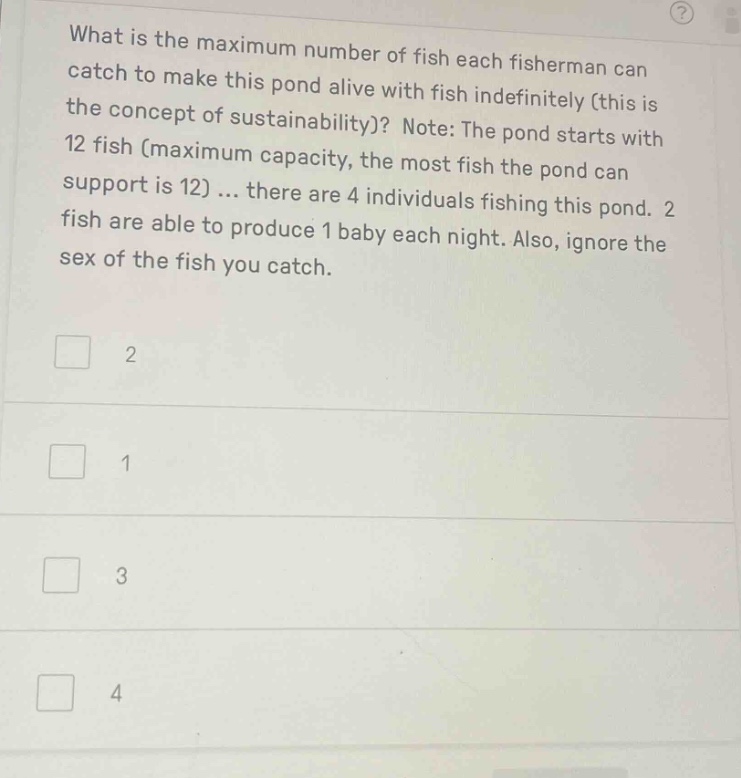
what is the maximum number of fish each fisherman can catch to make this pond alive with fish indefinitely (this is the concept of sustainability)? note: the pond starts with 12 fish (maximum capacity, the most fish the pond can support is 12)... there are 4 individuals fishing this pond. 2 fish are able to produce 1 baby each night. also, ignore the sex of the fish you catch.
2
1
3
4
Step1: Determine daily fish production
Since 2 fish produce 1 baby each night, the number of babies per night is $\frac{\text{Number of fish}}{2}$. With maximum capacity 12 fish, to sustain, the number of fish caught should equal the number of babies produced (to keep total fish at 12). Let total fish be 12, so number of babies is $\frac{12}{2} = 6$? Wait, no, we have 4 fishermen. Wait, let's re - think. The pond starts with 12 fish (maximum capacity). Each night, 2 fish produce 1 baby. So the number of babies produced per night is $\frac{\text{Current number of fish}}{2}$. To keep the pond sustainable (total fish remains 12), the total number of fish caught per night by 4 fishermen should equal the number of babies produced. Let $x$ be the number of fish each fisherman catches. Then total caught is $4x$. The number of babies produced is $\frac{12}{2}=6$ (since there are 12 fish). So we set $4x = 6$? No, that's not right. Wait, maybe the initial number of fish is 12, and we need to find how much each fisherman can catch so that the number of fish remains constant. The reproduction rate: 2 fish → 1 baby, so the number of new fish (babies) is $\frac{\text{Number of fish}}{2}$. To have sustainable fishing, the number of fish caught should equal the number of new fish. Let $x$ be the number of fish each fisherman catches. There are 4 fishermen, so total caught is $4x$. The number of new fish is $\frac{12}{2}=6$. So $4x=6$ → $x = 1.5$? But that's not one of the options. Wait, maybe I misread. Wait, the pond starts with 12 fish, maximum capacity is 12. Wait, maybe the number of fish is 12, and we need to find $x$ such that $12 - 4x+\frac{12}{2}=12$. Let's solve this equation: $12-4x + 6=12$ → $-4x+18 = 12$ → $-4x=12 - 18=-6$ → $x=\frac{6}{4}=1.5$. But the options are 2,1,3,4. Wait, maybe the initial number of fish is not 12, but we need to find the maximum $x$ such that $4x\leq\frac{12}{2}$. $\frac{12}{2}=6$, so $4x\leq6$ → $x\leq1.5$. So the maximum integer value for $x$ is 1. Let's check: if each fisherman catches 1, total caught is 4. Number of babies: $\frac{12}{2}=6$. So $12-4 + 6=14$, which is more than 12. Wait, that's not right. Wait, maybe the maximum capacity is 12, so we can't have more than 12. So the number of fish after catching and reproducing should be 12. Let $x$ be the number each fisherman catches. So $12-4x+\frac{12 - 4x}{2}=12$. Let's solve: $12-4x + 6 - 2x=12$ → $18-6x = 12$ → $-6x=12 - 18=-6$ → $x = 1$. Let's verify: After catching, number of fish is $12-4\times1 = 8$. Number of babies: $\frac{8}{2}=4$. Then total fish is $8 + 4=12$, which is the maximum capacity. Ah, that's the correct approach. So we should use the current number of fish after catching, not the initial 12. Let's redo the equation. Let $x$ be the number of fish each fisherman catches. Number of fish after catching: $12-4x$. Number of babies: $\frac{12 - 4x}{2}$. Then total fish after reproduction: $(12-4x)+\frac{12 - 4x}{2}=12$. Factor out $(12 - 4x)$: $(12 - 4x)(1+\frac{1}{2})=12$ → $(12 - 4x)\times\frac{3}{2}=12$ → $12-4x=12\times\frac{2}{3}=8$ → $-4x=8 - 12=-4$ → $x = 1$.
Step2: Verify the solution
If each fisherman catches 1 fish, total caught is $4\times1 = 4$. Number of fish left: $12 - 4=8$. Number of babies: $\frac{8}{2}=4$. Total fish after reproduction: $8 + 4=12$, which is the maximum capacity. So the number of fish each fisherman can catch to make the pond sustainable is 1.

Snap & solve any problem in the app
Get step-by-step solutions on Sovi AI
Photo-based solutions with guided steps
Explore more problems and detailed explanations
1 (corresponding to the option "1")