QUESTION IMAGE
Question
what is the measure of $\angle rcp$ in the figure below?
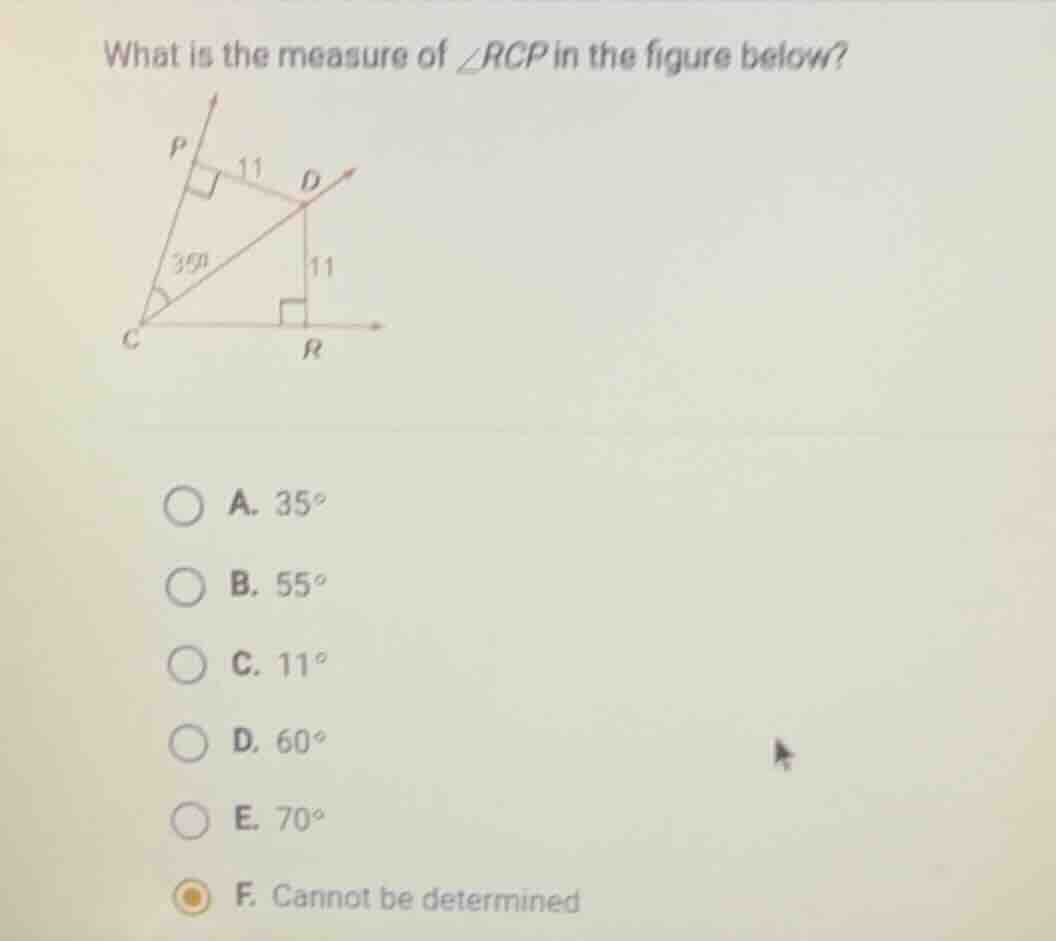
figure with right angles, segments of length 11, and a 35° angle at c
\\(\bigcirc\\) a. \\(35^\circ\\)
\\(\bigcirc\\) b. \\(55^\circ\\)
\\(\bigcirc\\) c. \\(11^\circ\\)
\\(\bigcirc\\) d. \\(60^\circ\\)
\\(\bigcirc\\) e. \\(70^\circ\\)
\\(\bigcirc\\) f. cannot be determined
Step1: Analyze the figure's congruency
We see that \( DP = DR = 11 \), and \( \angle DPC=\angle DRC = 90^\circ \), and \( CD \) is common. So, triangles \( DPC \) and \( DRC \) are congruent (by HL theorem, as right triangles with hypotenuse \( CD \) and one leg equal).
Step2: Determine the angle measure
Since the triangles are congruent, the corresponding angles \( \angle DCP \) and \( \angle DCR \) are equal? Wait, no, wait. Wait, the angle given is \( 35^\circ \) at \( \angle DCP \)? Wait, no, looking at the figure, the angle at \( C \) between \( CP \) and \( CD \) is \( 35^\circ \), and since \( DP \perp CP \) and \( DR \perp CR \), and \( DP = DR \), so \( CD \) is the angle bisector? Wait, no, actually, since \( DP \) and \( DR \) are both perpendicular to \( CP \) and \( CR \) respectively, and \( DP = DR \), then \( C \) lies on the angle bisector? Wait, no, more accurately, triangles \( DPC \) and \( DRC \) are congruent, so \( \angle DCP=\angle DCR \)? Wait, no, the angle we need is \( \angle RCP \). Wait, \( \angle RCP \) is composed of \( \angle DCR + \angle DCP \)? Wait, no, looking at the figure, \( CP \) and \( CR \) are two lines, with \( D \) a point such that \( DP \perp CP \), \( DR \perp CR \), and \( DP = DR = 11 \). So, by the angle - bisector theorem (or the property that a point equidistant from two sides of an angle lies on the angle bisector), \( CD \) bisects \( \angle RCP \). Wait, but the angle between \( CD \) and \( CP \) is \( 35^\circ \), so the angle between \( CD \) and \( CR \) is also \( 35^\circ \), so \( \angle RCP=\angle DCP+\angle DCR = 35^\circ+35^\circ = 70^\circ \)? Wait, no, that can't be. Wait, maybe I misread. Wait, no, let's re - examine.
Wait, actually, in the figure, \( \angle DCP = 35^\circ \), and since \( \triangle DPC\cong\triangle DRC \), then \( \angle DCR=\angle DCP = 35^\circ \), so \( \angle RCP=\angle DCP+\angle DCR=35^{\circ}+35^{\circ} = 70^{\circ} \)? Wait, no, that's not one of the options? Wait, no, wait the options are A. \( 35^\circ \), B. \( 55^\circ \), C. \( 11^\circ \), D. \( 60^\circ \), E. \( 70^\circ \), F. Cannot be determined. Wait, E is \( 70^\circ \). Wait, maybe my initial analysis was wrong. Wait, no, let's start over.
Wait, the figure: \( DP \perp CP \), \( DR \perp CR \), \( DP = DR = 11 \), \( CD \) is common. So \( \triangle DPC\cong\triangle DRC \) (HL: right angle, hypotenuse \( CD \), leg \( DP = DR \)). Therefore, \( \angle DCP=\angle DCR \). If \( \angle DCP = 35^\circ \), then \( \angle DCR = 35^\circ \), so \( \angle RCP=\angle DCP+\angle DCR = 35^{\circ}+35^{\circ}=70^{\circ} \). But wait, maybe the angle given is not \( \angle DCP \) but something else. Wait, the original figure: the angle at \( C \) between \( CP \) and \( CD \) is \( 35^\circ \), so \( \angle DCP = 35^\circ \), and since \( \triangle DPC\cong\triangle DRC \), \( \angle DCR=\angle DCP = 35^\circ \), so \( \angle RCP = 35^\circ+35^\circ = 70^\circ \), which is option E. But wait, maybe I made a mistake. Wait, no, let's check again. The key is that \( DP \) and \( DR \) are both perpendicular to \( CP \) and \( CR \), and equal in length, so \( CD \) bisects \( \angle RCP \). Wait, no, if \( D \) is equidistant from \( CP \) and \( CR \), then \( CD \) is the angle bisector, so \( \angle DCP=\angle DCR \). If \( \angle DCP = 35^\circ \), then \( \angle RCP = 2\times35^\circ=70^\circ \).

Snap & solve any problem in the app
Get step-by-step solutions on Sovi AI
Photo-based solutions with guided steps
Explore more problems and detailed explanations
E. \( 70^\circ \)