QUESTION IMAGE
Question
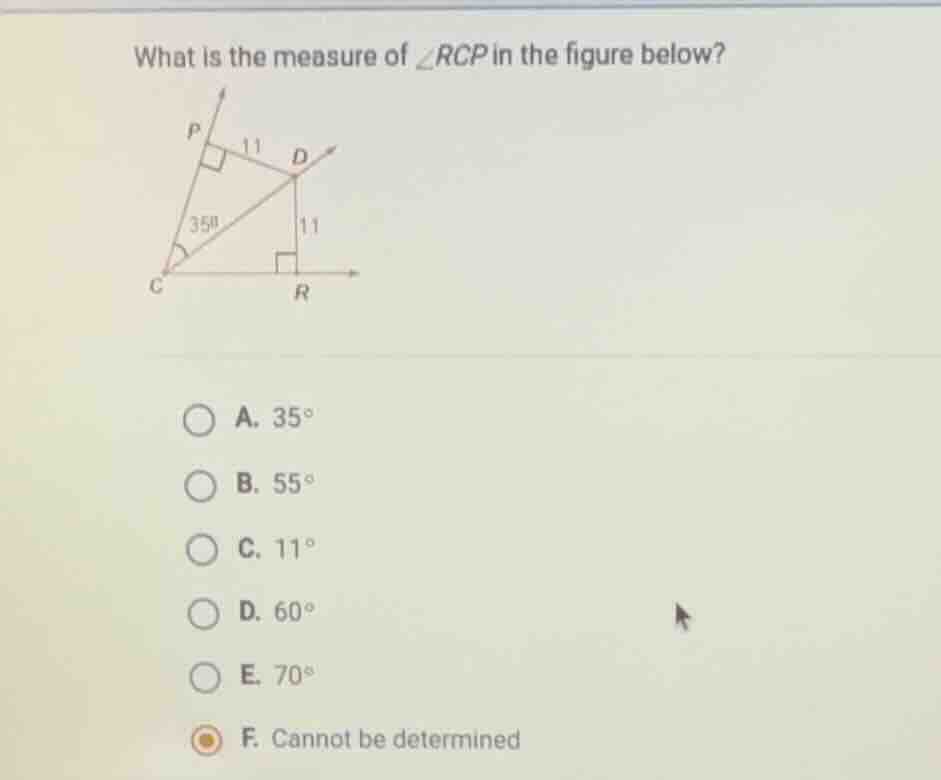
what is the measure of $angle rcp$ in the figure below? figure with right angles, segments of length 11, and a 35° angle a. $35^circ$ b. $55^circ$ c. $11^circ$ d. $60^circ$ e. $70^circ$ f. cannot be determined
Step1: Analyze the triangles
We have two right triangles, \( \triangle CPD \) and \( \triangle CRD \). Both have a leg of length 11, and \( CD \) is a common hypotenuse. By the Hypotenuse - Leg (HL) congruence criterion for right triangles, \( \triangle CPD \cong \triangle CRD \).
Step2: Determine the angle
Since the triangles are congruent, the angle \( \angle RCD \) is equal to \( \angle PCD = 35^{\circ} \). And \( \angle RCP=\angle RCD+\angle PCD = 35^{\circ}+35^{\circ}=70^{\circ} \)? Wait, no, wait. Wait, actually, looking at the figure, \( \angle RCP \) is composed of two angles each \( 35^{\circ} \)? Wait, no, maybe I misread. Wait, the angle at \( C \) in \( \triangle CPD \) is \( 35^{\circ} \), and since the triangles are congruent, the angle at \( C \) in \( \triangle CRD \) is also \( 35^{\circ} \). So \( \angle RCP=\angle RCD+\angle DCP \). Wait, no, actually, \( \angle RCP \) is the angle we need. Wait, maybe the correct way is: since \( DP = DR = 11 \) (both perpendicular to their respective sides) and \( CD \) is common, so \( \triangle CDP\cong\triangle CDR \) (HL). So \( \angle DCP=\angle DCR = 35^{\circ} \), so \( \angle RCP=\angle DCR+\angle DCP=35^{\circ}+35^{\circ} = 70^{\circ} \). Wait, but let's check the options. Option E is \( 70^{\circ} \). Wait, but the original selected option was F, but that's wrong. Wait, maybe I made a mistake. Wait, no, let's re - examine. The figure has \( \angle PCD = 35^{\circ} \), and \( CR \) and \( CP \) are two lines with \( D \) equidistant from both (since \( DR = DP = 11 \)). So \( CD \) is the angle bisector? No, wait, if \( DR\perp CR \) and \( DP\perp CP \), and \( DR = DP \), then \( CD \) is the angle bisector of \( \angle RCP \). Wait, that's the Angle - Bisector theorem converse. So if a point is equidistant from the sides of an angle, it lies on the angle bisector. So \( CD \) bisects \( \angle RCP \). So \( \angle RCD=\angle PCD = 35^{\circ} \), so \( \angle RCP = 2\times35^{\circ}=70^{\circ} \).

Snap & solve any problem in the app
Get step-by-step solutions on Sovi AI
Photo-based solutions with guided steps
Explore more problems and detailed explanations
E. \( 70^{\circ} \)