QUESTION IMAGE
Question
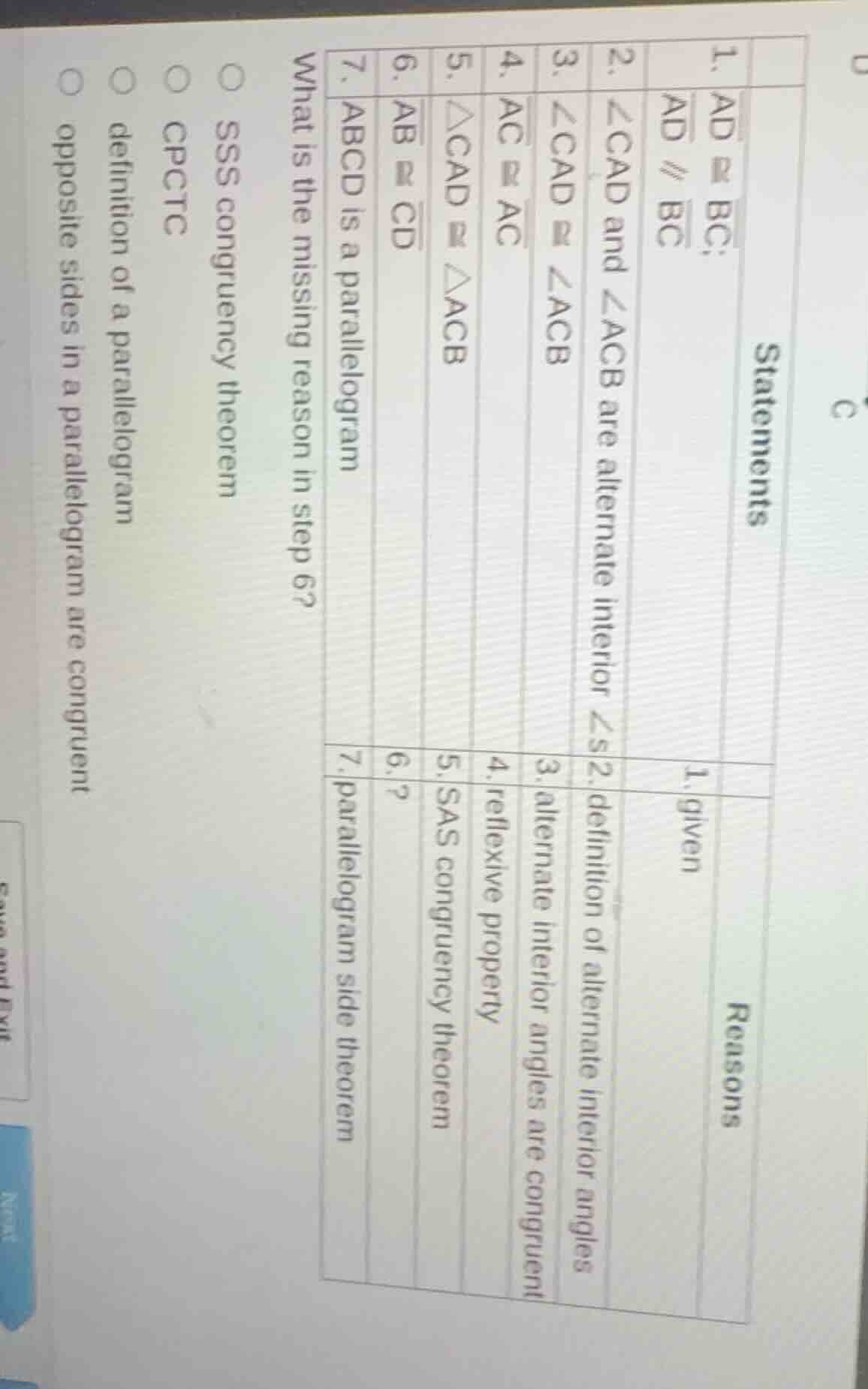
what is the missing reason in step 6?
statements\treasons
- \\(\overline{ad} \cong \overline{bc}\\); \\(\overline{ad} \parallel \overline{bc}\\)\t1. given
- \\(\angle cad\\) and \\(\angle acb\\) are alternate interior \\(\angle s\\)\t2. definition of alternate interior angles
- \\(\angle cad \cong \angle acb\\)\t3. alternate interior angles are congruent
- \\(\overline{ac} \cong \overline{ac}\\)\t4. reflexive property
- \\(\triangle cad \cong \triangle acb\\)\t5. sas congruency theorem
- \\(\overline{ab} \cong \overline{cd}\\)\t6.?
- abcd is a parallelogram\t7. parallelogram side theorem
options:
- sss congruency theorem
- cpctc
- definition of a parallelogram
- opposite sides in a parallelogram are congruent
To determine the missing reason in step 6 (where \( \overline{AB} \cong \overline{CD} \) is stated), we analyze the previous steps. Step 5 shows \( \triangle CAD \cong \triangle ACB \) by the SAS congruence theorem. When two triangles are congruent, their corresponding parts (sides or angles) are congruent. This is the definition of CPCTC (Corresponding Parts of Congruent Triangles are Congruent). So, the reason for \( \overline{AB} \cong \overline{CD} \) is CPCTC, as these sides are corresponding parts of the congruent triangles \( \triangle CAD \) and \( \triangle ACB \).

Snap & solve any problem in the app
Get step-by-step solutions on Sovi AI
Photo-based solutions with guided steps
Explore more problems and detailed explanations
CPCTC