QUESTION IMAGE
Question
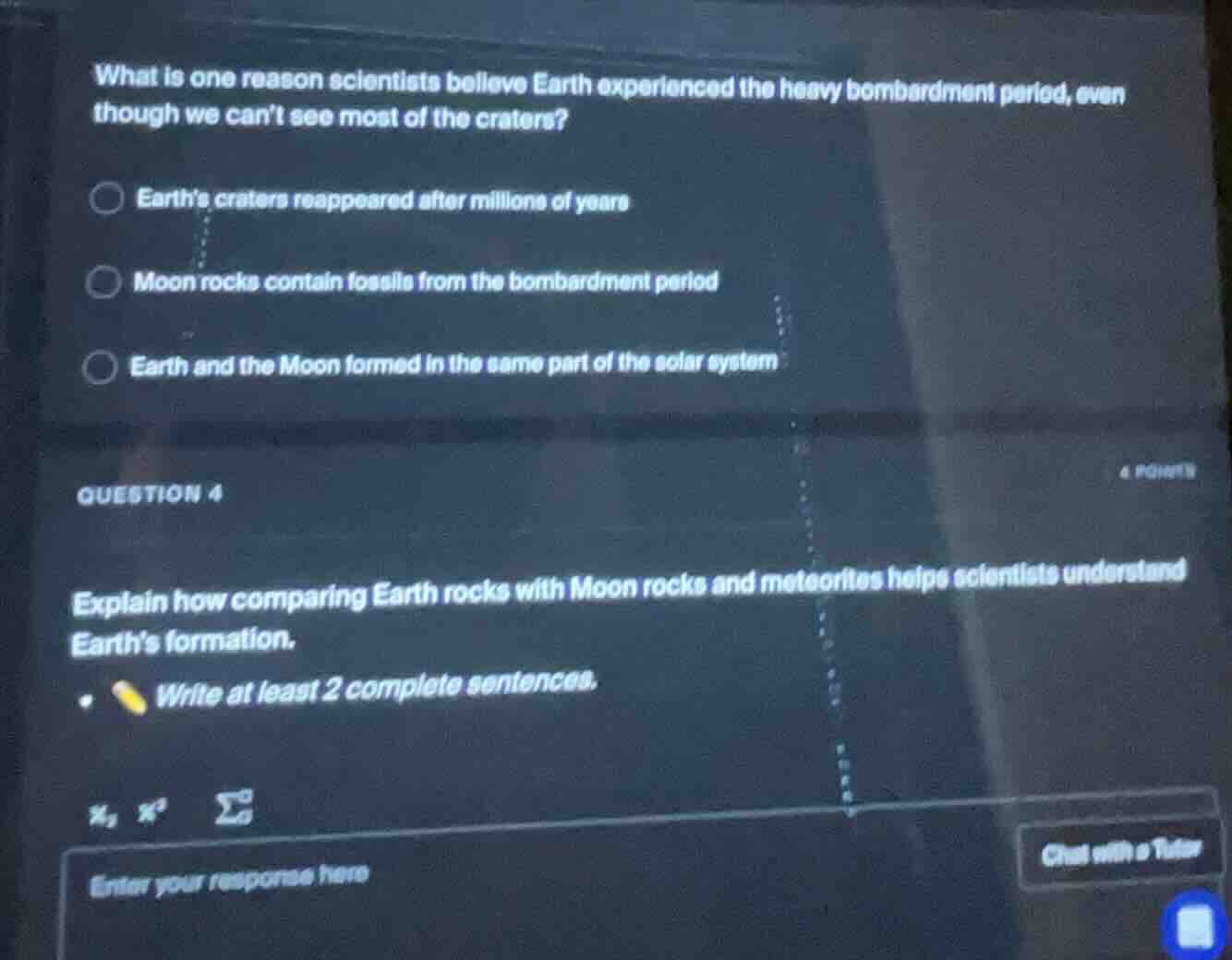
what is one reason scientists believe earth experienced the heavy bombardment period, even though we cant see most of the craters? earths craters reappeared after millions of years moon rocks contain fossils from the bombardment period earth and the moon formed in the same part of the solar system question 4 explain how comparing earth rocks with moon rocks and meteorites helps scientists understand earths formation. write at least 2 complete sentences.
First Question (Multiple Choice)
- Option 1: Earth's craters don't "reappear" in a way that supports the heavy bombardment idea; geological processes like erosion and plate tectonics erase Earth's craters.
- Option 2: Moon rocks don't contain fossils from bombardment (fossils are biological, and bombardment is about impacts).
- Option 3: Earth and the Moon formed in the same solar system region, so the Moon's preserved impact craters (since it has no erosion/plate tectonics) and Earth's inferred history (from Moon's record, as they formed similarly) support Earth having a heavy bombardment period.
Moon rocks and meteorites have less geological alteration than Earth rocks (Moon has no erosion/plate tectonics, meteorites are unchanged since formation). By comparing their ages, compositions, and structures to Earth rocks, scientists can infer Earth’s early conditions (like impact history, material composition) and how it formed, as all three formed from the same solar nebula.

Snap & solve any problem in the app
Get step-by-step solutions on Sovi AI
Photo-based solutions with guided steps
Explore more problems and detailed explanations
C. Earth and the Moon formed in the same part of the solar system