QUESTION IMAGE
Question
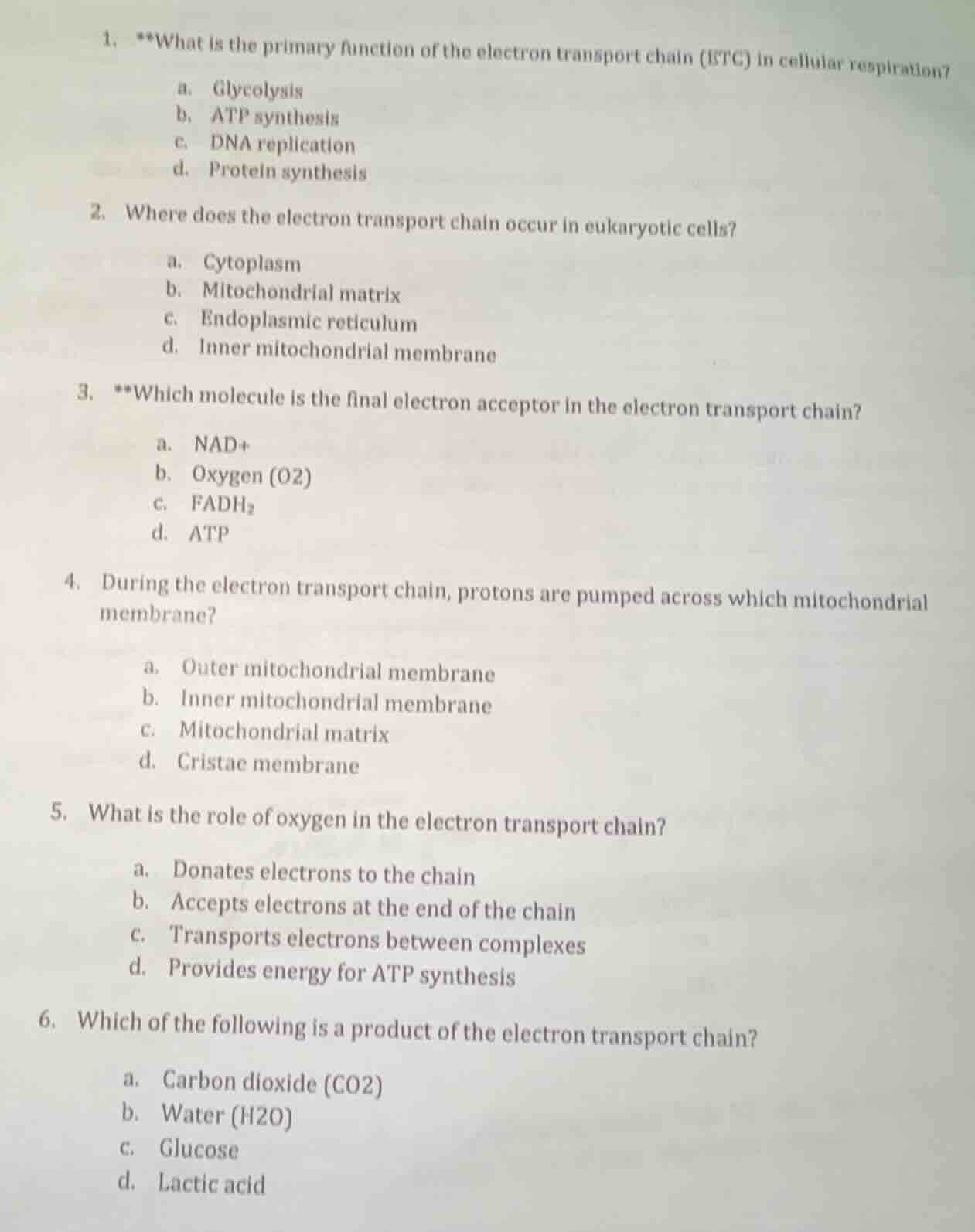
- **what is the primary function of the electron transport chain (etc) in cellular respiration?
a. glycolysis
b. atp synthesis
c. dna replication
d. protein synthesis
- where does the electron transport chain occur in eukaryotic cells?
a. cytoplasm
b. mitochondrial matrix
c. endoplasmic reticulum
d. inner mitochondrial membrane
- **which molecule is the final electron acceptor in the electron transport chain?
a. nad+
b. oxygen (o2)
c. fadh₂
d. atp
- during the electron transport chain, protons are pumped across which mitochondrial membrane?
a. outer mitochondrial membrane
b. inner mitochondrial membrane
c. mitochondrial matrix
d. cristae membrane
- what is the role of oxygen in the electron transport chain?
a. donates electrons to the chain
b. accepts electrons at the end of the chain
c. transports electrons between complexes
d. provides energy for atp synthesis
- which of the following is a product of the electron transport chain?
a. carbon dioxide (co2)
b. water (h2o)
c. glucose
d. lactic acid
Brief Explanations
- The electron transport chain's core role is to generate ATP via oxidative phosphorylation. Glycolysis is a separate early step, DNA replication makes new DNA, and protein synthesis builds proteins, none are the ETC's primary function.
- In eukaryotes, the ETC's protein complexes are embedded in the inner mitochondrial membrane, which allows proton pumping to create the gradient for ATP synthesis.
- Oxygen is the final electron acceptor; it combines with electrons and protons to form water, keeping the chain functional. NAD+ and FADH₂ are electron carriers, ATP is a product.
- Protons are pumped from the mitochondrial matrix across the inner mitochondrial membrane to the intermembrane space, creating the proton gradient that drives ATP synthesis.
- Oxygen acts as the terminal electron acceptor, accepting electrons at the end of the chain to prevent electron buildup and maintain the flow of electrons for ATP production.
- When oxygen accepts electrons and protons at the end of the ETC, it forms water. Carbon dioxide is a product of the Krebs cycle, glucose is a starting molecule for cellular respiration, and lactic acid is a fermentation product.

Snap & solve any problem in the app
Get step-by-step solutions on Sovi AI
Photo-based solutions with guided steps
Explore more problems and detailed explanations
- b. ATP synthesis
- d. Inner mitochondrial membrane
- b. Oxygen (O2)
- b. Inner mitochondrial membrane
- b. Accepts electrons at the end of the chain
- b. Water (H2O)