QUESTION IMAGE
Question
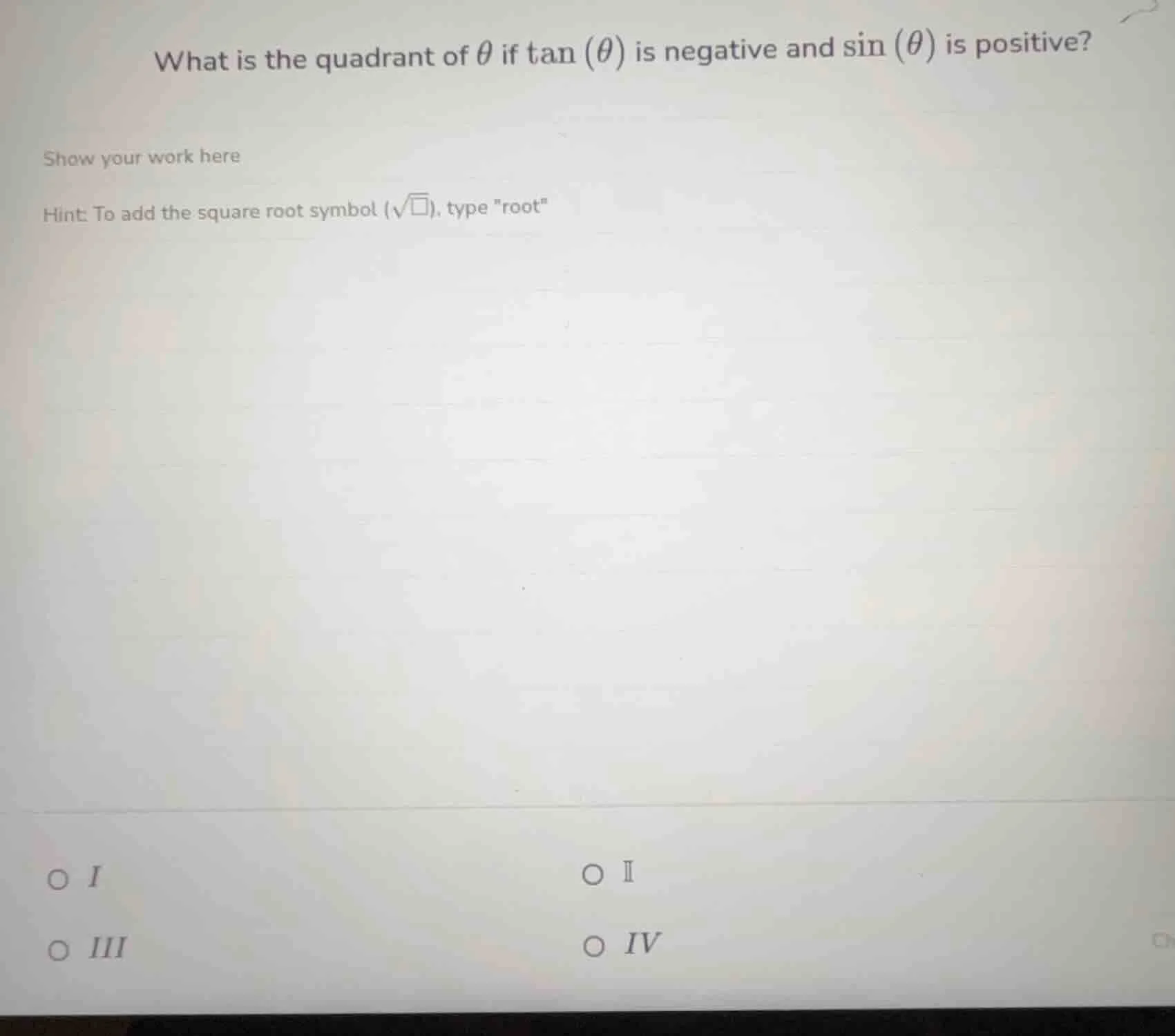
what is the quadrant of $\theta$ if $\tan(\theta)$ is negative and $\sin(\theta)$ is positive?
show your work here
hint: to add the square root symbol ($\sqrt{\square}$), type
oot\
\bigcirc i \bigcirc ii
\bigcirc iii \bigcirc iv
Step1: Recall sign rules of trigonometric functions
In the coordinate plane, for an angle \(\theta\):
- \(\sin(\theta)=\frac{y}{r}\), where \(r = \sqrt{x^{2}+y^{2}}>0\). So \(\sin(\theta)\) is positive when \(y>0\) (Quadrants I and II).
- \(\tan(\theta)=\frac{\sin(\theta)}{\cos(\theta)}=\frac{y}{x}\) (where \(x
eq0\)). So \(\tan(\theta)\) is negative when \(x\) and \(y\) have opposite signs (Quadrants II and IV).
Step2: Find the common quadrant
We know \(\sin(\theta)>0\) implies \(\theta\) is in Quadrant I or II. \(\tan(\theta)<0\) implies \(\theta\) is in Quadrant II or IV. The common quadrant from these two sets is Quadrant II.

Snap & solve any problem in the app
Get step-by-step solutions on Sovi AI
Photo-based solutions with guided steps
Explore more problems and detailed explanations
\(\boldsymbol{\text{II}}\) (or "II" or "Quadrant II")