QUESTION IMAGE
Question
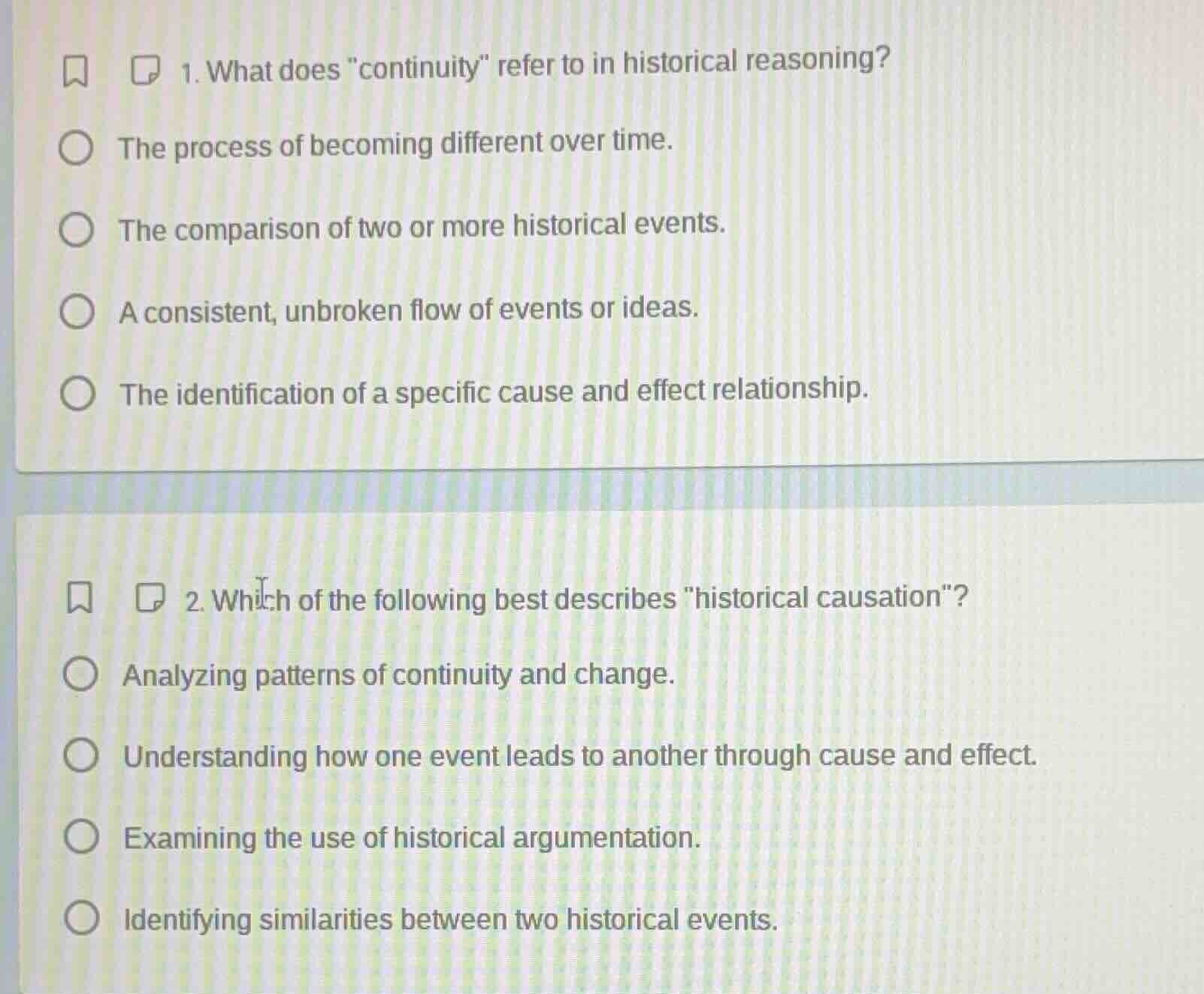
- what does \continuity\ refer to in historical reasoning?
the process of becoming different over time.
the comparison of two or more historical events.
a consistent, unbroken flow of events or ideas.
the identification of a specific cause and effect relationship.
- which of the following best describes \historical causation\?
analyzing patterns of continuity and change.
understanding how one event leads to another through cause and effect.
examining the use of historical argumentation.
identifying similarities between two historical events.
Question 1
To determine the meaning of "continuity" in historical reasoning, we analyze each option:
- The first option describes "change" (becoming different over time), not continuity.
- The second option refers to comparison of events, not continuity.
- The third option, "a consistent, unbroken flow of events or ideas," matches the concept of continuity (something that remains consistent over time).
- The fourth option is about cause - effect identification, not continuity.
To find the best description of "historical causation":
- The first option is about analyzing continuity and change, not causation.
- The second option, "understanding how one event leads to another through cause and effect," is the definition of causation (exploring the causal links between events).
- The third option is about examining historical argumentation, not causation.
- The fourth option is about identifying similarities (comparison), not causation.

Snap & solve any problem in the app
Get step-by-step solutions on Sovi AI
Photo-based solutions with guided steps
Explore more problems and detailed explanations
C. A consistent, unbroken flow of events or ideas.