QUESTION IMAGE
Question
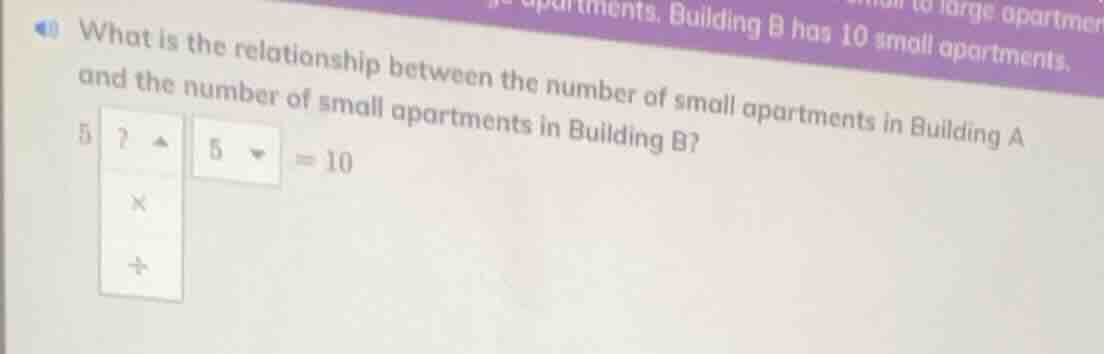
what is the relationship between the number of small apartments in building a and the number of small apartments in building b?
5? 5 = 10
×
÷
building b has 10 small apartments.
Step1: Analyze the equation structure
We have \( 5 \,? \, 5 = 10 \). Let's test the operations. For multiplication: \( 5\times5 = 25
eq10 \). For addition: \( 5 + 5=10 \), which works.
Step2: Relate to the problem context
Building B has 10 small apartments. If Building A has 5 small apartments, then the number of small apartments in Building B (10) is the sum of the number of small apartments in Building A (5) and another 5 (since \( 5 + 5 = 10 \)). So the operation is addition, meaning the number of small apartments in Building B is twice the number of small apartments in Building A (or the sum of two times the number in Building A, but more directly, \( 5+5 = 10 \)).

Snap & solve any problem in the app
Get step-by-step solutions on Sovi AI
Photo-based solutions with guided steps
Explore more problems and detailed explanations
The number of small apartments in Building B (10) is equal to the number of small apartments in Building A (5) added to itself (i.e., \( 5 + 5 = 10 \)), so the relationship is that the number of small apartments in Building B is the sum of two groups of the number of small apartments in Building A (or simply, Building B has twice as many small apartments as Building A when Building A has 5, since \( 5\times2 = 10 \) which is equivalent to \( 5 + 5 = 10 \)). The operation relating them is addition (or multiplication by 2), and \( 5+5 = 10 \) shows that Building B's small apartments are the sum of two times Building A's (when A has 5).