QUESTION IMAGE
Question
- what is the role of dna helicase in replication?
- what is the role of dna polymerase in replication?
- what are okazaki fragments and how are they joined together?
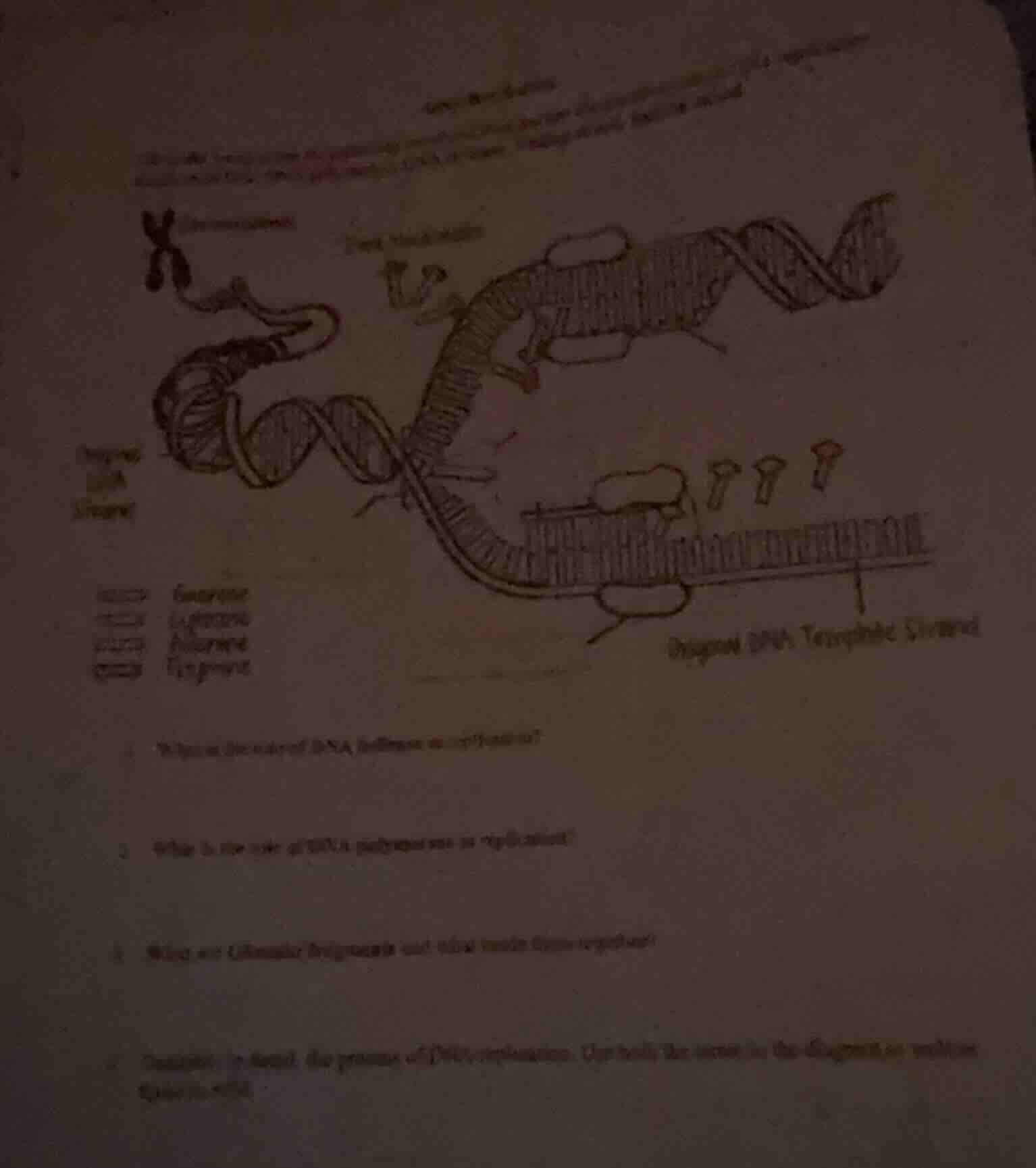
- describe, in detail, the process of dna replication. use both the terms in the diagram and written description.
Question 1: What is the role of DNA helicase in replication?
DNA helicase is an enzyme that plays a crucial role in DNA replication. Its main function is to unwind the double - stranded DNA molecule by breaking the hydrogen bonds between the complementary base pairs (adenine - thymine and guanine - cytosine). This unwinding action creates the replication fork, which is a Y - shaped structure. The replication fork provides the single - stranded DNA templates that are necessary for the DNA polymerase to synthesize new complementary strands. Without the action of DNA helicase, the DNA double helix would not be able to separate, and the replication machinery would not have access to the DNA template strands needed for copying the genetic information.
DNA polymerase is a key enzyme in DNA replication. It has two main important roles. First, it adds deoxyribonucleotide triphosphates (dNTPs) to the 3' - OH end of a growing DNA strand, following the base - pairing rules (A with T, G with C). This process is known as DNA synthesis or elongation. Second, DNA polymerase also has a proofreading function. It can detect and correct errors (such as mismatched base pairs) that occur during DNA synthesis. This proofreading ability helps to ensure the high fidelity of DNA replication, meaning that the newly synthesized DNA strand is as accurate a copy of the template strand as possible.
Okazaki fragments are short segments of DNA that are synthesized on the lagging strand during DNA replication. The lagging strand is synthesized in the direction opposite to the movement of the replication fork, so DNA polymerase can only synthesize short stretches of DNA (the Okazaki fragments) as the replication fork opens up. These Okazaki fragments are joined together by the enzyme DNA ligase. DNA ligase catalyzes the formation of a phosphodiester bond between the 3' - OH end of one Okazaki fragment and the 5' - phosphate end of the adjacent Okazaki fragment, thereby creating a continuous DNA strand.

Snap & solve any problem in the app
Get step-by-step solutions on Sovi AI
Photo-based solutions with guided steps
Explore more problems and detailed explanations
The role of DNA helicase in DNA replication is to unwind the double - stranded DNA by breaking the hydrogen bonds between complementary base pairs, thereby creating the replication fork and providing single - stranded DNA templates for DNA polymerase to synthesize new DNA strands.