QUESTION IMAGE
Question
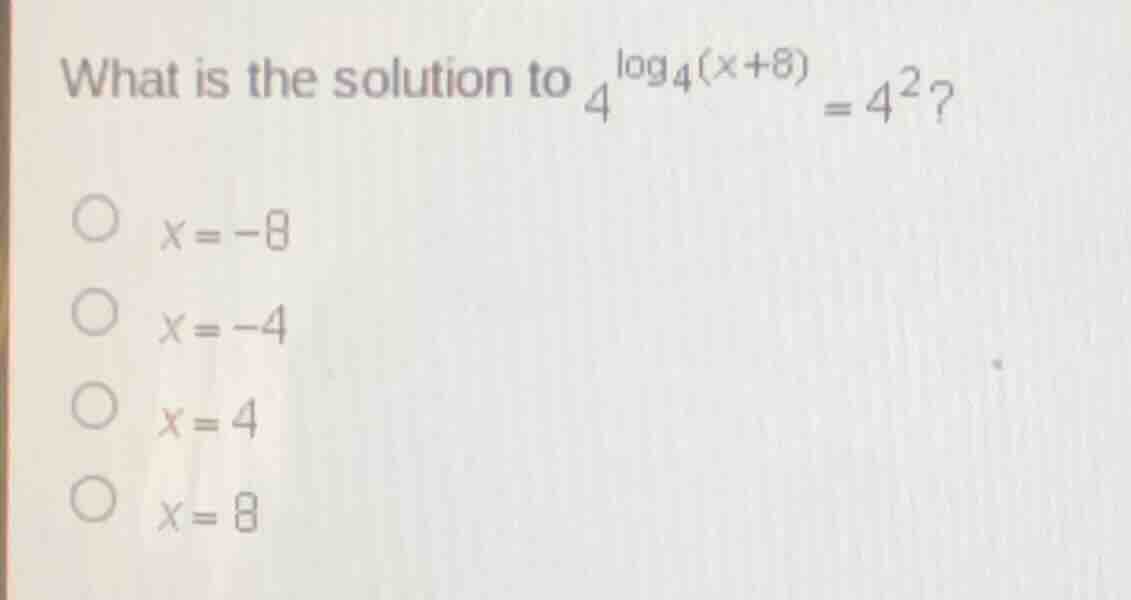
what is the solution to $4^{\log_4(x + 8)} = 4^2$?\
\bigcirc $x = -8$\
\bigcirc $x = -4$\
\bigcirc $x = 4$\
\bigcirc $x = 8$
Step1: Use the property of exponential and logarithm
Recall that for any positive \( a
eq 1 \), \( a^{\log_a b}=b \). So for the left - hand side of the equation \( 4^{\log_4(x + 8)} \), by this property, we have \( 4^{\log_4(x + 8)}=x + 8 \) (where \( x+8>0\), i.e., \( x>- 8\)).
The original equation \( 4^{\log_4(x + 8)}=4^{2} \) becomes \( x + 8=4^{2} \).
Step2: Solve the resulting equation
We know that \( 4^{2}=16 \), so the equation \( x + 8 = 16 \).
Subtract 8 from both sides of the equation: \( x=16 - 8 \).
Calculate \( 16-8 = 8 \)? Wait, no, wait. Wait, \( 4^{2}=16 \)? Wait, no, the right - hand side is \( 4^{2}=16 \)? Wait, no, wait the equation is \( 4^{\log_4(x + 8)}=4^{2} \). Since the bases are the same and the exponential function \( y = 4^{x}\) is one - to - one (if \( a^{m}=a^{n}\), then \( m = n\) for \( a>0,a
eq1\)), we can set the exponents equal.
The exponent of the left - hand side is \( \log_4(x + 8) \) and the exponent of the right - hand side is 2. So \( \log_4(x + 8)=2 \). But we can also use the property \( a^{\log_a b}=b \) first. So \( 4^{\log_4(x + 8)}=x + 8 \), and \( 4^{2}=16 \)? Wait, no, the original equation is \( 4^{\log_4(x + 8)}=4^{2} \), so \( x + 8=4^{2}\)? Wait, no, \( 4^{2}=16 \), then \( x=16 - 8=8 \)? Wait, but let's check the options. Wait, maybe I made a mistake. Wait, no, wait the right - hand side is \( 4^{2}=16 \)? Wait, no, the options have \( x = 8 \) as an option. Wait, let's re - do it.
Wait, the property \( a^{\log_a b}=b \) (for \( a>0,a
eq1,b > 0\)). So \( 4^{\log_4(x + 8)}=x + 8 \), and the right - hand side is \( 4^{2}=16 \)? Wait, no, the equation is \( 4^{\log_4(x + 8)}=4^{2} \). Since the exponential function \( y = 4^{x}\) is injective (one - to - one), if \( 4^{u}=4^{v}\), then \( u = v \). Here \( u=\log_4(x + 8)\) and \( v = 2 \), so \( \log_4(x + 8)=2 \). Then by the definition of logarithm, if \( \log_a b=c \), then \( b=a^{c}\). So \( x + 8=4^{2}=16 \), then \( x=16 - 8 = 8 \). Wait, but let's check the domain. When \( x = 8 \), \( x+8=16>0 \), which is valid for the logarithm.
Wait, but wait, maybe I misread the problem. Wait, the problem is \( 4^{\log_4(x + 8)}=4^{2} \). Let's use the one - to - one property of exponential functions. For the function \( f(t)=4^{t}\), if \( f(a)=f(b)\), then \( a = b \). So if \( 4^{\log_4(x + 8)}=4^{2}\), then \( \log_4(x + 8)=2 \). Then, by the definition of logarithm, \( x + 8=4^{2}=16 \), so \( x=16 - 8 = 8 \).
Wait, but let's check the options. The last option is \( x = 8 \). Let's verify:
If \( x = 8 \), then the left - hand side: \( 4^{\log_4(8 + 8)}=4^{\log_4(16)}\). Since \( \log_4(16)=\log_4(4^{2}) = 2 \) (because \( \log_a(a^{k})=k\) for \( a>0,a
eq1\)), then \( 4^{\log_4(16)}=4^{2}=16 \), and the right - hand side is \( 4^{2}=16 \). So the equation holds.
Wait, but earlier when I used the property \( a^{\log_a b}=b \), \( 4^{\log_4(x + 8)}=x + 8 \), and the right - hand side is \( 4^{2}=16 \), so \( x + 8=16 \), so \( x = 8 \).

Snap & solve any problem in the app
Get step-by-step solutions on Sovi AI
Photo-based solutions with guided steps
Explore more problems and detailed explanations
\( x = 8 \) (the option: \( x = 8 \))