QUESTION IMAGE
Question
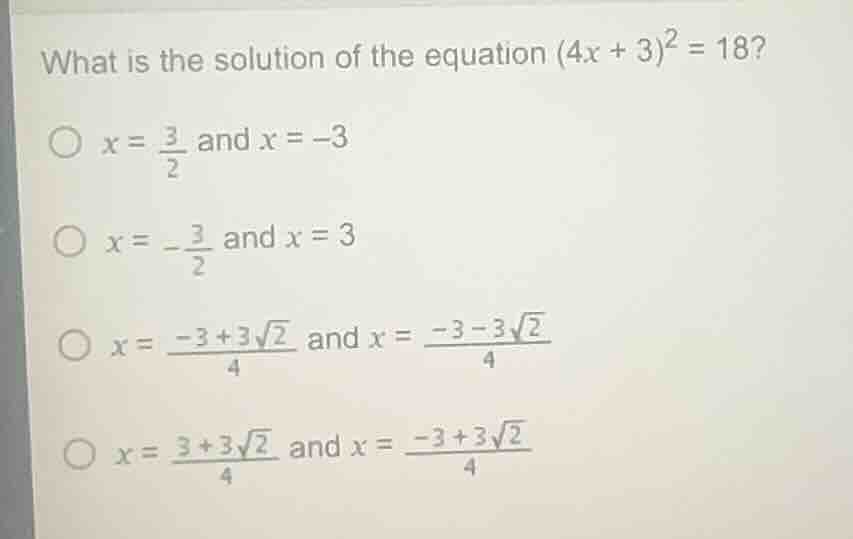
what is the solution of the equation $(4x + 3)^2 = 18$?
$\bigcirc$ $x = \frac{3}{2}$ and $x = -3$
$\bigcirc$ $x = -\frac{3}{2}$ and $x = 3$
$\bigcirc$ $x = \frac{-3 + 3\sqrt{2}}{4}$ and $x = \frac{-3 - 3\sqrt{2}}{4}$
$\bigcirc$ $x = \frac{3 + 3\sqrt{2}}{4}$ and $x = \frac{-3 + 3\sqrt{2}}{4}$
Step1: Take square root of both sides
To solve the equation \((4x + 3)^2 = 18\), we first take the square root of both sides. Remember that when we take the square root of a square, we get both the positive and negative roots. So we have:
\[
4x + 3 = \pm\sqrt{18}
\]
Simplify \(\sqrt{18}\). We know that \(18 = 9\times2\), so \(\sqrt{18}=\sqrt{9\times2} = 3\sqrt{2}\). So the equation becomes:
\[
4x + 3 = \pm 3\sqrt{2}
\]
Step2: Solve for \(x\) in two cases
Case 1: Positive root
When we take the positive root, the equation is \(4x + 3 = 3\sqrt{2}\). Subtract 3 from both sides:
\[
4x = 3\sqrt{2}- 3
\]
Factor out 3 from the right side:
\[
4x = 3(\sqrt{2}- 1)
\]
Wait, actually, let's do it step by step. Subtract 3: \(4x=3\sqrt{2}-3\), then divide both sides by 4:
\[
x=\frac{3\sqrt{2}-3}{4}=\frac{-3 + 3\sqrt{2}}{4}
\]
Case 2: Negative root
When we take the negative root, the equation is \(4x + 3=-3\sqrt{2}\). Subtract 3 from both sides:
\[
4x=-3\sqrt{2}-3
\]
Factor out -3 from the right side:
\[
4x=-3(\sqrt{2}+ 1)
\]
Divide both sides by 4:
\[
x=\frac{-3\sqrt{2}-3}{4}=\frac{-3 - 3\sqrt{2}}{4}
\]

Snap & solve any problem in the app
Get step-by-step solutions on Sovi AI
Photo-based solutions with guided steps
Explore more problems and detailed explanations
\(x=\frac{-3 + 3\sqrt{2}}{4}\) and \(x=\frac{-3 - 3\sqrt{2}}{4}\) (which corresponds to the third option: \(x=\frac{-3 + 3\sqrt{2}}{4}\) and \(x=\frac{-3 - 3\sqrt{2}}{4}\))