QUESTION IMAGE
Question
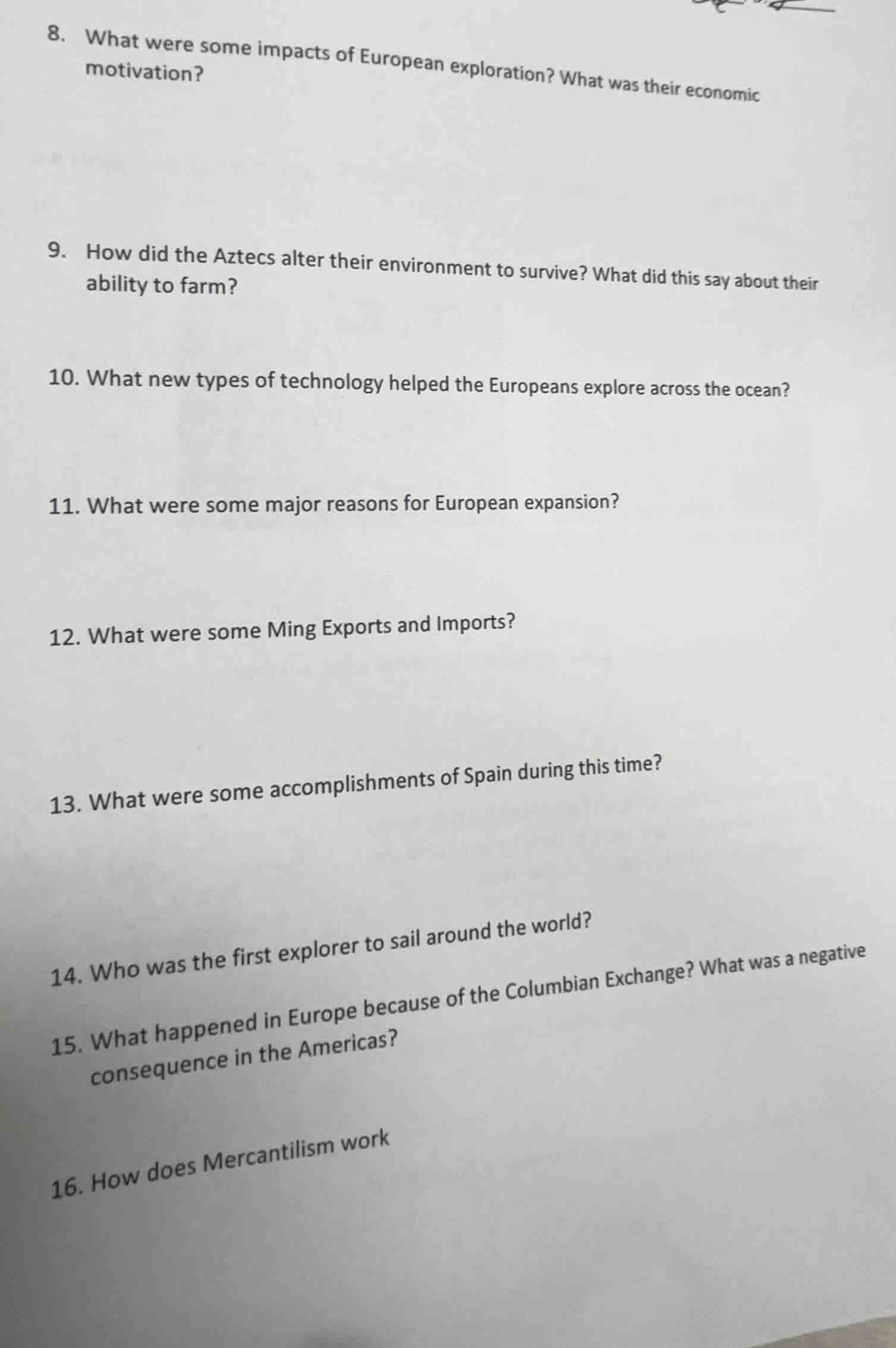
- what were some impacts of european exploration? what was their economic motivation?
- how did the aztecs alter their environment to survive? what did this say about their ability to farm?
- what new types of technology helped the europeans explore across the ocean?
- what were some major reasons for european expansion?
- what were some ming exports and imports?
- what were some accomplishments of spain during this time?
- who was the first explorer to sail around the world?
- what happened in europe because of the columbian exchange? what was a negative consequence in the americas?
- how does mercantilism work
Brief Explanations
Question 8
- Impacts: Included the Columbian Exchange (transfer of crops, animals, and diseases between hemispheres), establishment of European colonial empires, and cultural diffusion. Economic motivation: Primarily mercantilism—acquiring gold/silver, establishing new trade routes to bypass middlemen in the East, and securing raw materials for European economies while creating markets for European goods.
Question 9
- The Aztecs built chinampas (floating agricultural platforms) on Lake Texcoco to farm in their marshy environment, and they constructed irrigation systems to manage water. This showed they had advanced, adaptive farming skills to thrive in a challenging landscape.
Question 10
- Key technologies included the caravel (small, maneuverable ships with lateen sails), astrolabe (to determine latitude), magnetic compass (for navigation), and improved map-making (portolan charts).
Question 11
- Major reasons included economic gain (access to wealth, raw materials, new trade routes), religious conversion (spreading Christianity), political competition between European powers, and technological advancements enabling long-distance travel.
Question 12
- Exports: Porcelain, silk, tea, and spices. Imports: Silver (from the Americas via European traders), new crops like corn and sweet potatoes, and some luxury goods from other regions.
Question 13
- Spain established a vast global empire across the Americas, Philippines, and parts of Europe; extracted massive amounts of gold and silver from the Americas; spread Spanish language and Catholicism in its colonies; and built a powerful navy (the Spanish Armada, though it later declined).
Question 14
- Ferdinand Magellan led the first expedition to circumnavigate the globe (1519-1522), though he died mid-voyage; his crew completed the journey.
Question 15
- In Europe: New crops like potatoes and corn boosted food production, leading to population growth; access to raw materials and wealth from the Americas fueled economic growth and mercantilism. In the Americas: A major negative consequence was the spread of European diseases (smallpox, measles) that killed up to 90% of the Indigenous population, along with forced labor and cultural erasure.
Question 16
- Mercantilism is an economic system where nations aim to accumulate wealth (primarily gold and silver) by maintaining a favorable balance of trade (exporting more than importing). Colonies exist to supply the mother country with raw materials and serve as exclusive markets for the mother country's manufactured goods, limiting colonial trade with other nations.

Snap & solve any problem in the app
Get step-by-step solutions on Sovi AI
Photo-based solutions with guided steps
Explore more problems and detailed explanations
- Question 8:
- Impacts: Columbian Exchange, colonial empires, cultural diffusion.
- Economic motivation: Mercantilism (gold/silver, new trade routes, raw materials/markets).
- Question 9:
- Altered environment with chinampas and irrigation.
- Showed advanced, adaptive farming ability.
- Question 10:
- Caravels, astrolabes, magnetic compasses, improved maps.
- Question 11:
- Economic gain, religious conversion, political competition, tech advancements.
- Question 12:
- Exports: Porcelain, silk, tea, spices.
- Imports: Silver, corn, sweet potatoes.
- Question 13:
- Vast global empire, extracted massive gold/silver, spread Spanish culture/religion, powerful navy.
- Question 14:
- Ferdinand Magellan (his crew completed the voyage).
- Question 15:
- Europe: Population growth, economic growth from new crops/wealth.
- Americas: Mass Indigenous death from European diseases.
- Question 16:
- Nations accumulate wealth via favorable trade balance; colonies supply raw materials and act as exclusive markets for the mother country.