QUESTION IMAGE
Question
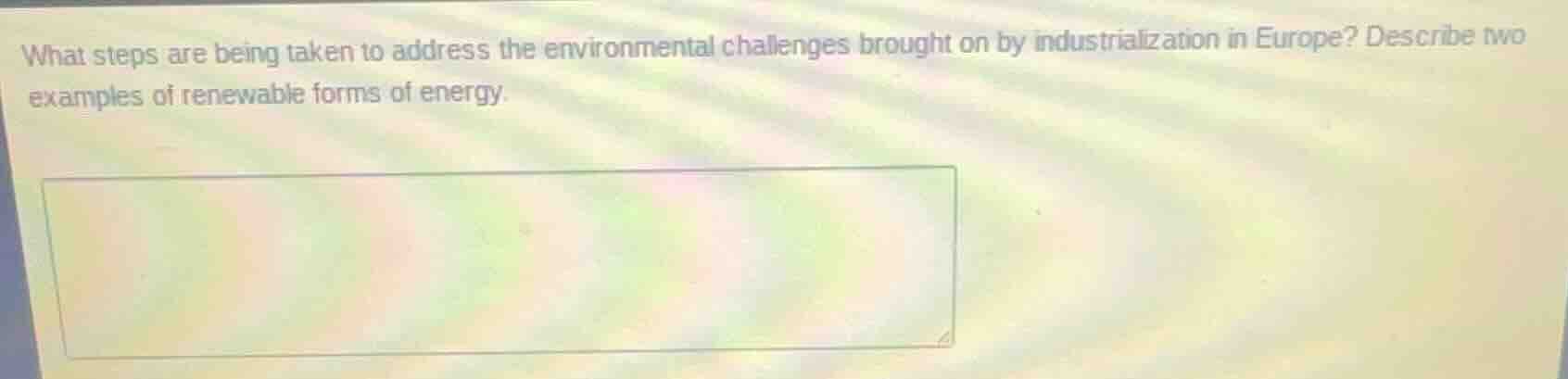
what steps are being taken to address the environmental challenges brought on by industrialization in europe? describe two examples of renewable forms of energy.
First, for European industrialization-related environmental challenges, policy frameworks like the EU Green Deal set emissions reduction targets and phase out fossil fuel reliance. Additionally, industrial sectors are adopting circular economy models to cut waste and reuse resources. For renewable energy: 1. Solar energy uses photovoltaic panels to convert sunlight into electricity, with widespread utility-scale and rooftop installations in Europe. 2. Wind energy, both onshore and offshore, harnesses wind power via turbines; the North Sea has major offshore wind farms supplying grid electricity.

Snap & solve any problem in the app
Get step-by-step solutions on Sovi AI
Photo-based solutions with guided steps
Explore more problems and detailed explanations
- Steps to address environmental challenges from European industrialization:
- Implementation of the EU Green Deal, which mandates strict greenhouse gas reduction goals (net-zero by 2050) and supports industrial transition to low-carbon practices.
- Adoption of circular economy principles across manufacturing industries, focusing on waste reduction, material recycling, and product lifecycle extension to minimize industrial environmental impact.
- Renewable energy examples:
- Solar Energy: This form converts sunlight into usable electricity through photovoltaic (PV) cells. Europe has expanded both large-scale solar farms and residential rooftop PV systems, with countries like Spain and Germany leading in installed capacity.
- Offshore Wind Energy: Wind turbines are installed in coastal and offshore waters (such as the North Sea) to capture strong, consistent winds. These facilities generate large volumes of clean electricity, with the EU targeting 300 GW of offshore wind capacity by 2030.