QUESTION IMAGE
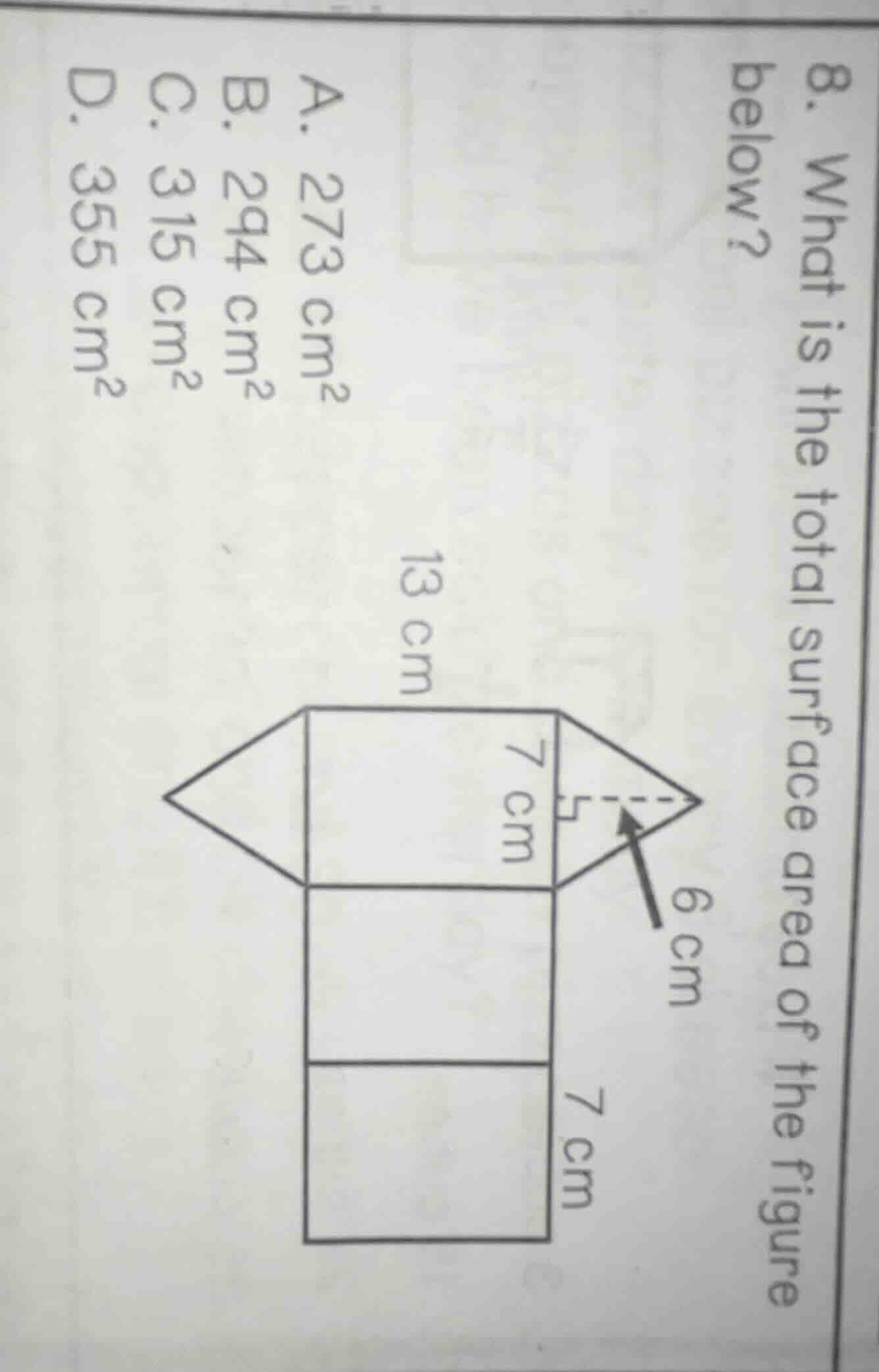
Question
- what is the total surface area of the figure below?
a. 273 cm²
b. 294 cm²
c. 315 cm²
d. 355 cm²
Step1: Analyze the figure components
The figure consists of two triangular faces and a rectangular part (which seems to be a combination of rectangles). First, let's handle the triangles. Each triangle has a base of \( 13 \, \text{cm} \) and a height of \( 5 \, \text{cm} \)? Wait, no, looking at the diagram, the triangle has a base related to the side, maybe the triangle's base is \( 7 \, \text{cm} \)? Wait, no, let's re - examine. The figure has two congruent triangles (the pointed parts) and a rectangular section with length \( 13 \, \text{cm} \) and the height of the rectangular part is \( 7 + 7+ 7=21 \, \text{cm} \)? Wait, no, the diagram shows the rectangles with height \( 7 \, \text{cm} \) each, three of them? Wait, maybe the figure is a composite of two triangles and a rectangle, and also some other rectangles. Wait, let's calculate the area of the triangles first. Each triangle: base \( b = 13 \, \text{cm} \), height \( h = 5 \, \text{cm} \)? No, the arrow points to a height of \( 5 \, \text{cm} \) for the triangle, and the side of the triangle is \( 6 \, \text{cm} \)? Wait, maybe I misread. Let's try again.
Wait, the figure: the two triangular faces. Let's assume each triangle has a base of \( 7 \, \text{cm} \) (the side of the rectangle) and a height of \( 5 \, \text{cm} \)? No, the length of the rectangle is \( 13 \, \text{cm} \). Wait, maybe the correct approach is:
The figure is made up of:
- Two congruent triangles: base \( = 13 \, \text{cm} \), height \( = 5 \, \text{cm} \)
- A rectangle with length \( 13 \, \text{cm} \) and width \( 7 \times 3=21 \, \text{cm} \)? No, the vertical sides are \( 7 \, \text{cm} \) each, three of them? Wait, the diagram has three rectangles stacked vertically, each with height \( 7 \, \text{cm} \), so total height of the rectangular part is \( 7 + 7+ 7 = 21 \, \text{cm} \), and length \( 13 \, \text{cm} \). Also, two side rectangles with dimensions \( 6 \, \text{cm} \) and \( 7 \, \text{cm} \), three of them? Wait, this is getting confusing. Let's look at the answer options. Let's try to calculate the area step by step.
Wait, maybe the figure is a prism - like shape with two triangular bases and three rectangular faces, and two side rectangular faces.
First, area of the two triangles: The formula for the area of a triangle is \( A=\frac{1}{2}bh \). If the base \( b = 13 \, \text{cm} \) and height \( h = 5 \, \text{cm} \), then area of one triangle is \( \frac{1}{2}\times13\times5 = 32.5 \, \text{cm}^2 \), two triangles: \( 2\times32.5 = 65 \, \text{cm}^2 \)
Then, the area of the three rectangles (the vertical ones) with dimensions \( 13 \, \text{cm}\times7 \, \text{cm} \): \( 3\times13\times7=273 \, \text{cm}^2 \)
Then, the area of the two side rectangles with dimensions \( 6 \, \text{cm}\times7 \, \text{cm} \): \( 2\times6\times7 = 84 \, \text{cm}^2 \)
Wait, no, that doesn't match. Wait, maybe the correct components are:
- Two triangles: base \( = 7 \, \text{cm} \), height \( = 5 \, \text{cm} \)? No, let's check the answer options. The answer options are 273, 294, 315, 355.
Wait, another approach: The figure is a combination of a rectangle and two triangles, and some other rectangles. Wait, maybe the total surface area is calculated as follows:
The rectangular part: length \( 13 \, \text{cm} \), width \( 7\times3 = 21 \, \text{cm} \), area \( 13\times21 = 273 \, \text{cm}^2 \)
Then the two triangles: each with base \( 7 \, \text{cm} \), height \( 5 \, \text{cm} \), area of two triangles \( 2\times\frac{1}{2}\times7\times5=35 \, \text{cm}^2 \)
No, that's not right. Wait, ma…

Snap & solve any problem in the app
Get step-by-step solutions on Sovi AI
Photo-based solutions with guided steps
Explore more problems and detailed explanations
A. \( 273 \, \text{cm}^2 \)