QUESTION IMAGE
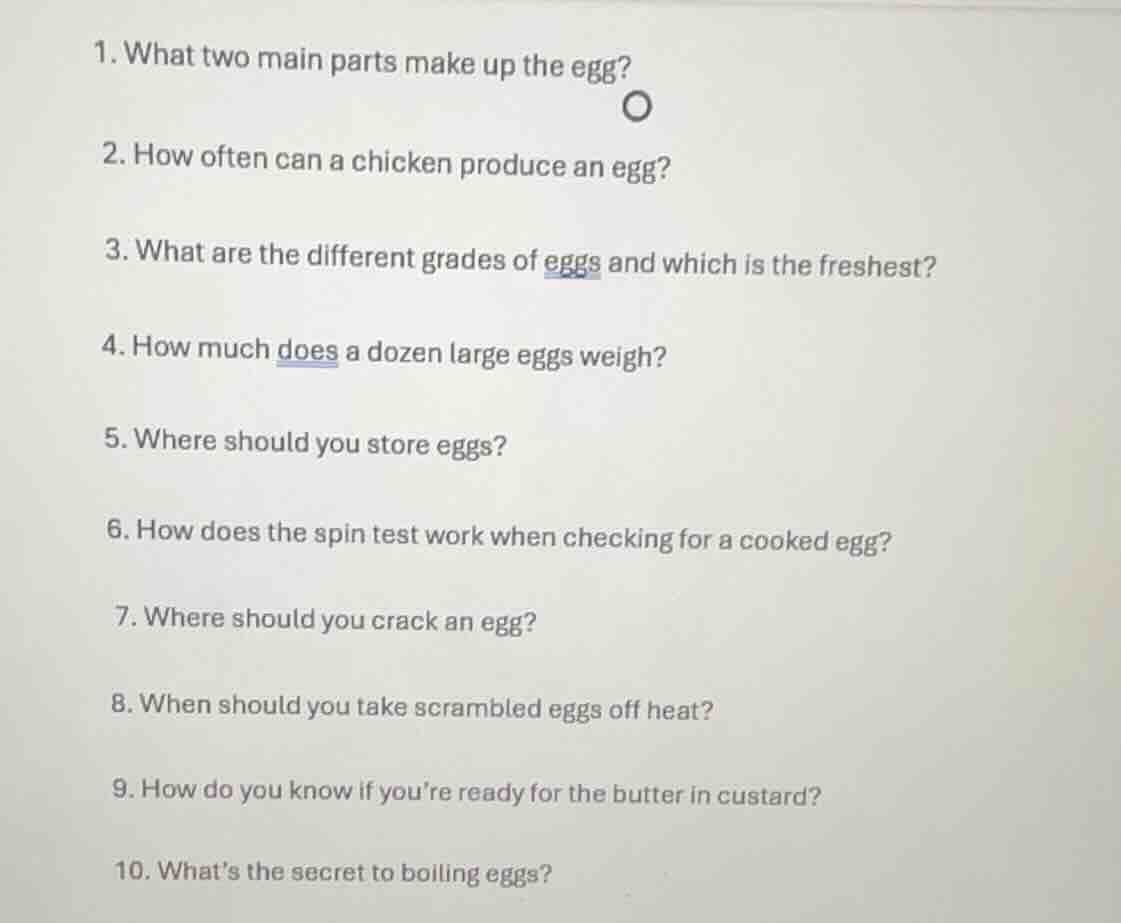
Question
- what two main parts make up the egg?
- how often can a chicken produce an egg?
- what are the different grades of eggs and which is the freshest?
- how much does a dozen large eggs weigh?
- where should you store eggs?
- how does the spin test work when checking for a cooked egg?
- where should you crack an egg?
- when should you take scrambled eggs off heat?
- how do you know if you’re ready for the butter in custard?
- what’s the secret to boiling eggs?
Brief Explanations
- Identifies the two core structural components of an egg.
- States the typical egg-laying frequency for hens.
- Lists standard egg grades and the freshest one.
- Provides the standard weight for a dozen large eggs.
- Notes the optimal storage location for eggs.
- Explains the physics behind the cooked egg spin test.
- Recommends the best surface to crack an egg.
- Specifies the visual cue for removing scrambled eggs from heat.
- Describes the temperature sign for adding butter to custard.
- Shares the key step for perfect boiled eggs.

Snap & solve any problem in the app
Get step-by-step solutions on Sovi AI
Photo-based solutions with guided steps
Explore more problems and detailed explanations
- The shell and the internal contents (albumen/yolk)
- Healthy laying hens produce an egg every 24-26 hours, or roughly 6 eggs per week.
- The main U.S. egg grades are AA, A, and B; Grade AA is the freshest.
- A dozen large eggs weighs approximately 24 ounces (680 grams).
- Eggs should be stored in the main compartment of the refrigerator, not the door, at 40°F (4°C) or below.
- A cooked egg spins smoothly and steadily because its solidified internal contents move as one; a raw egg wobbles and stops quickly as the liquid inside sloshes around.
- Crack an egg on a flat, hard surface (like a countertop), not the edge of a bowl, to avoid shell fragments falling into the egg.
- Take scrambled eggs off the heat when they are softly set and still slightly runny; residual heat will finish cooking them.
- You are ready for butter in custard when the custard has thickened enough to coat the back of a spoon, and it has been removed from direct heat.
- The secret to boiling eggs is to submerge room-temperature eggs in cold water, bring to a rolling boil, then remove from heat, cover, and let sit for 9-12 minutes (depending on desired doneness) before shocking in ice water to stop cooking and make peeling easier.