QUESTION IMAGE
Question
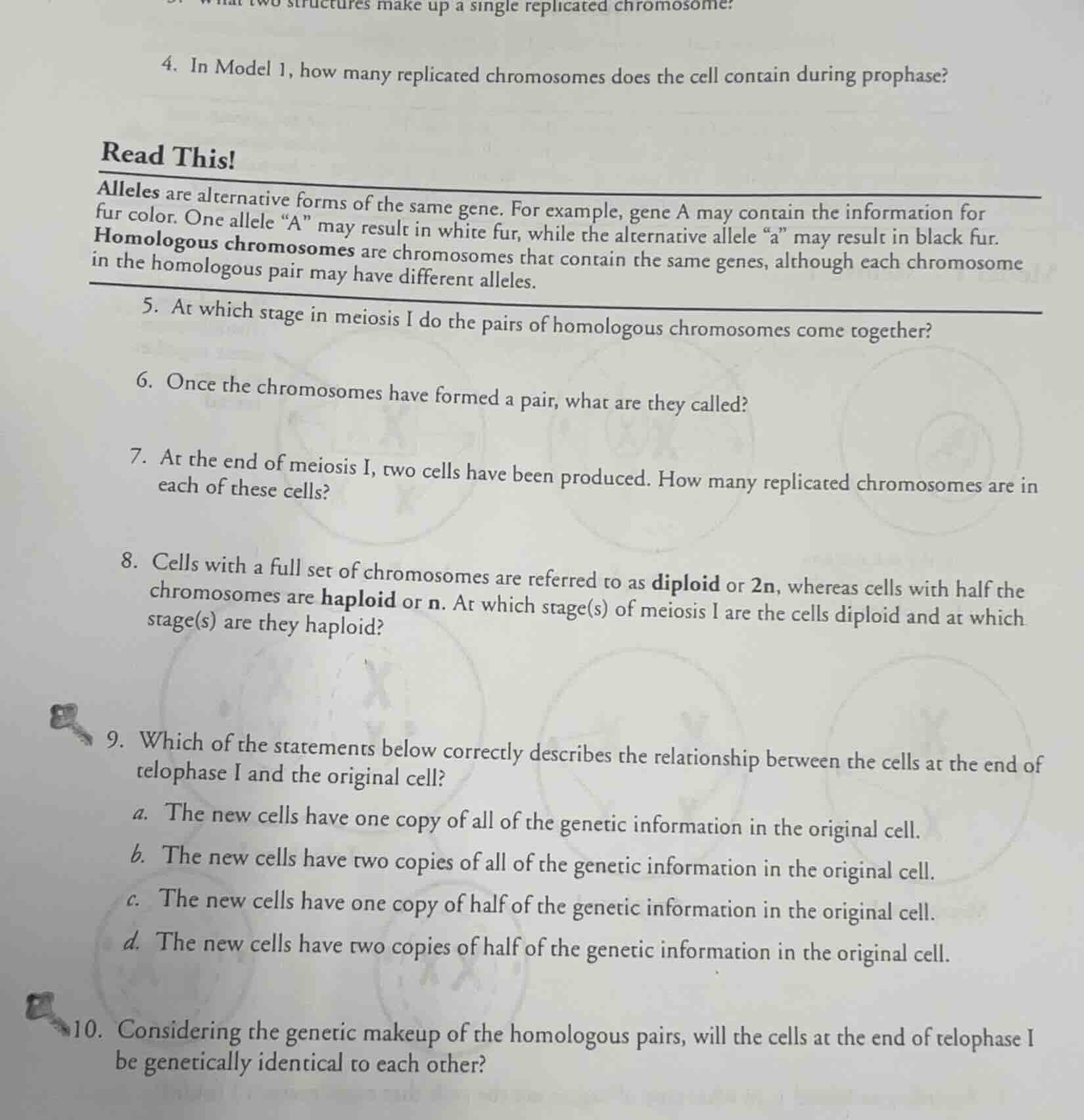
- what two structures make up a single replicated chromosome?
- in model 1, how many replicated chromosomes does the cell contain during prophase?
read this!
alleles are alternative forms of the same gene. for example, gene a may contain the information for fur color. one allele \a\ may result in white fur, while the alternative allele \a\ may result in black fur.
homologous chromosomes are chromosomes that contain the same genes, although each chromosome in the homologous pair may have different alleles.
- at which stage in meiosis i do the pairs of homologous chromosomes come together?
- once the chromosomes have formed a pair, what are they called?
- at the end of meiosis i, two cells have been produced. how many replicated chromosomes are in each of these cells?
- cells with a full set of chromosomes are referred to as diploid or 2n, whereas cells with half the chromosomes are haploid or n. at which stage(s) of meiosis i are the cells diploid and at which stage(s) are they haploid?
- which of the statements below correctly describes the relationship between the cells at the end of telophase i and the original cell?
a. the new cells have one copy of all of the genetic information in the original cell.
b. the new cells have two copies of all of the genetic information in the original cell.
c. the new cells have one copy of half of the genetic information in the original cell.
d. the new cells have two copies of half of the genetic information in the original cell.
- considering the genetic makeup of the homologous pairs, will the cells at the end of telophase i be genetically identical to each other?
Question 5
In meiosis I, homologous chromosomes pair up during prophase I. This pairing is called synapsis, and it occurs specifically in the early stages of prophase I (leptotene, zygotene stages of prophase I, with zygotene being when synapsis is prominent).
When homologous chromosomes form a pair during meiosis, this paired structure is called a tetrad (or a bivalent). A tetrad consists of two homologous chromosomes, each with two sister chromatids, so a total of four chromatids.
At the end of meiosis I, the cell has undergone a reduction division in terms of chromosome number (homologous pairs are separated), but each chromosome is still replicated (has two sister chromatids). If the original cell (before meiosis I) had, for example, 4 replicated chromosomes (in a diploid cell with 2n = 4, replicated to 4 chromosomes each with two chromatids), after meiosis I (which separates homologous pairs), each resulting cell will have half the number of replicated chromosomes as the original cell before meiosis I. Typically, if the original cell (diploid, 2n) had 2n replicated chromosomes (each chromosome is replicated), after meiosis I, each cell has n replicated chromosomes. For example, in a human cell, before meiosis I, there are 46 replicated chromosomes (23 homologous pairs, each chromosome replicated). After meiosis I, each cell has 23 replicated chromosomes (each with two sister chromatids).

Snap & solve any problem in the app
Get step-by-step solutions on Sovi AI
Photo-based solutions with guided steps
Explore more problems and detailed explanations
Prophase I (specifically during synapsis in prophase I)