QUESTION IMAGE
Question
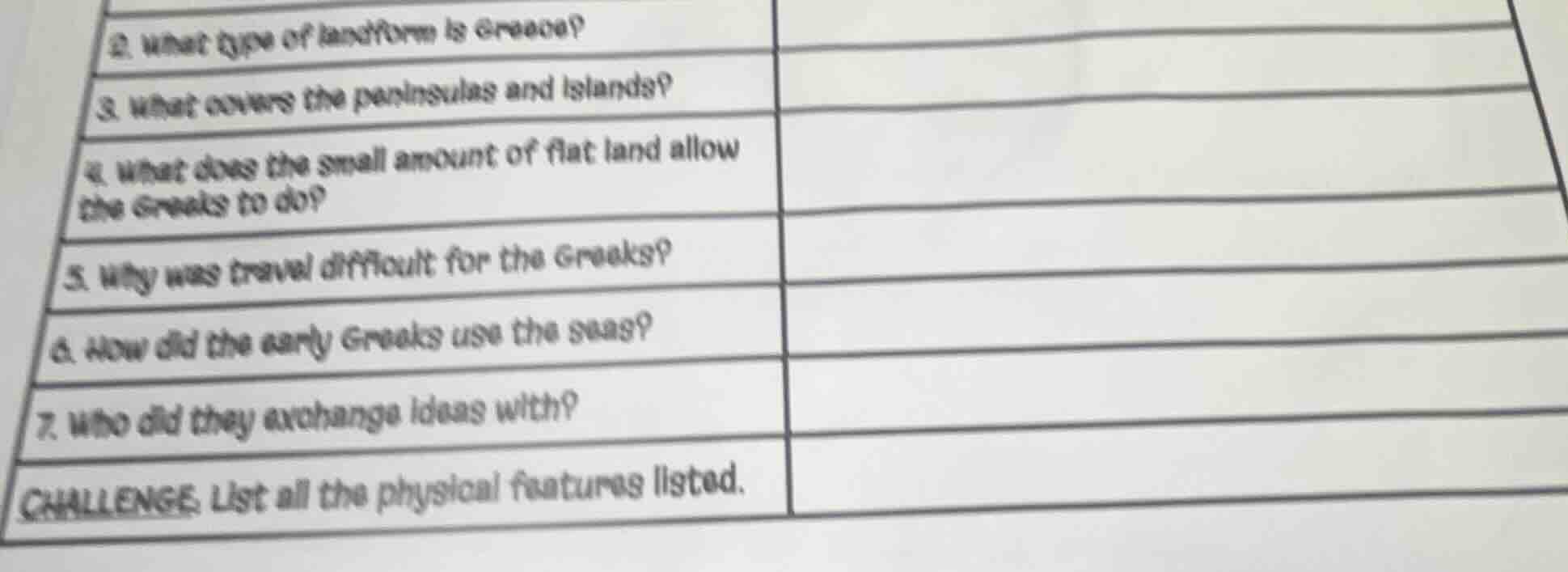
- what type of landform is greece?
- what covers the peninsulas and islands?
- what does the small amount of flat land allow the greeks to do?
- why was travel difficult for the greeks?
- how did the early greeks use the seas?
- who did they exchange ideas with?
challenge: list all the physical features listed.
Brief Explanations
- Greece's core landform is a mountainous archipelago/peninsula complex, with most area as mountains and scattered islands.
- Rocky, mountainous terrain and Mediterranean vegetation (like olive trees, scrub) cover its peninsulas and islands.
- Limited flat land meant Greeks focused on intensive, small-scale farming (e.g., olives, grapes) and herding.
- Travel was hard due to rugged mountains dividing regions, no major navigable rivers, and scattered islands.
- Early Greeks used seas for fishing, trade of goods (olive oil, wine), colonization, and transportation between islands/peninsulas.
- They exchanged ideas with neighboring cultures like the Egyptians, Phoenicians, and Anatolian civilizations via maritime contact.
- The key physical features referenced are mountains, peninsulas, islands, small areas of flat land, and surrounding seas.

Snap & solve any problem in the app
Get step-by-step solutions on Sovi AI
Photo-based solutions with guided steps
Explore more problems and detailed explanations
- Greece is a mountainous peninsula/archipelago (dominated by mountains and scattered islands).
- Rocky, mountainous terrain and Mediterranean scrub/vegetation.
- Practice intensive, small-scale farming (olives, grapes) and herding.
- Rugged mountains, lack of navigable rivers, scattered islands.
- For fishing, trade, colonization, and inter-region travel.
- Egyptians, Phoenicians, and Anatolian cultures.
- Mountains, peninsulas, islands, small flat land areas, Mediterranean seas.