QUESTION IMAGE
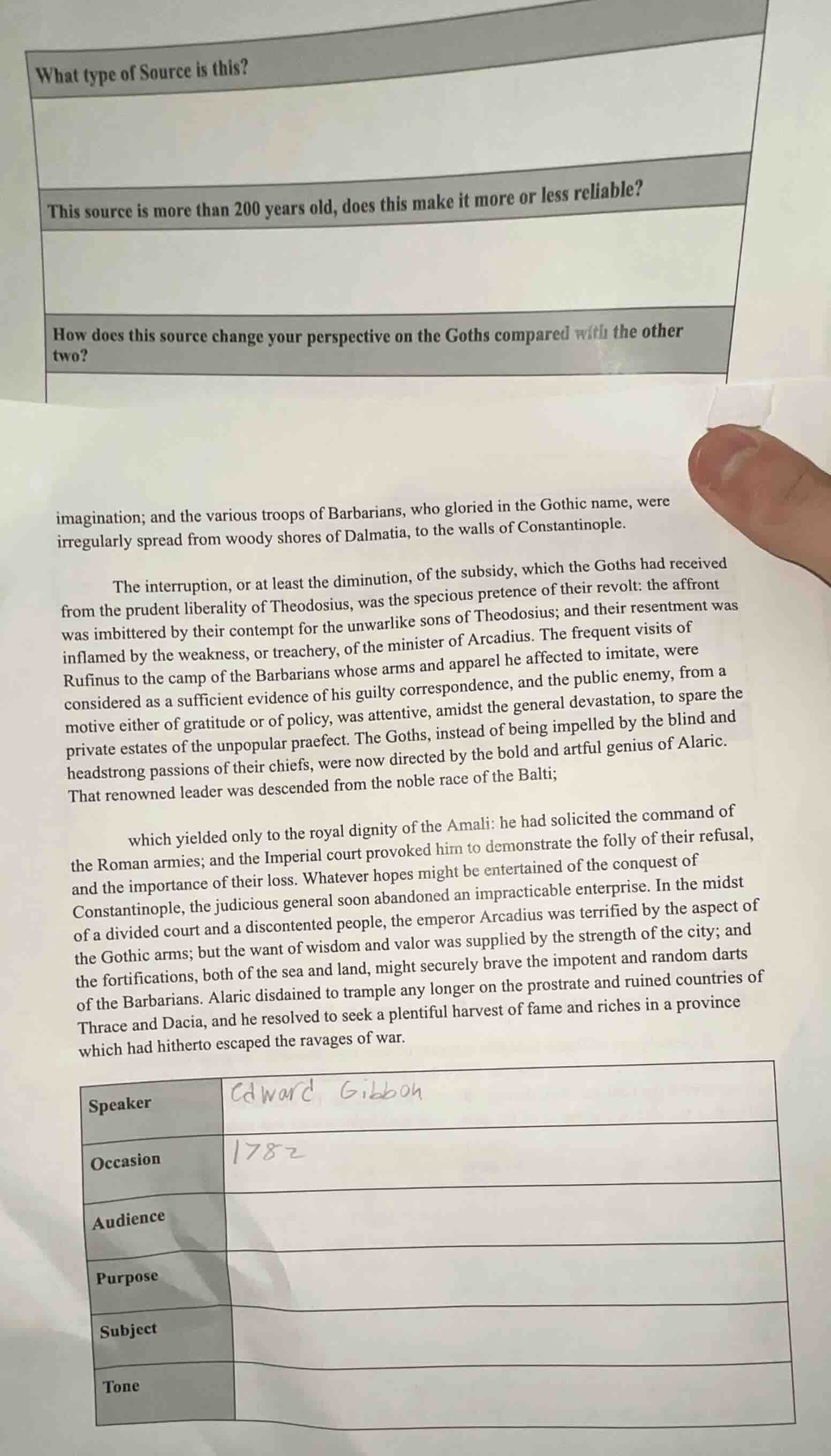
Question
what type of source is this?
this source is more than 200 years old, does this make it more or less reliable?
how does this source change your perspective on the goths compared with the other two?
imagination; and the various troops of barbarians, who gloried in the gothic name, were irregularly spread from woody shores of dalmatia, to the walls of constantinople.
the interruption, or at least the diminution, of the subsidy, which the goths had received from the prudent liberality of theodosius, was the specious pretence of their revolt: the affront was imbittered by their contempt for the unwarlike sons of theodosius; and their resentment was inflamed by the weakness, or treachery, of the minister of arcadius. the frequent visits of rufinus to the camp of the barbarians whose arms and apparel he affected to imitate, were considered as a sufficient evidence of his guilty correspondence, and the public enemy, from a motive either of gratitude or of policy, was attentive, amidst the general devastation, to spare the private estates of the unpopular praefect. the goths, instead of being impelled by the blind and headstrong passions of their chiefs, were now directed by the bold and artful genius of alaric. that renowned leader was descended from the noble race of the balti;
which yielded only to the royal dignity of the amali: he had solicited the command of the roman armies; and the imperial court provoked him to demonstrate the folly of their refusal, and the importance of their loss. whatever hopes might be entertained of the conquest of constantinople, the judicious general soon abandoned an impracticable enterprise. in the midst of a divided court and a discontented people, the emperor arcadius was terrified by the aspect of the gothic arms; but the want of wisdom and valor was supplied by the strength of the city; and the fortifications, both of the sea and land, might securely brave the impotent and random darts of the barbarians. alaric disdained to trample any longer on the prostrate and ruined countries of thrace and dacia, and he resolved to seek a plentiful harvest of fame and riches in a province which had hitherto escaped the ravages of war.
speaker edward gibbon
occasion 1782
audience
purpose
subject
tone
For the SOAPSTone table:
- Audience: This historical text was written for educated 18th-century readers, including scholars and members of the literate public interested in classical and medieval history.
- Purpose: To analyze and narrate the causes and events of Gothic revolts against the Eastern Roman Empire, explaining the role of Roman politics and Gothic leadership in these conflicts.
- Subject: The Gothic revolts against the Eastern Roman Empire under Arcadius, focusing on the role of Alaric, Roman mismanagement, and the motivations for Gothic military action.
- Tone: Scholarly, analytical, and formal; Gibbon maintains a detached, critical perspective while presenting historical events and interpretations.
For the top questions:
- Source Type: This is a secondary historical source, a scholarly narrative from Edward Gibbon's The History of the Decline and Fall of the Roman Empire.
- Reliability: Its age makes it both more and less reliable. It is more reliable as a foundational work of late Roman history with extensive research, but less reliable because it reflects 18th-century biases (like framing "barbarians" and Roman decline through Enlightenment perspectives) and lacks access to modern archaeological and historical research on the Goths.
- Perspective Shift: Unlike sources that may frame the Goths as purely destructive "barbarians," this source emphasizes Roman political failures (weak leadership, mismanagement of subsidies) as key triggers for revolt, and portrays the Goths as a cohesive group led by a strategic, rational leader (Alaric) rather than a disorganized horde.

Snap & solve any problem in the app
Get step-by-step solutions on Sovi AI
Photo-based solutions with guided steps
Explore more problems and detailed explanations
SOAPSTone Table:
- Audience: Educated 18th-century literate public/scholars
- Purpose: To analyze and narrate Gothic revolts against Eastern Rome
- Subject: Gothic revolts, Alaric's leadership, Roman political failures
- Tone: Scholarly, analytical, formal, detached
Top Questions:
- What type of Source is this? Secondary historical scholarly source (from The History of the Decline and Fall of the Roman Empire)
- This source is more than 200 years old, does this make it more or less reliable? It is both: more reliable as a foundational, extensively researched historical work; less reliable due to 18th-century biases and lack of modern historical/archaeological data.
- How does this source change your perspective on the Goths compared with the other two? It shifts focus from framing Goths as purely destructive barbarians to highlighting Roman political failures as revolt triggers, and portrays Goths as a strategically led, cohesive group.