QUESTION IMAGE
Question
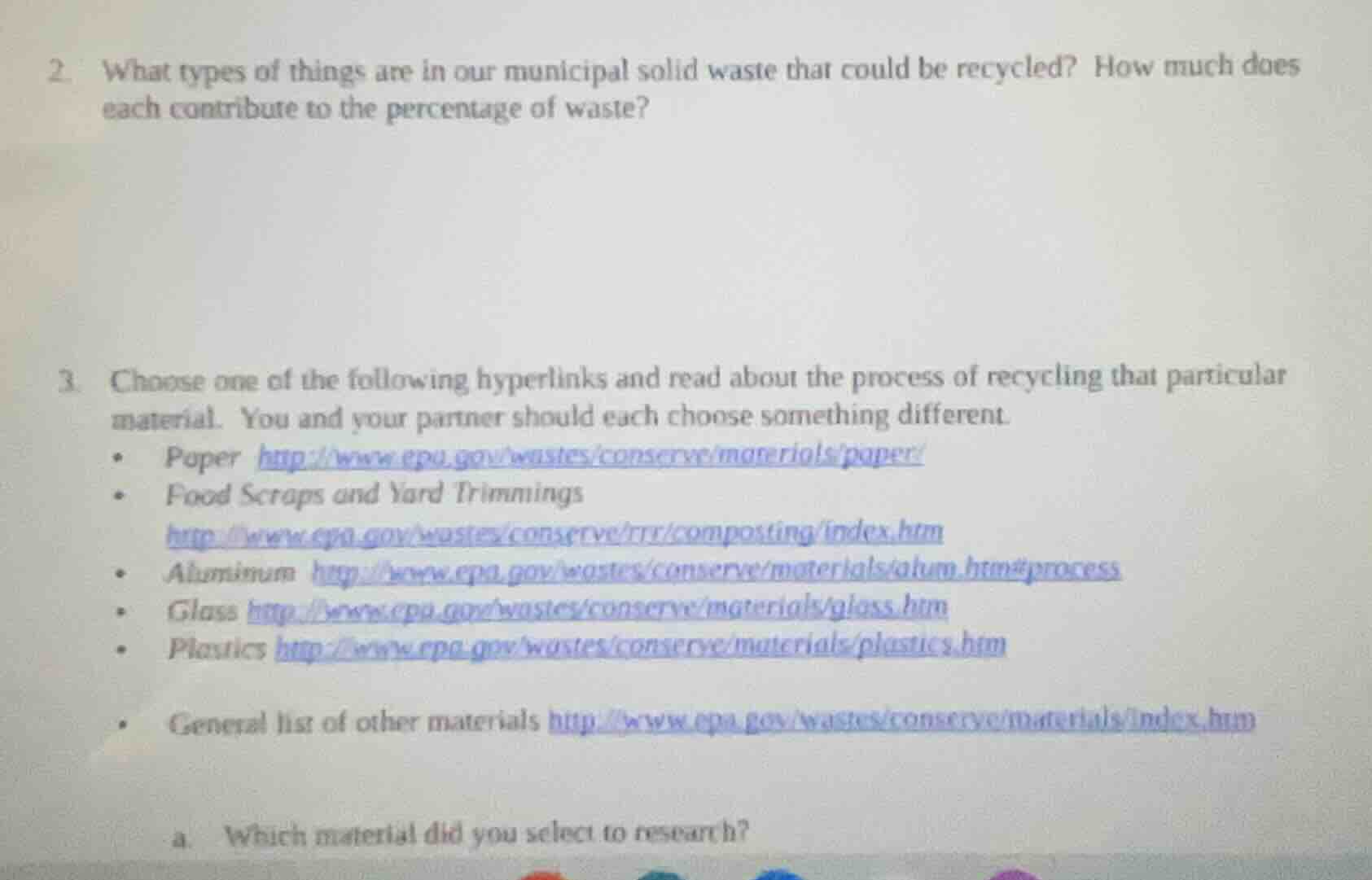
- what types of things are in our municipal solid waste that could be recycled? how much does each contribute to the percentage of waste?
- choose one of the following hyperlinks and read about the process of recycling that particular material. you and your partner should each choose something different.
- paper http://www.epa.gov/wastes/conserve/materials/paper/
- food scraps and yard trimmings
http://www.epa.gov/wastes/conserve/rrr/composting/index.htm
- aluminum http://www.epa.gov/wastes/conserve/materials/alum.htm#process
- glass http://www.epa.gov/wastes/conserve/materials/glass.htm
- plastics http://www.epa.gov/wastes/conserve/materials/plastics.htm
- general list of other materials http://www.epa.gov/wastes/conserve/materials/index.htm
a. which material did you select to research?
Brief Explanations
For Question 2:
Common recyclable municipal solid waste items and their typical U.S. EPA-contributed percentages (2021 data) are based on standard waste composition studies.
For Question 3a:
This is a subjective selection from the provided material options.

Snap & solve any problem in the app
Get step-by-step solutions on Sovi AI
Photo-based solutions with guided steps
Explore more problems and detailed explanations
Question 2:
- Paper and paperboard: Makes up ~23.1% of municipal solid waste, the largest recyclable portion.
- Food scraps: Accounts for ~24.1% (compostable/recyclable via organics programs).
- Plastics: Contributes ~12.2% of waste, with certain types recyclable.
- Aluminum: Makes up ~0.6% of waste, highly recyclable.
- Glass: Accounts for ~4.6% of municipal solid waste.
- Yard trimmings: Contributes ~12.1% (compostable/recyclable).
Question 3a:
(Example selection) Paper
(Note: This can be replaced with any of the listed materials: Food Scraps and Yard Trimmings, Aluminum, Glass, Plastics, or a material from the general other materials list)