QUESTION IMAGE
Question
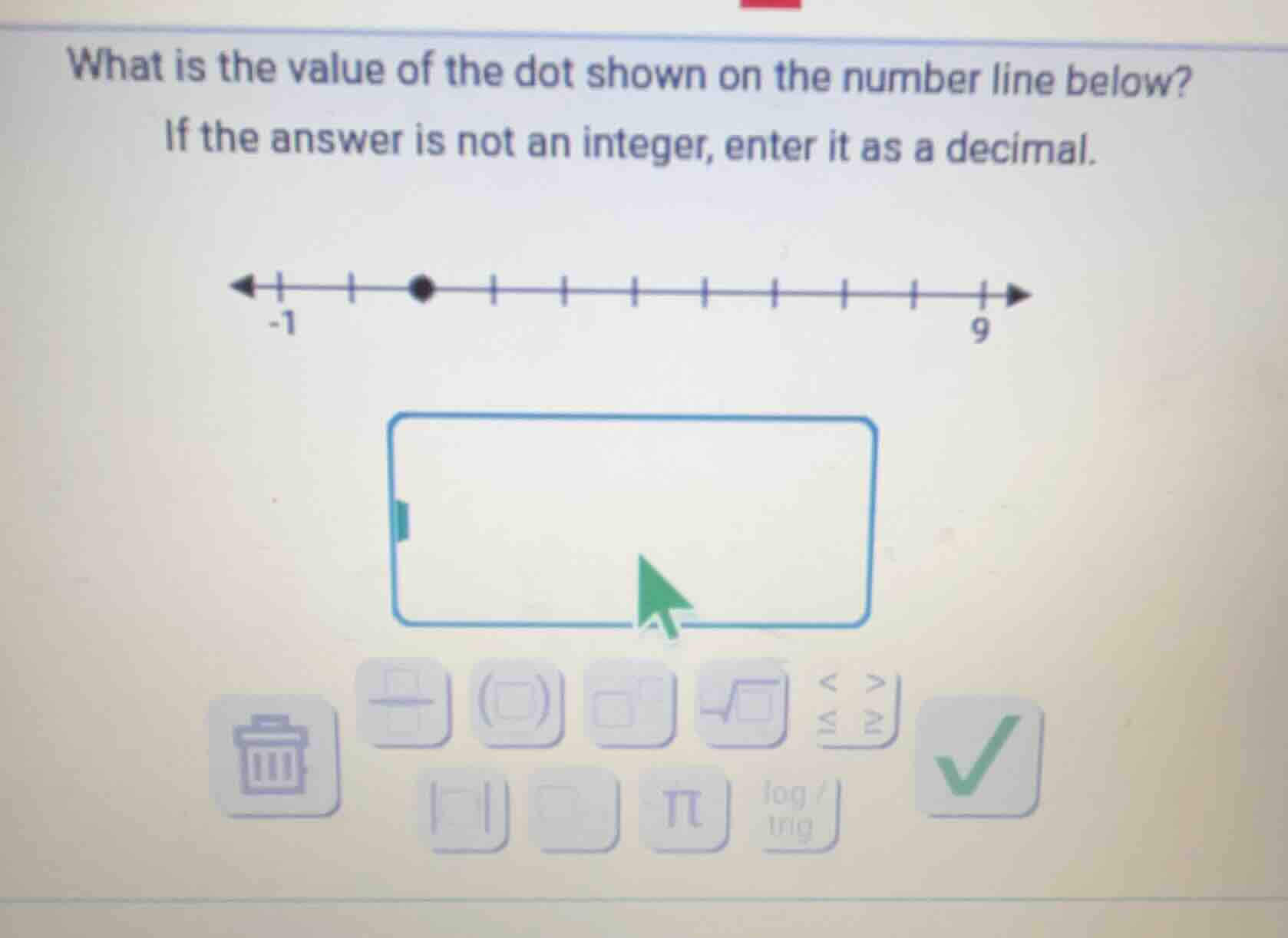
what is the value of the dot shown on the number line below? if the answer is not an integer, enter it as a decimal.
Step1: Find the total number of intervals
From -1 to 9, the total distance is \(9 - (-1)=10\). Count the number of intervals between -1 and 9. Looking at the number line, from -1 to 9, there are 10 intervals (since from -1, the next marks up to 9: let's see, from -1, the first mark after -1, then the dot, then more marks until 9. Wait, actually, the number of intervals between -1 and 9: let's count the spaces. From -1 to 9, the total length is 10, and the number of intervals (the number of spaces between the ticks) is 10? Wait, no, let's see the ticks. The leftmost tick is -1, then the next ticks: let's count how many ticks from -1 to 9. From -1, then the dot is at the third tick? Wait, no, let's look at the number of intervals. Let's see, from -1 to 9, the total number of units is \(9 - (-1) = 10\). The number of intervals (the number of spaces between the vertical lines) from -1 to 9: let's count the spaces. From -1, the first space, then the dot is in the second space? Wait, no, the number line has ticks: -1, then a tick, then the dot, then a tick, then more ticks until 9. Wait, actually, from -1 to 9, how many intervals? Let's see, the distance from -1 to 9 is 10, and the number of intervals (the number of equal parts) is 10? Wait, no, let's count the number of spaces between the ticks. From -1 to 9, there are 10 spaces? Wait, the left tick is -1, then the next tick, then the dot, then a tick, then 7 more ticks to 9? Wait, no, let's calculate the length of each interval. The total distance between -1 and 9 is \(9 - (-1)=10\). The number of intervals (the number of spaces between the vertical lines) from -1 to 9: let's see, from -1 to 9, how many intervals? Let's count the number of vertical lines between -1 and 9. From -1, then the dot is at the second interval? Wait, maybe better to calculate the length of each interval. Let the length of each interval be \(d\). The total number of intervals from -1 to 9 is 10 (since from -1 to 9, the number of steps: let's see, from -1, adding \(d\) each time, after \(n\) intervals, we reach 9. So \(-1 + n \times d=9\), so \(n \times d = 10\). Now, count the number of intervals between -1 and 9. Looking at the number line, from -1 to 9, there are 10 intervals (because from -1, the first interval, then the dot is at the second interval? Wait, no, the dot is at the second tick after -1? Wait, the leftmost tick is -1, then the next tick (first interval), then the dot (second interval?), no, maybe the number of intervals from -1 to 9 is 10, so each interval is \(10 / 10 = 1\)? Wait, no, that can't be. Wait, no, let's look again. The number line has -1 on the left, then a tick, then the dot, then a tick, then 7 more ticks to 9. Wait, total ticks from -1 to 9: -1, tick1, dot, tick2, tick3, tick4, tick5, tick6, tick7, tick8, 9. So that's 10 intervals (from -1 to tick1: 1, tick1 to dot: 1, dot to tick2:1, ..., tick8 to 9:1). Wait, no, the number of intervals between -1 and 9 is 10, so each interval is \(10 / 10 = 1\)? But then -1 + 1 (first interval) is 0, then the dot is at -1 + 21? Wait, no, maybe I miscounted. Wait, the distance from -1 to 9 is 10, and the number of intervals (the number of equal parts) is 10, so each interval is 1. Wait, but then the dot is at -1 + 21 = 1? No, that doesn't seem right. Wait, maybe the number of intervals is 10, so each interval is 1, but let's check. Wait, from -1, the first tick is 0, then the dot is at 1? No, the problem is that the number line has -1 on the left, then a tick, then the dot, then a tick, then more ticks until 9. Wait, maybe the total number of…

Snap & solve any problem in the app
Get step-by-step solutions on Sovi AI
Photo-based solutions with guided steps
Explore more problems and detailed explanations
1