QUESTION IMAGE
Question
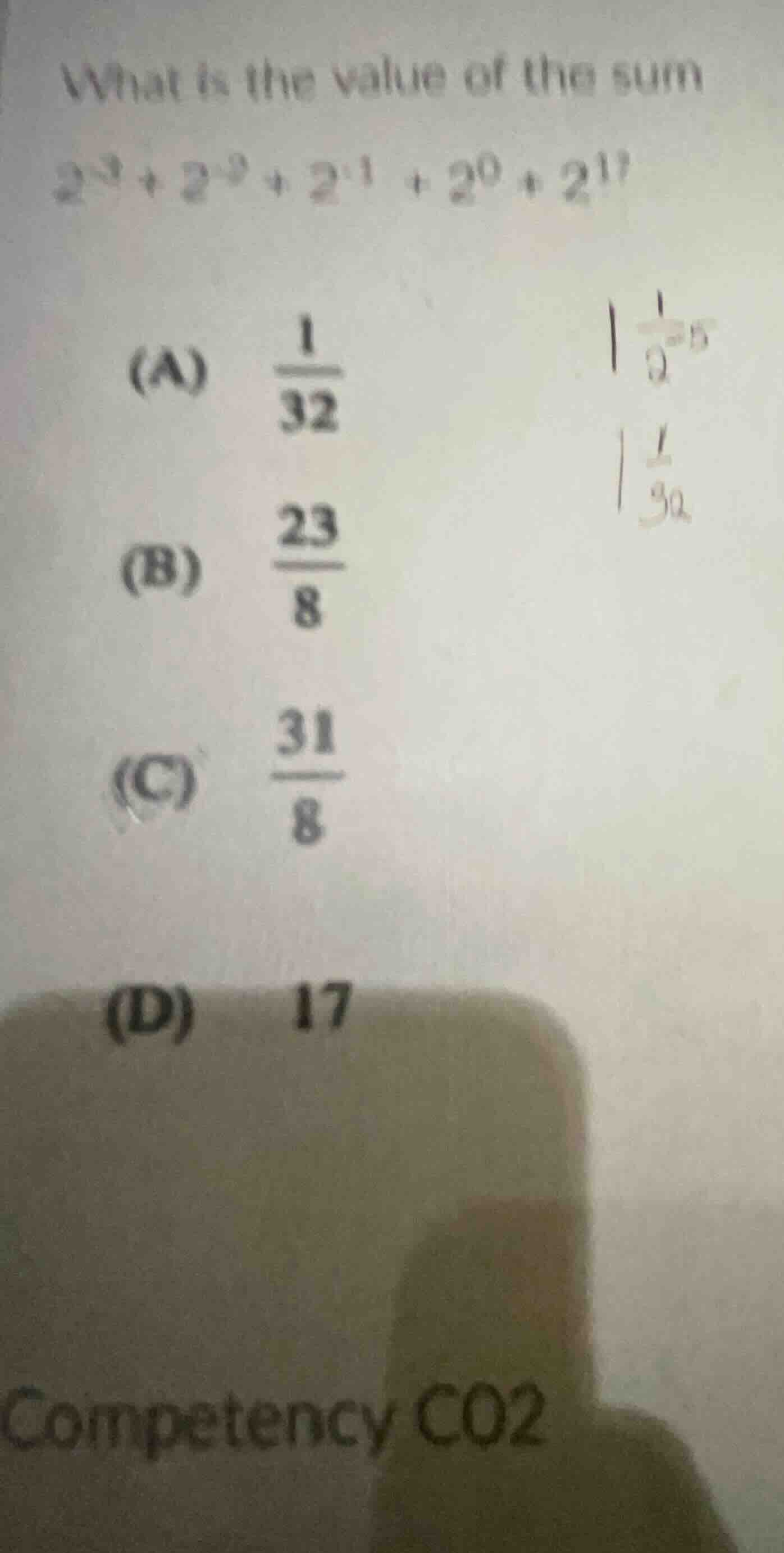
what is the value of the sum $2^{-3}+2^{-2}+2^{-1}+2^{0}+2^{1}$?
(a) $\frac{1}{32}$
(b) $\frac{23}{8}$
(c) $\frac{31}{8}$
(d) $17$
Step1: Calculate each term
Recall that \(a^{-n}=\frac{1}{a^n}\) and \(a^0 = 1\) (for \(a
eq0\)).
- For \(2^{-3}\): Using the negative - exponent rule, \(2^{-3}=\frac{1}{2^3}=\frac{1}{8}\)
- For \(2^{-2}\): \(2^{-2}=\frac{1}{2^2}=\frac{1}{4}\)
- For \(2^{-1}\): \(2^{-1}=\frac{1}{2^1}=\frac{1}{2}\)
- For \(2^{0}\): By the zero - exponent rule, \(2^{0}=1\)
- For \(2^{1}\): \(2^{1}=2\)
Step2: Find a common denominator and add the fractions
The common denominator of \(\frac{1}{8},\frac{1}{4},\frac{1}{2},1,2\) is 8.
- \(\frac{1}{4}=\frac{1\times2}{4\times2}=\frac{2}{8}\)
- \(\frac{1}{2}=\frac{1\times4}{2\times4}=\frac{4}{8}\)
- \(1=\frac{1\times8}{1\times8}=\frac{8}{8}\)
- \(2=\frac{2\times8}{1\times8}=\frac{16}{8}\)
- And \(\frac{1}{8}\) remains as \(\frac{1}{8}\)
Now, add the fractions:
\(\frac{1}{8}+\frac{2}{8}+\frac{4}{8}+\frac{8}{8}+\frac{16}{8}=\frac{1 + 2+4 + 8+16}{8}\)
Step3: Calculate the numerator
Calculate the sum of the numerators: \(1+2 + 4+8 + 16=31\)
So, \(\frac{1 + 2+4 + 8+16}{8}=\frac{31}{8}\)

Snap & solve any problem in the app
Get step-by-step solutions on Sovi AI
Photo-based solutions with guided steps
Explore more problems and detailed explanations
C. \(\frac{31}{8}\)