QUESTION IMAGE
Question
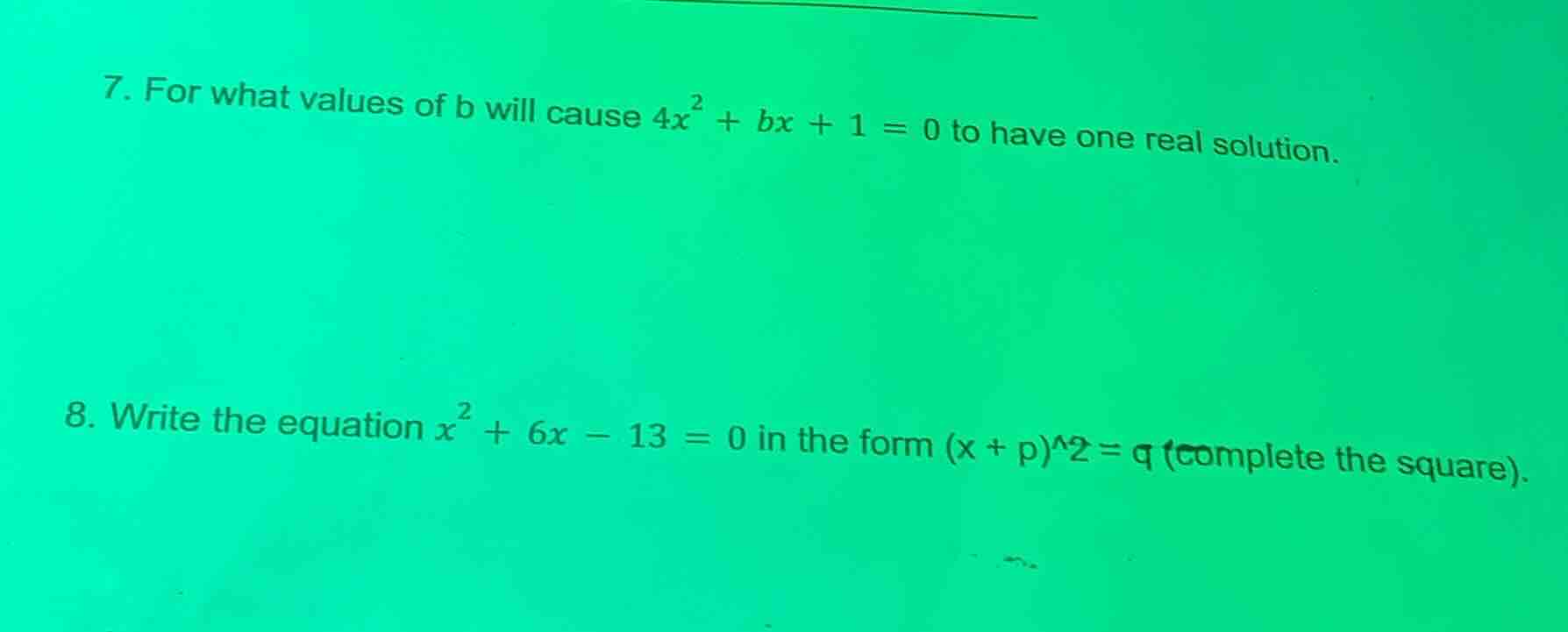
- for what values of b will cause $4x^{2}+bx + 1 = 0$ to have one real solution.
- write the equation $x^{2}+6x - 13 = 0$ in the form $(x + p)^{2}=q$ (complete the square).
Problem 7
Step1: Recall discriminant formula
For a quadratic equation \(ax^2 + bx + c = 0\), the discriminant is \(\Delta = b^2 - 4ac\). If there is one real solution, \(\Delta = 0\).
Here, \(a = 4\), \(b = b\) (the variable we're solving for), \(c = 1\). So \(\Delta = b^2 - 4(4)(1)\).
Step2: Set discriminant to zero
Set \(\Delta = 0\): \(b^2 - 16 = 0\).
Step3: Solve for b
\(b^2 = 16\), so \(b = \pm 4\).
Step1: Start with the equation
We have \(x^2 + 6x - 13 = 0\). Move the constant term to the other side: \(x^2 + 6x = 13\).
Step2: Complete the square
To complete the square for \(x^2 + 6x\), take half of 6 (which is 3), square it (which is 9), and add it to both sides: \(x^2 + 6x + 9 = 13 + 9\).
Step3: Rewrite as a square
The left side is \((x + 3)^2\), and the right side is 22. So \((x + 3)^2 = 22\).

Snap & solve any problem in the app
Get step-by-step solutions on Sovi AI
Photo-based solutions with guided steps
Explore more problems and detailed explanations
\(b = 4\) or \(b = -4\)