QUESTION IMAGE
Question
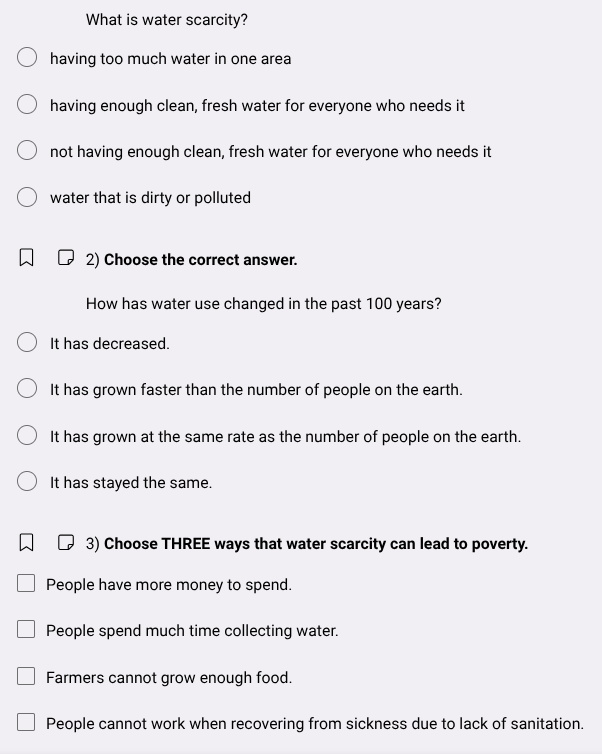
what is water scarcity?
having too much water in one area
having enough clean, fresh water for everyone who needs it
not having enough clean, fresh water for everyone who needs it
water that is dirty or polluted
- choose the correct answer.
how has water use changed in the past 100 years?
it has decreased.
it has grown faster than the number of people on the earth.
it has grown at the same rate as the number of people on the earth.
it has stayed the same.
- choose three ways that water scarcity can lead to poverty.
people have more money to spend.
people spend much time collecting water.
farmers cannot grow enough food.
people cannot work when recovering from sickness due to lack of sanitation.
Question 1: What is water scarcity?
Water scarcity is defined as a situation where there is an insufficient supply of clean, fresh water to meet the needs of all individuals who require it. The first option is incorrect as it describes excess water. The second option describes water sufficiency. The fourth option describes polluted water, not scarcity. So the correct option is the one about not having enough clean, fresh water for everyone who needs it.
Over the past 100 years, with industrialization, urbanization, and increased agricultural demands, water use has grown at a rate faster than the population growth. Population increase alone doesn't account for all water - using activities like industrial processes. So the option "It has grown faster than the number of people on the earth" is correct. The other options (decreased, same rate as population, stayed same) don't align with real - world trends.
- "People have more money to spend" is incorrect as water scarcity usually leads to increased costs related to water, leaving people with less money.
- "People spend much time collecting water": When people spend a lot of time collecting water, they have less time for income - generating activities like working or going to school, which can lead to poverty.
- "Farmers cannot grow enough food": If farmers don't have enough water for irrigation, crop yields decrease. This can lead to food insecurity, and farmers may earn less, pushing them into poverty.
- "People cannot work when recovering from sickness due to lack of sanitation": Water scarcity often leads to poor sanitation, which causes diseases. When people are sick and recovering, they can't work, so they lose income, leading to poverty.
So the three correct options are "People spend much time collecting water", "Farmers cannot grow enough food", and "People cannot work when recovering from sickness due to lack of sanitation".

Snap & solve any problem in the app
Get step-by-step solutions on Sovi AI
Photo-based solutions with guided steps
Explore more problems and detailed explanations
C. not having enough clean, fresh water for everyone who needs it (assuming the options are labeled A, B, C, D in order)