QUESTION IMAGE
Question
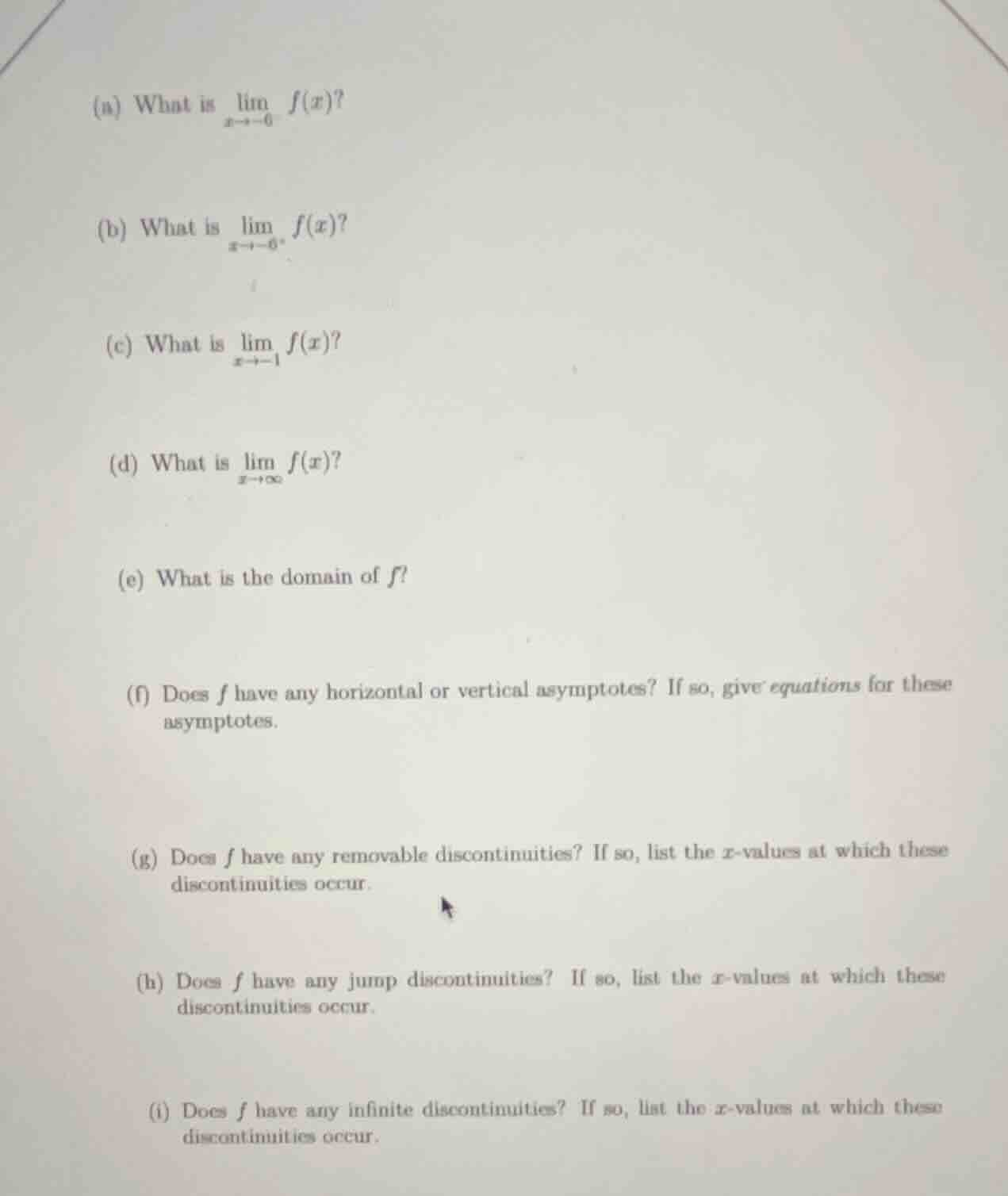
(a) what is $limlimits_{x\to -6^{-}} f(x)$?
(b) what is $limlimits_{x\to -6^{+}} f(x)$?
(c) what is $limlimits_{x\to -1} f(x)$?
(d) what is $limlimits_{x\to infty} f(x)$?
(e) what is the domain of $f$?
(f) does $f$ have any horizontal or vertical asymptotes? if so, give equations for these asymptotes.
(g) does $f$ have any removable discontinuities? if so, list the $x$-values at which these discontinuities occur.
(h) does $f$ have any jump discontinuities? if so, list the $x$-values at which these discontinuities occur.
(i) does $f$ have any infinite discontinuities? if so, list the $x$-values at which these discontinuities occur.
To solve these problems, we need the graph of the function \( f(x) \). Since the graph is not provided, we can only explain the general methods to solve each part:
Part (a): \( \lim_{x \to -6^-} f(x) \)
- Explanation: As \( x \) approaches \( -6 \) from the left (values less than \( -6 \)), we look at the \( y \)-value the function approaches.
- Method: On the graph, trace the curve from the left side of \( x = -6 \) towards \( x = -6 \) and find the corresponding \( y \)-value.
Part (b): \( \lim_{x \to -6^+} f(x) \)
- Explanation: As \( x \) approaches \( -6 \) from the right (values greater than \( -6 \)), we look at the \( y \)-value the function approaches.
- Method: On the graph, trace the curve from the right side of \( x = -6 \) towards \( x = -6 \) and find the corresponding \( y \)-value.
Part (c): \( \lim_{x \to -1} f(x) \)
- Explanation: For the limit as \( x \) approaches \( -1 \) to exist, the left-hand limit (\( \lim_{x \to -1^-} f(x) \)) and the right-hand limit (\( \lim_{x \to -1^+} f(x) \)) must be equal. We find these two limits and check if they are the same.
- Method: Trace the curve from the left and right of \( x = -1 \) towards \( x = -1 \) and see if the \( y \)-values match. If they do, that is the limit; if not, the limit does not exist.
Part (d): \( \lim_{x \to \infty} f(x) \)
- Explanation: As \( x \) becomes very large (approaches infinity), we look at the horizontal asymptote (if any) or the behavior of the function.
- Method: Observe the graph as \( x \) increases without bound. If the function approaches a horizontal line \( y = L \), then \( \lim_{x \to \infty} f(x) = L \).
Part (e): Domain of \( f \)
- Explanation: The domain is all \( x \)-values for which the function is defined (has a point on the graph).
- Method: Identify all \( x \)-values where there is a point on the graph. Exclude any \( x \)-values where there is a vertical asymptote or a hole (but holes are still in the domain if we consider removable discontinuities, but typically, the domain excludes \( x \)-values where the function is undefined, like vertical asymptotes).
Part (f): Horizontal and Vertical Asymptotes
- Horizontal Asymptotes: These are horizontal lines \( y = L \) that the function approaches as \( x \to \infty \) or \( x \to -\infty \).
- Vertical Asymptotes: These are vertical lines \( x = a \) where the function approaches \( \pm \infty \) as \( x \to a^- \) or \( x \to a^+ \).
- Method:
- For horizontal asymptotes, check the behavior as \( x \to \infty \) and \( x \to -\infty \).
- For vertical asymptotes, check where the function has infinite discontinuities (e.g., where the graph goes to \( \pm \infty \)).
Part (g): Removable Discontinuities
- Explanation: A removable discontinuity (hole) occurs when the function has a single point missing (a hole) but the left and right limits exist and are equal.
- Method: Look for \( x \)-values where there is a hole (an open circle) on the graph, and the left and right limits at that \( x \)-value are equal.
Part (h): Jump Discontinuities
- Explanation: A jump discontinuity occurs when the left-hand limit and right-hand limit exist but are not equal.
- Method: Look for \( x \)-values where the graph "jumps" from one \( y \)-value to another as \( x \) approaches that value (left and right limits exist but are different).
Part (i): Infinite Discontinuities
- Explanation: An infinite discontinuity occurs when the function approaches \( \pm \infty \) as \( x \)…

Snap & solve any problem in the app
Get step-by-step solutions on Sovi AI
Photo-based solutions with guided steps
Explore more problems and detailed explanations
To solve these problems, we need the graph of the function \( f(x) \). Since the graph is not provided, we can only explain the general methods to solve each part:
Part (a): \( \lim_{x \to -6^-} f(x) \)
- Explanation: As \( x \) approaches \( -6 \) from the left (values less than \( -6 \)), we look at the \( y \)-value the function approaches.
- Method: On the graph, trace the curve from the left side of \( x = -6 \) towards \( x = -6 \) and find the corresponding \( y \)-value.
Part (b): \( \lim_{x \to -6^+} f(x) \)
- Explanation: As \( x \) approaches \( -6 \) from the right (values greater than \( -6 \)), we look at the \( y \)-value the function approaches.
- Method: On the graph, trace the curve from the right side of \( x = -6 \) towards \( x = -6 \) and find the corresponding \( y \)-value.
Part (c): \( \lim_{x \to -1} f(x) \)
- Explanation: For the limit as \( x \) approaches \( -1 \) to exist, the left-hand limit (\( \lim_{x \to -1^-} f(x) \)) and the right-hand limit (\( \lim_{x \to -1^+} f(x) \)) must be equal. We find these two limits and check if they are the same.
- Method: Trace the curve from the left and right of \( x = -1 \) towards \( x = -1 \) and see if the \( y \)-values match. If they do, that is the limit; if not, the limit does not exist.
Part (d): \( \lim_{x \to \infty} f(x) \)
- Explanation: As \( x \) becomes very large (approaches infinity), we look at the horizontal asymptote (if any) or the behavior of the function.
- Method: Observe the graph as \( x \) increases without bound. If the function approaches a horizontal line \( y = L \), then \( \lim_{x \to \infty} f(x) = L \).
Part (e): Domain of \( f \)
- Explanation: The domain is all \( x \)-values for which the function is defined (has a point on the graph).
- Method: Identify all \( x \)-values where there is a point on the graph. Exclude any \( x \)-values where there is a vertical asymptote or a hole (but holes are still in the domain if we consider removable discontinuities, but typically, the domain excludes \( x \)-values where the function is undefined, like vertical asymptotes).
Part (f): Horizontal and Vertical Asymptotes
- Horizontal Asymptotes: These are horizontal lines \( y = L \) that the function approaches as \( x \to \infty \) or \( x \to -\infty \).
- Vertical Asymptotes: These are vertical lines \( x = a \) where the function approaches \( \pm \infty \) as \( x \to a^- \) or \( x \to a^+ \).
- Method:
- For horizontal asymptotes, check the behavior as \( x \to \infty \) and \( x \to -\infty \).
- For vertical asymptotes, check where the function has infinite discontinuities (e.g., where the graph goes to \( \pm \infty \)).
Part (g): Removable Discontinuities
- Explanation: A removable discontinuity (hole) occurs when the function has a single point missing (a hole) but the left and right limits exist and are equal.
- Method: Look for \( x \)-values where there is a hole (an open circle) on the graph, and the left and right limits at that \( x \)-value are equal.
Part (h): Jump Discontinuities
- Explanation: A jump discontinuity occurs when the left-hand limit and right-hand limit exist but are not equal.
- Method: Look for \( x \)-values where the graph "jumps" from one \( y \)-value to another as \( x \) approaches that value (left and right limits exist but are different).
Part (i): Infinite Discontinuities
- Explanation: An infinite discontinuity occurs when the function approaches \( \pm \infty \) as \( x \) approaches a value (vertical asymptote).
- Method: Look for \( x \)-values where the graph goes to \( \pm \infty \) (vertical asymptotes).
Since the graph is not provided, we cannot give numerical answers. Please provide the graph of \( f(x) \) to get the specific solutions.