QUESTION IMAGE
Question
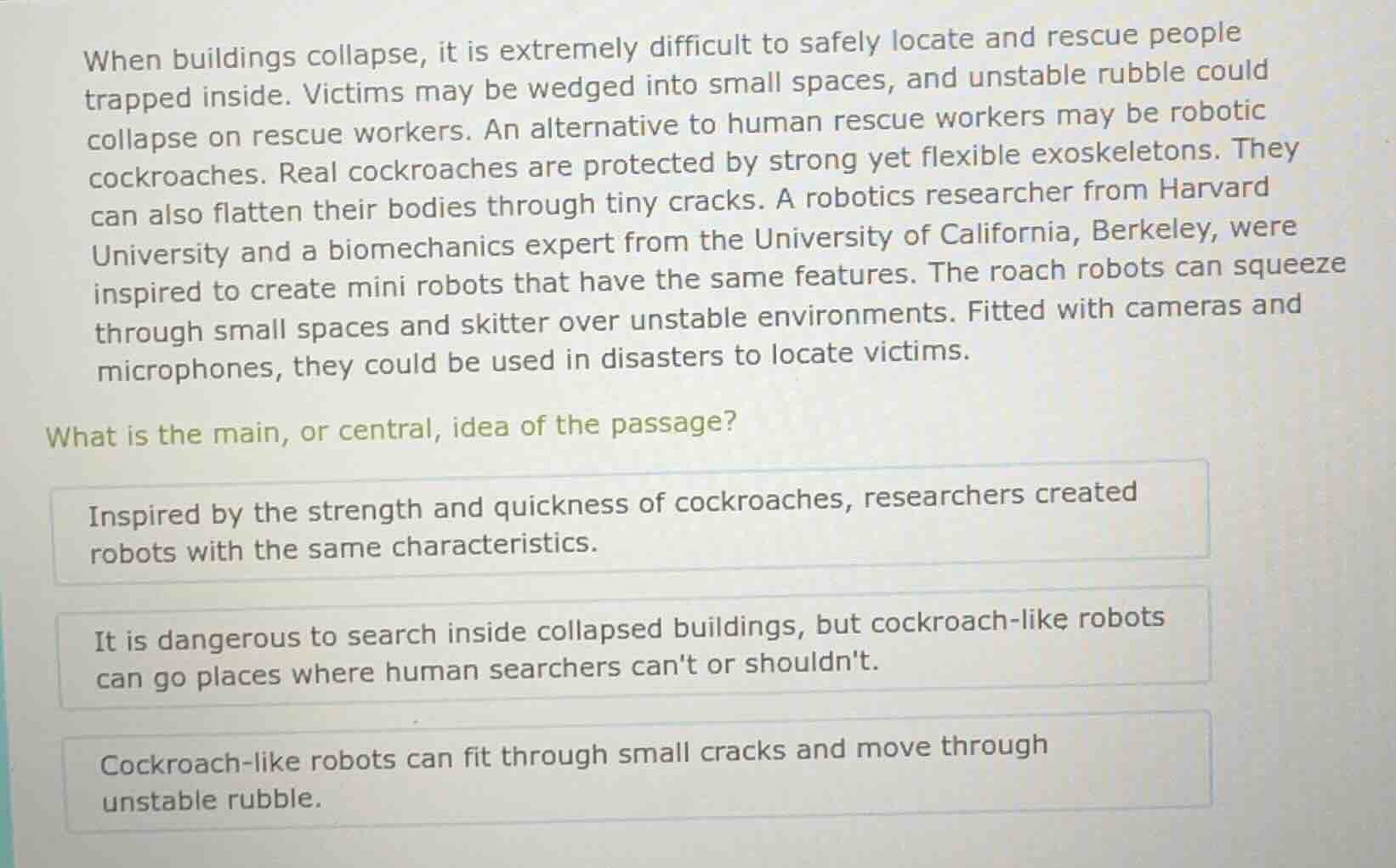
when buildings collapse, it is extremely difficult to safely locate and rescue people trapped inside. victims may be wedged into small spaces, and unstable rubble could collapse on rescue workers. an alternative to human rescue workers may be robotic cockroaches. real cockroaches are protected by strong yet flexible exoskeletons. they can also flatten their bodies through tiny cracks. a robotics researcher from harvard university and a biomechanics expert from the university of california, berkeley, were inspired to create mini robots that have the same features. the roach robots can squeeze through small spaces and skitter over unstable environments. fitted with cameras and microphones, they could be used in disasters to locate victims.
what is the main, or central, idea of the passage?
inspired by the strength and quickness of cockroaches, researchers created robots with the same characteristics.
it is dangerous to search inside collapsed buildings, but cockroach - like robots can go places where human searchers cant or shouldnt.
cockroach - like robots can fit through small cracks and move through unstable rubble.
The passage first outlines the dangers and challenges of rescuing people in collapsed buildings, then introduces cockroach-like robots as a solution, explaining they are inspired by real cockroaches' physical traits and can access areas unsafe or unreachable for human rescuers to locate victims. The first option only covers the creation inspiration, missing the rescue context. The third option only details a feature of the robots, not the overarching purpose. The second option captures both the problem of dangerous collapsed building searches and the robots' unique utility as an alternative.

Snap & solve any problem in the app
Get step-by-step solutions on Sovi AI
Photo-based solutions with guided steps
Explore more problems and detailed explanations
It is dangerous to search inside collapsed buildings, but cockroach-like robots can go places where human searchers can't or shouldn't.