QUESTION IMAGE
Question
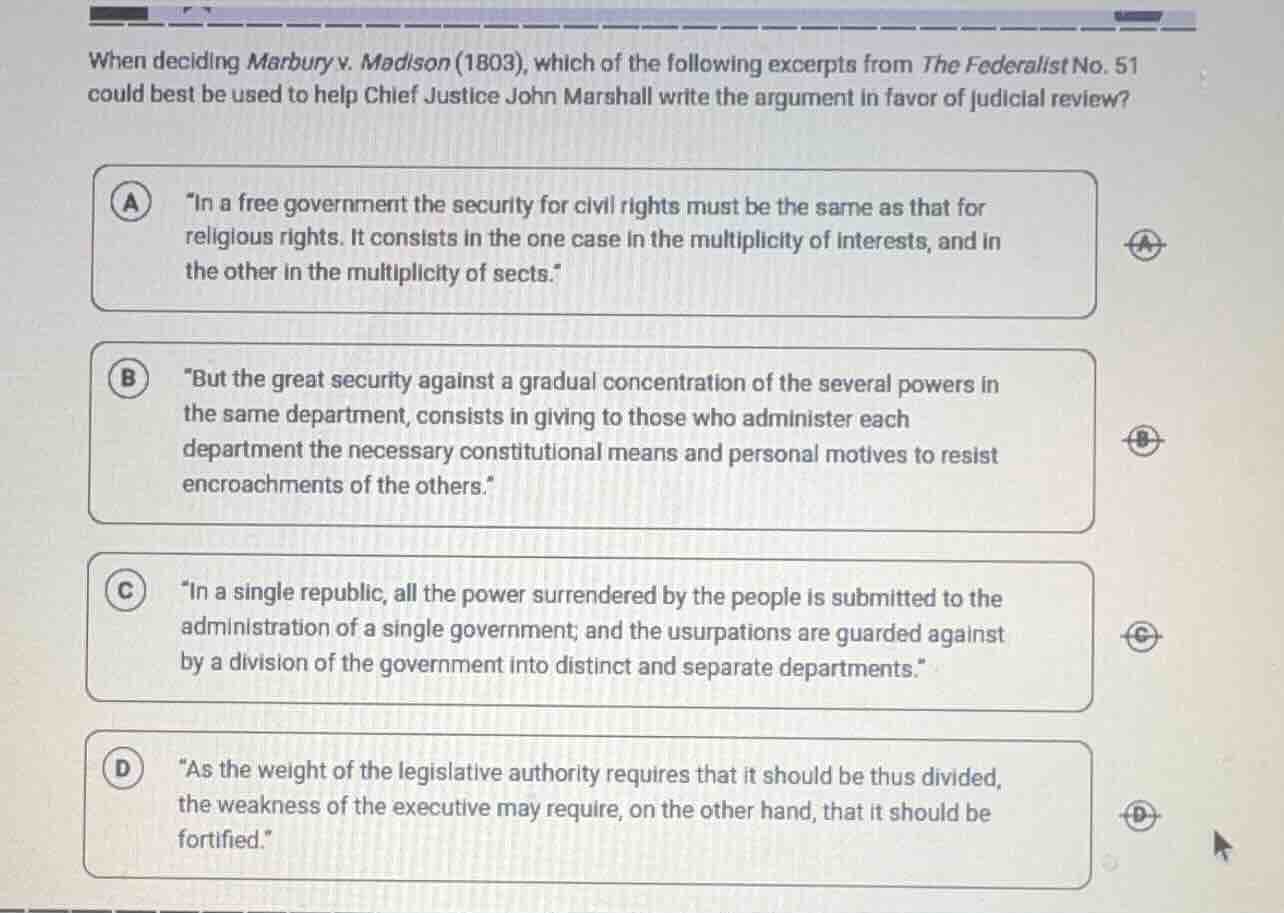
when deciding marbury v. madison (1803), which of the following excerpts from the federalist no. 51 could best be used to help chief justice john marshall write the argument in favor of judicial review?
a \in a free government the security for civil rights must be the same as that for religious rights. it consists in the one case in the multiplicity of interests, and in the other in the multiplicity of sects.\
b \but the great security against a gradual concentration of the several powers in the same department, consists in giving to those who administer each department the necessary constitutional means and personal motives to resist encroachments of the others.\
c \in a single republic, all the power surrendered by the people is submitted to the administration of a single government; and the usurpations are guarded against by a division of the government into distinct and separate departments.\
d \as the weight of the legislative authority requires that it should be thus divided, the weakness of the executive may require, on the other hand, that it should be fortified.\
Judicial review, established in Marbury v. Madison, centers on the judiciary's power to check other branches' constitutional overreach. The Federalist No. 51 excerpt that supports this must relate to inter-branch checks and balances. Option B focuses on giving each government department the means to resist encroachments from others, which directly aligns with the judiciary's role of reviewing and pushing back against unconstitutional acts by the legislative or executive branches. The other options address civil/religious rights (A), separation of powers generally (C), and legislative/executive structure (D), which do not directly support the argument for judicial review.

Snap & solve any problem in the app
Get step-by-step solutions on Sovi AI
Photo-based solutions with guided steps
Explore more problems and detailed explanations
B. "But the great security against a gradual concentration of the several powers in the same department, consists in giving to those who administer each department the necessary constitutional means and personal motives to resist encroachments of the others."