QUESTION IMAGE
Question
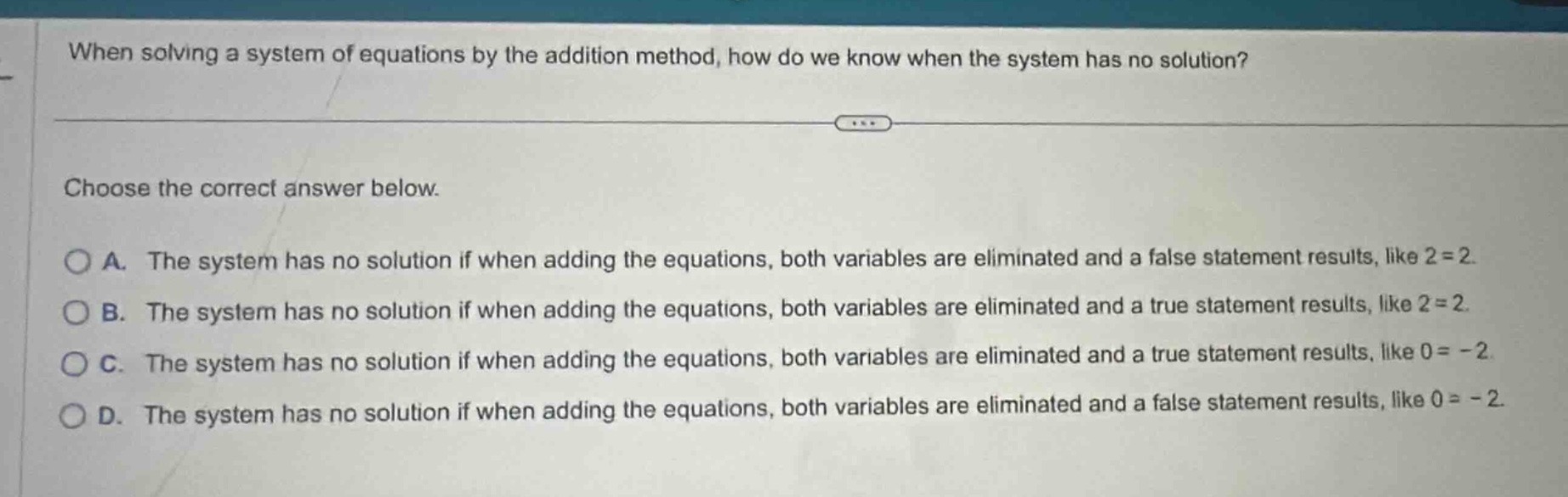
when solving a system of equations by the addition method, how do we know when the system has no solution? choose the correct answer below. a. the system has no solution if when adding the equations, both variables are eliminated and a false statement results, like 2 = 2. b. the system has no solution if when adding the equations, both variables are eliminated and a true statement results, like 2 = 2. c. the system has no solution if when adding the equations, both variables are eliminated and a true statement results, like 0 = -2. d. the system has no solution if when adding the equations, both variables are eliminated and a false statement results, like 0 = -2.
To determine when a system of equations has no solution using the addition method, we analyze the results after eliminating variables:
- A true statement (e.g., \(2 = 2\) or \(0 = 0\)) after eliminating variables means the system has infinitely many solutions (the equations are dependent).
- A false statement (e.g., \(0=-2\)) after eliminating variables means the system is inconsistent and has no solution (the lines are parallel and never intersect).
Now let's evaluate each option:
- Option A: Claims a false statement like \(2 = 2\) (but \(2 = 2\) is true) indicates no solution. Incorrect.
- Option B: Claims a true statement like \(2 = 2\) indicates no solution. But a true statement means infinitely many solutions. Incorrect.
- Option C: Claims a true statement like \(0=-2\) (but \(0=-2\) is false) indicates no solution. Contradictory. Incorrect.
- Option D: Correctly states that when both variables are eliminated and a false statement (e.g., \(0=-2\)) results, the system has no solution.

Snap & solve any problem in the app
Get step-by-step solutions on Sovi AI
Photo-based solutions with guided steps
Explore more problems and detailed explanations
D. The system has no solution if when adding the equations, both variables are eliminated and a false statement results, like \(0 = -2\).