QUESTION IMAGE
Question
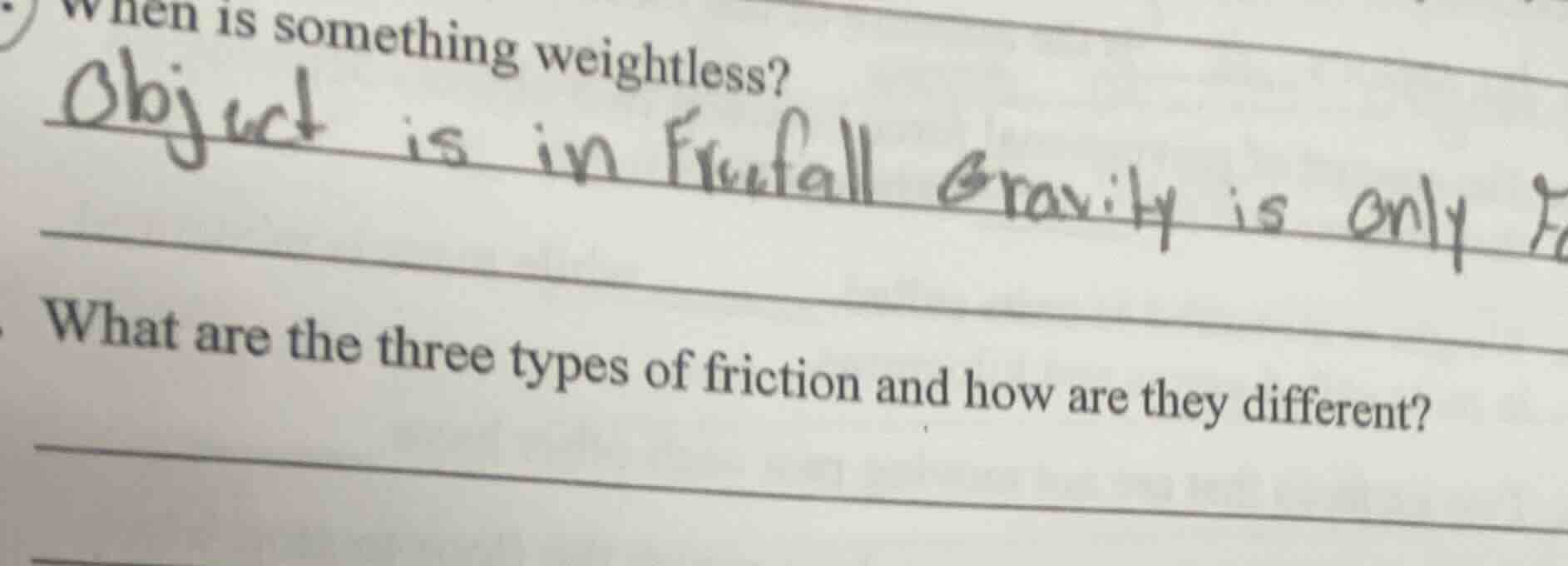
when is something weightless?
what are the three types of friction and how are they different?
First Question (When is something weightless?):
Weightlessness occurs when an object is in free - fall (where the only force acting on it is gravity, and it has no normal force acting on it, like in a falling elevator or an orbiting spacecraft) or in a state of zero - gravity (such as in deep space far from gravitational sources). The hand - written answer starts to explain it in terms of free - fall.
The three main types of friction are static friction, sliding (kinetic) friction, and rolling friction. Static friction acts on an object at rest, opposing the force that tries to set it in motion. It has a maximum value (the limiting friction) and can vary from 0 up to that maximum. Sliding friction acts on an object that is sliding over a surface. It is generally less than the maximum static friction and is relatively constant for a given pair of surfaces and normal force. Rolling friction acts on an object that is rolling over a surface (like a wheel on the ground). It is much smaller than sliding friction because the area of contact and the nature of the interaction (deformation of the surface and the rolling object) are different from sliding.

Snap & solve any problem in the app
Get step-by-step solutions on Sovi AI
Photo-based solutions with guided steps
Explore more problems and detailed explanations
An object is weightless when it is in free - fall (where the gravitational force is the only significant force acting on it and there is no normal force opposing gravity, e.g., in a falling elevator, a spacecraft in orbit, or in deep space with negligible gravitational influence).