QUESTION IMAGE
Question
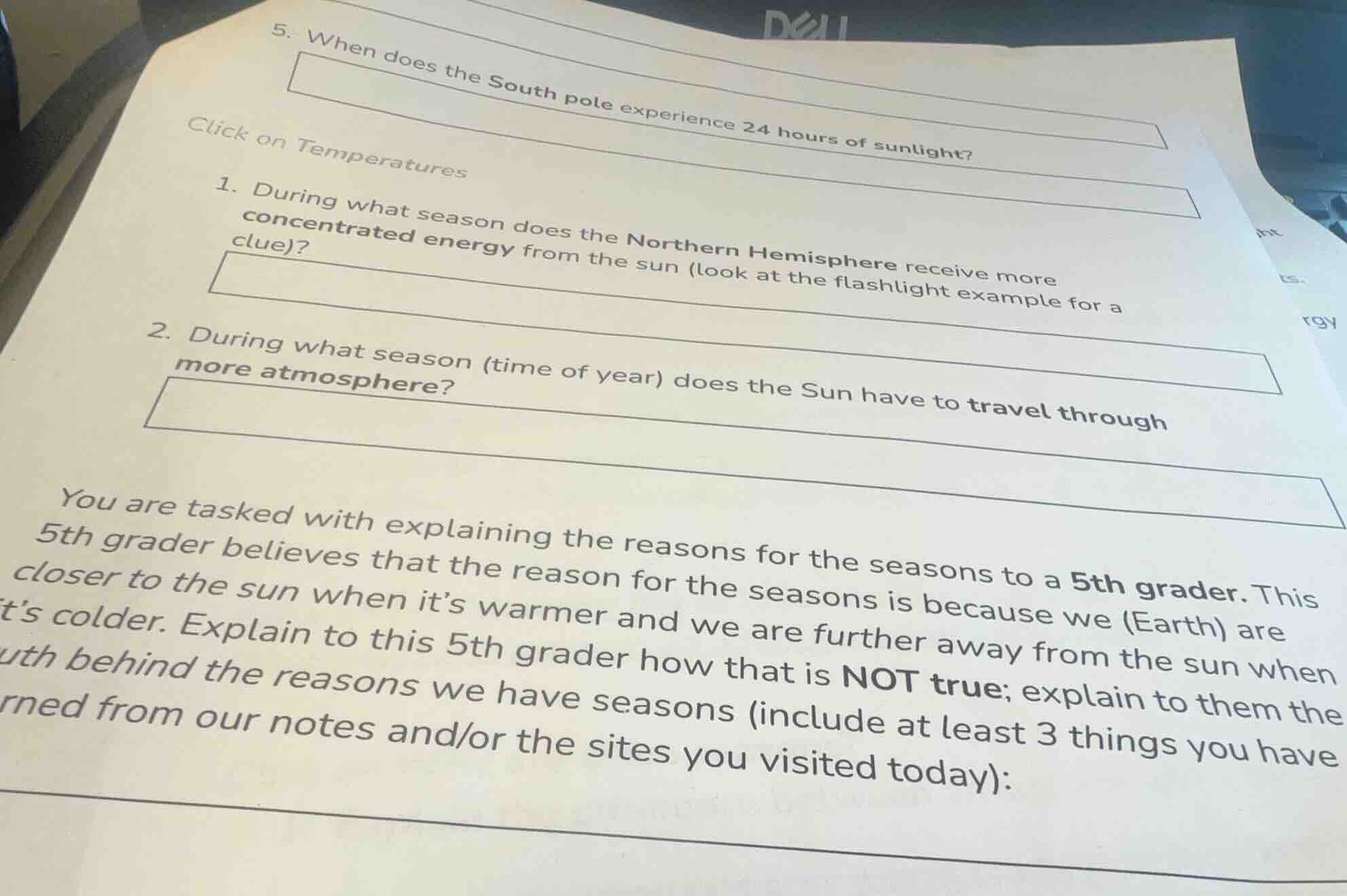
- when does the south pole experience 24 hours of sunlight? click on temperatures 1. during what season does the northern hemisphere receive more concentrated energy from the sun (look at the flashlight example for a clue)? 2. during what season (time of year) does the sun have to travel through more atmosphere? you are tasked with explaining the reasons for the seasons to a 5th grader. this 5th grader believes that the reason for the seasons is because we (earth) are closer to the sun when it’s warmer and we are further away from the sun when it’s colder. explain to this 5th grader how that is not true; explain to them the truth behind the reasons we have seasons (include at least 3 things you have learned from our notes and/or the sites you visited today):
Brief Explanations
- For the South Pole's 24-hour sunlight: Earth's tilt means when the Southern Hemisphere is tilted toward the Sun, the South Pole is in constant daylight, which happens during the Southern Hemisphere's summer (Northern Hemisphere's winter).
- For Northern Hemisphere's concentrated solar energy: When the Northern Hemisphere is tilted toward the Sun, sunlight hits at a steeper angle, concentrating energy, which is summer.
- For Sun traveling through more atmosphere: When the Northern Hemisphere is tilted away from the Sun, sunlight hits at a shallow angle, traveling through a thicker layer of atmosphere, which is winter.
- For correcting the 5th grader:
- First, Earth's orbit is nearly circular, so distance to the Sun changes very little (only about 3 million miles, which is negligible for temperature).
- Second, seasons come from Earth's 23.5° tilt: when a hemisphere tilts toward the Sun, sunlight is more concentrated (like a flashlight pointed straight at paper, making a bright, small spot) and days are longer, bringing more warmth.
- Third, when a hemisphere tilts away, sunlight is spread out (flashlight tilted, making a dim, big spot) and days are shorter, leading to colder temperatures. Also, when it's summer in the Northern Hemisphere, Earth is actually slightly farther from the Sun, which proves distance isn't the cause.

Snap & solve any problem in the app
Get step-by-step solutions on Sovi AI
Photo-based solutions with guided steps
Explore more problems and detailed explanations
- Southern Hemisphere Summer (Northern Hemisphere Winter, roughly December to February)
- Northern Hemisphere Summer (roughly June to August)
- Northern Hemisphere Winter (roughly December to February)
- (As explained above: Earth's orbit is nearly circular, so distance doesn't drive seasons; seasons come from Earth's 23.5° tilt causing concentrated/spread-out sunlight and longer/shorter days; Northern Hemisphere summer occurs when Earth is slightly farther from the Sun, disproving the distance idea.)