QUESTION IMAGE
Question
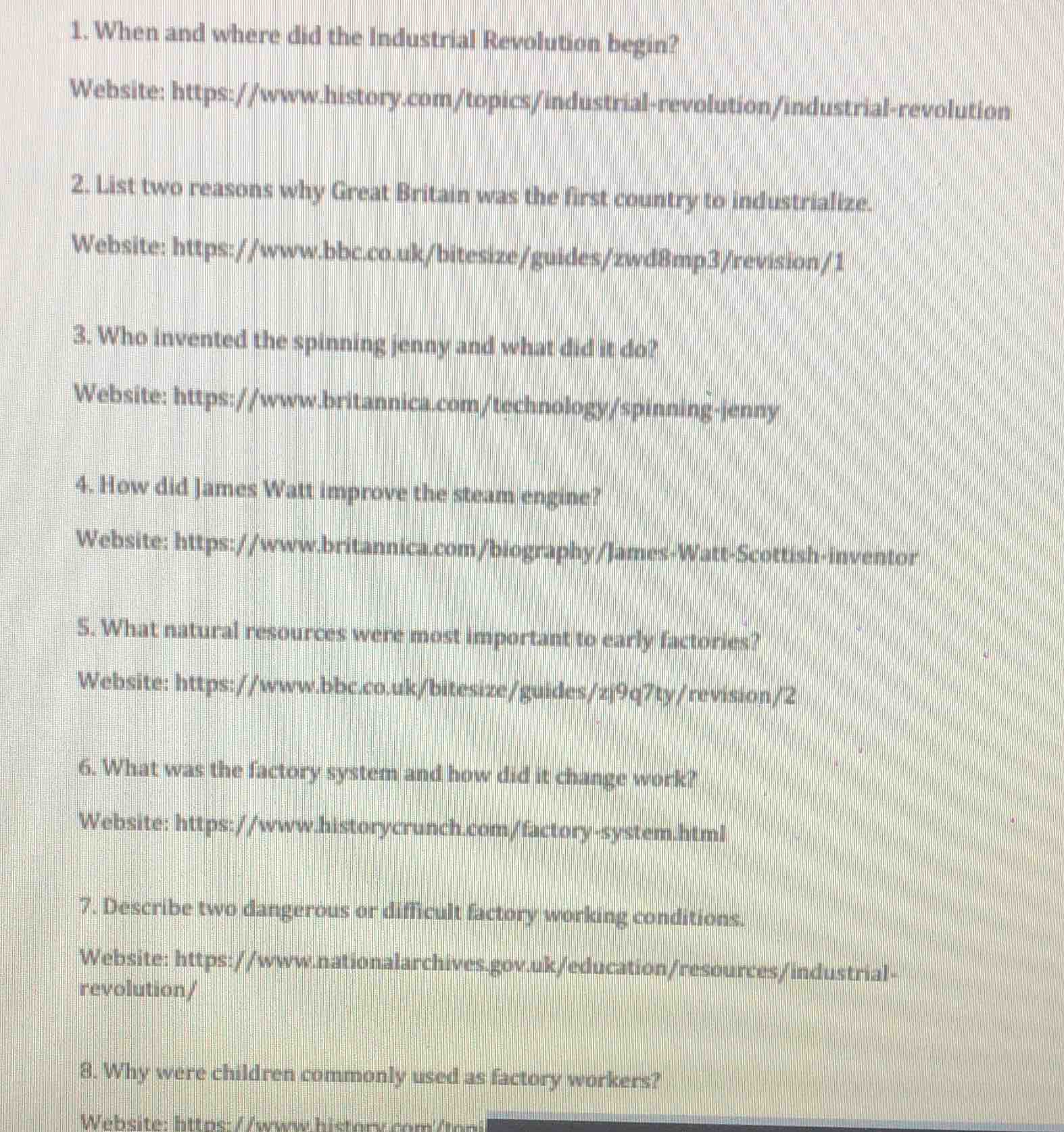
- when and where did the industrial revolution begin?website: https://www.history.com/topics/industrial-revolution/industrial-revolution2. list two reasons why great britain was the first country to industrialize.website: https://www.bbc.co.uk/bitesize/guides/zwd8mp3/revision/13. who invented the spinning jenny and what did it do?website: https://www.britannica.com/technology/spinning-jenny4. how did james watt improve the steam engine?website: https://www.britannica.com/biography/james-watt-scottish-inventor5. what natural resources were most important to early factories?website: https://www.bbc.co.uk/bitesize/guides/zj9q7ty/revision/26. what was the factory system and how did it change work?website: https://www.historycrunch.com/factory-system.html7. describe two dangerous or difficult factory working conditions.website: https://www.nationalarchives.gov.uk/education/resources/industrial-revolution/8. why were children commonly used as factory workers?website: https://www.history.com/topi
Brief Explanations
- Sourced from the provided history site, the Industrial Revolution's origins are documented as starting in this time and location.
- The BBC Bitesize source identifies these key factors enabling Britain's early industrialization.
- Britannica's entry on the spinning jenny confirms the inventor and the machine's function.
- Britannica's biography of James Watt details this critical improvement to the steam engine.
- The BBC Bitesize resource lists these as the core natural resources for early factories.
- The History Crunch source defines the factory system and outlines its impact on labor.
- The National Archives resource describes these harsh conditions of early factory work.
- Historical resources confirm these were the primary motivations for child labor in factories.

Snap & solve any problem in the app
Get step-by-step solutions on Sovi AI
Photo-based solutions with guided steps
Explore more problems and detailed explanations
- The Industrial Revolution began in the 1760s in Great Britain (specifically in the textile industry of England).
- - Great Britain had abundant supplies of coal and iron, critical resources for industrial machinery and energy.
- It had a large colonial empire that provided access to raw materials and a huge market for manufactured goods.
- The spinning jenny was invented by James Hargreaves. It was a multi-spindle spinning frame that allowed a single worker to spin multiple threads at once, greatly increasing the production of yarn for textiles.
- James Watt added a separate condenser to the Newcomen steam engine. This innovation prevented the main cylinder from cooling down with each cycle, making the engine far more efficient, using less coal and producing more power, which made it viable for widespread industrial use.
- The most important natural resources for early factories were coal (for energy to power machinery), iron (for making machinery, tools, and factory structures), and water (for early water-powered mills and later for steam engine cooling).
- The factory system was a method of manufacturing that centralized production in a single, large facility with specialized machinery, rather than in home-based workshops. It changed work by:
- Standardizing work hours and imposing strict discipline on workers, who had to follow set schedules instead of setting their own pace.
- Separating workers from the means of production; they no longer owned their tools or materials, and instead sold their labor for wages.
- - Unsafe machinery: Factories had unguarded moving parts, and workers (including children) often suffered severe injuries like crushed limbs or scalping when they came into contact with the equipment.
- Extreme working hours: Workers typically labored 12-16 hours a day, 6 days a week, with very few breaks, leading to extreme fatigue and increased risk of accidents.
- - Children were paid much lower wages than adult workers, making them a cheap source of labor for factory owners looking to cut costs.
- Their small size allowed them to access tight spaces in machinery (like reaching into spinning machines to clear jams) that adult workers could not, making them useful for specific tasks.