QUESTION IMAGE
Question
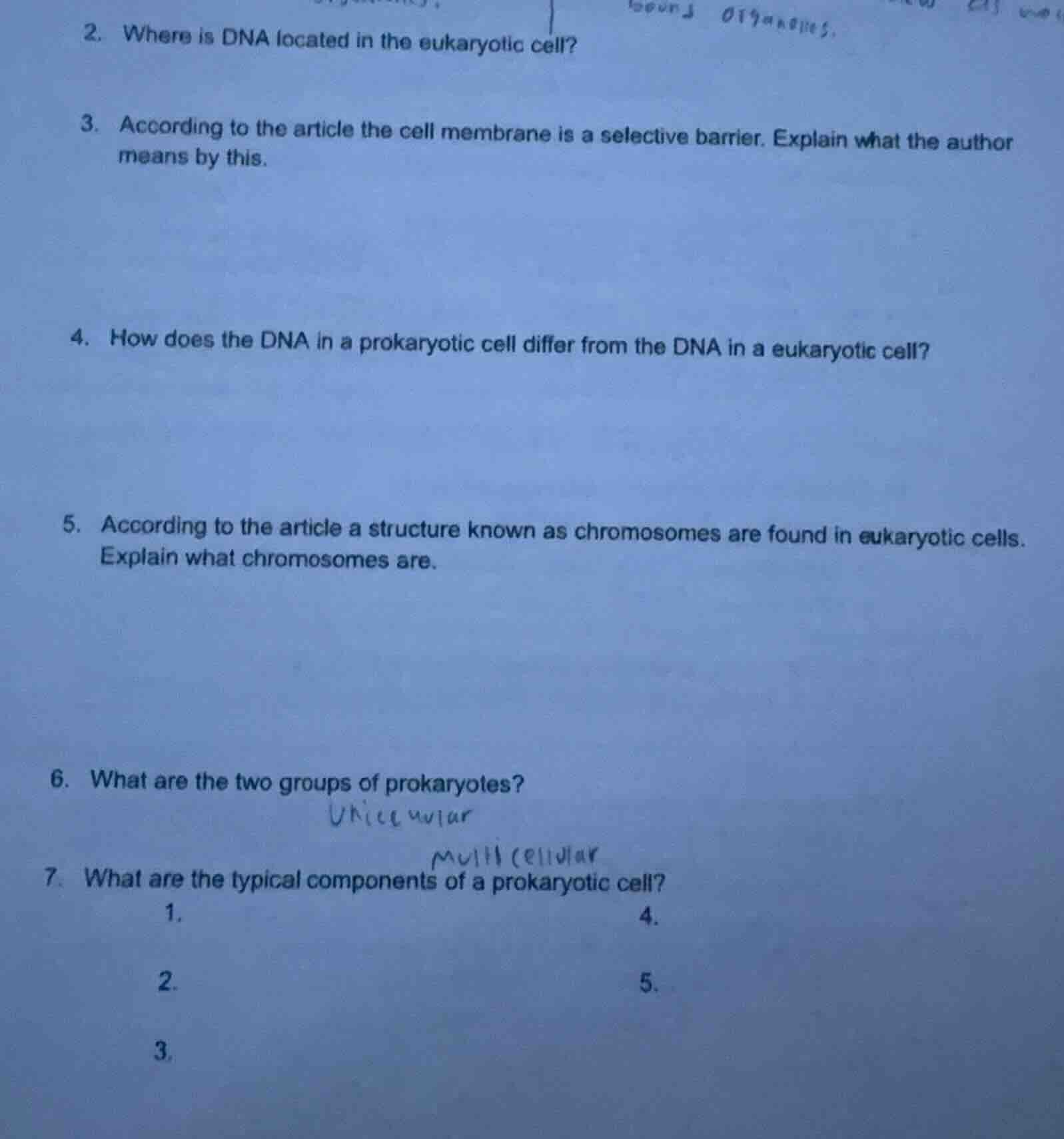
- where is dna located in the eukaryotic cell?
- according to the article the cell membrane is a selective barrier. explain what the author means by this.
- how does the dna in a prokaryotic cell differ from the dna in a eukaryotic cell?
- according to the article a structure known as chromosomes are found in eukaryotic cells. explain what chromosomes are.
- what are the two groups of prokaryotes?
- what are the typical components of a prokaryotic cell?
- \t\t\t\t\t4.
- \t\t\t\t\t5.
3.
Brief Explanations
- Eukaryotic cells have membrane-bound organelles that house DNA.
- A selective barrier regulates passage of substances.
- Prokaryotic and eukaryotic DNA differ in location and structure.
- Chromosomes package DNA with proteins for cell processes.
- Prokaryotes are split into two main evolutionary groups.
- Prokaryotic cells have core structural and functional components.

Snap & solve any problem in the app
Get step-by-step solutions on Sovi AI
Photo-based solutions with guided steps
Explore more problems and detailed explanations
- Most of the DNA is located in the nucleus (a membrane-bound organelle). Small amounts of DNA can also be found in mitochondria and chloroplasts (in photosynthetic eukaryotes).
- This means the cell membrane controls which substances can move into and out of the cell. It allows necessary molecules like nutrients and water to pass through, while blocking harmful substances or retaining essential molecules inside the cell; some substances move passively, others require energy-based transport.
- - Location: Prokaryotic DNA is in the cytoplasm (in a region called the nucleoid, no surrounding membrane), while eukaryotic DNA is mostly enclosed in a nucleus.
- Structure: Prokaryotic DNA is typically a single, circular chromosome, while eukaryotic DNA is organized into multiple linear chromosomes. Prokaryotes may also have small circular DNA fragments called plasmids, which are less common in eukaryotes.
- Chromosomes are thread-like structures made of tightly coiled DNA molecules wrapped around proteins called histones. They contain the genetic information (genes) that determine an organism's traits, and they become visible during cell division when they condense.
- The two groups of prokaryotes are Bacteria and Archaea.
- Typical components of a prokaryotic cell:
- Cell membrane
- Cell wall
- Cytoplasm
- Nucleoid (region with circular DNA)
- Ribosomes