QUESTION IMAGE
Question
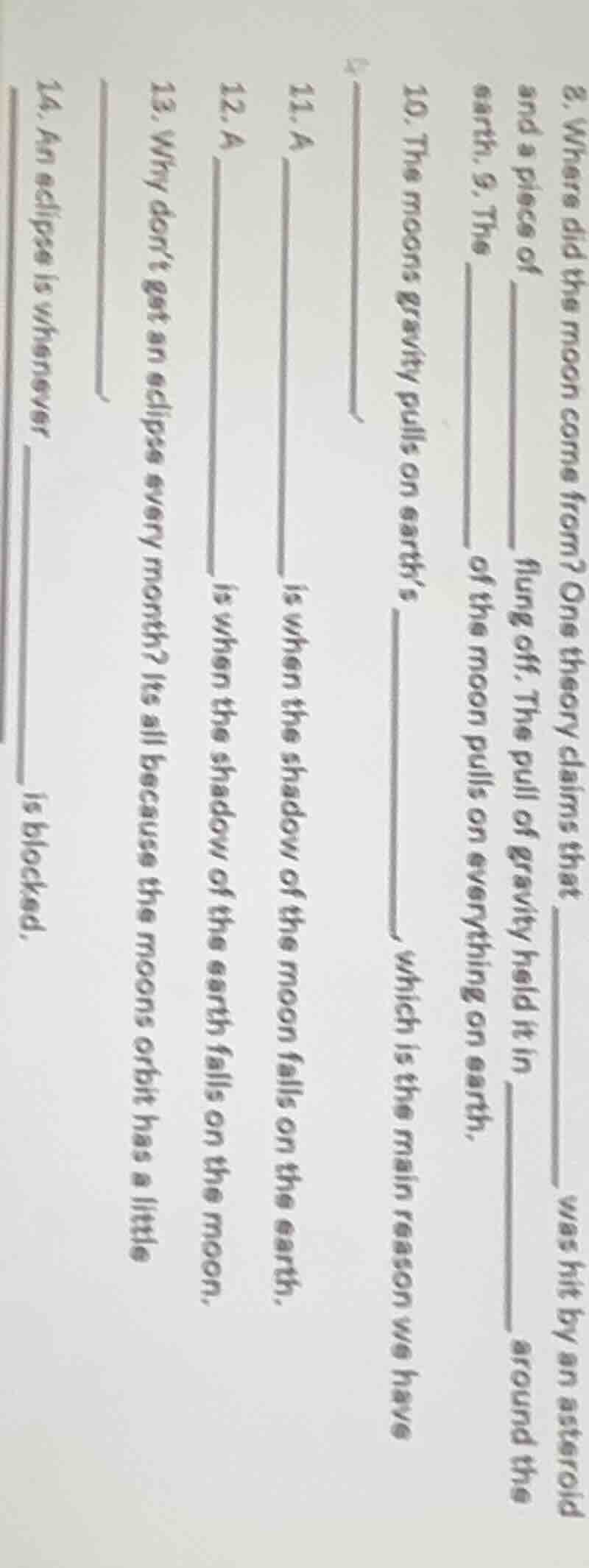
- where did the moon come from? one theory claims that __ was hit by an asteroid and a piece of flung off. the pull of gravity held it in around the earth. 9. the of the moon pulls on everything on earth. 10. the moon’s gravity pulls on earth’s , which is the main reason we have . 11. a is when the shadow of the moon falls on the earth. 12. a is when the shadow of the earth falls on the moon. 13. why don’t we get an eclipse every month? it’s all because the moon’s orbit has a little . 14. an eclipse is whenever __ is blocked.
To solve these fill - in - the - blank questions about the moon, we can use our knowledge of astronomy (a sub - field of Natural Science: Physics or Geography can also be related, but Astronomy is more specific here) to determine the appropriate words.
Question 8
One theory about the origin of the moon is the giant - impact hypothesis. In this theory, the moon was formed when the early Earth (which we can refer to as "it" here) was hit by an asteroid - like object (a planetesimal), and a piece of "it" (the Earth) was flung off. So the blanks should be filled as: 8. Where did the moon come from? One theory claims that it was hit by an asteroid and a piece of it flung off. The pull of gravity held it in orbit around the earth.
Question 9
The moon exerts a force on everything on Earth, and this force is called gravity. Specifically, the "gravity" of the moon pulls on everything on earth. So: 9. The gravity of the moon pulls on everything on earth.
Question 10
The moon's gravity also pulls on the Earth's "oceans", and this is the main reason we have "tides". So: 10. The moon's gravity pulls on earth's oceans, which is the main reason we have tides.
Question 11
A solar eclipse occurs when the shadow of the moon falls on the earth. So: 11. A solar eclipse is when the shadow of the moon falls on the earth.
Question 12
A lunar eclipse is when the shadow of the earth falls on the moon. So: 12. A lunar eclipse is when the shadow of the earth falls on the moon.
Question 13
Why don't we get an eclipse every month? It's all because the moon's orbit has a little "tilt" (the moon's orbit is tilted relative to the Earth - Sun plane). So: 13. Why don't get an eclipse every month? Its all because the moons orbit has a little tilt.
Question 14
An eclipse is whenever the "light" from the sun (in the case of a solar eclipse, the sun's light is blocked by the moon; in the case of a lunar eclipse, the sun's light that reaches the moon is blocked by the Earth) is blocked. So: 14. An eclipse is whenever the sun's light is blocked.
Final Answers (Filled Blanks)
- Where did the moon come from? One theory claims that \(\boldsymbol{\text{it}}\) was hit by an asteroid and a piece of \(\boldsymbol{\text{it}}\) flung off. The pull of gravity held it in \(\boldsymbol{\text{orbit}}\) around the earth.
- The \(\boldsymbol{\text{gravity}}\) of the moon pulls on everything on earth.
- The moon's gravity pulls on earth's \(\boldsymbol{\text{oceans}}\), which is the main reason we have \(\boldsymbol{\text{tides}}\).
- A \(\boldsymbol{\text{solar eclipse}}\) is when the shadow of the moon falls on the earth.
- A \(\boldsymbol{\text{lunar eclipse}}\) is when the shadow of the earth falls on the moon.
- Why don't get an eclipse every month? Its all because the moons orbit has a little \(\boldsymbol{\text{tilt}}\).
- An eclipse is whenever \(\boldsymbol{\text{the sun's light}}\) is blocked.

Snap & solve any problem in the app
Get step-by-step solutions on Sovi AI
Photo-based solutions with guided steps
Explore more problems and detailed explanations
To solve these fill - in - the - blank questions about the moon, we can use our knowledge of astronomy (a sub - field of Natural Science: Physics or Geography can also be related, but Astronomy is more specific here) to determine the appropriate words.
Question 8
One theory about the origin of the moon is the giant - impact hypothesis. In this theory, the moon was formed when the early Earth (which we can refer to as "it" here) was hit by an asteroid - like object (a planetesimal), and a piece of "it" (the Earth) was flung off. So the blanks should be filled as: 8. Where did the moon come from? One theory claims that it was hit by an asteroid and a piece of it flung off. The pull of gravity held it in orbit around the earth.
Question 9
The moon exerts a force on everything on Earth, and this force is called gravity. Specifically, the "gravity" of the moon pulls on everything on earth. So: 9. The gravity of the moon pulls on everything on earth.
Question 10
The moon's gravity also pulls on the Earth's "oceans", and this is the main reason we have "tides". So: 10. The moon's gravity pulls on earth's oceans, which is the main reason we have tides.
Question 11
A solar eclipse occurs when the shadow of the moon falls on the earth. So: 11. A solar eclipse is when the shadow of the moon falls on the earth.
Question 12
A lunar eclipse is when the shadow of the earth falls on the moon. So: 12. A lunar eclipse is when the shadow of the earth falls on the moon.
Question 13
Why don't we get an eclipse every month? It's all because the moon's orbit has a little "tilt" (the moon's orbit is tilted relative to the Earth - Sun plane). So: 13. Why don't get an eclipse every month? Its all because the moons orbit has a little tilt.
Question 14
An eclipse is whenever the "light" from the sun (in the case of a solar eclipse, the sun's light is blocked by the moon; in the case of a lunar eclipse, the sun's light that reaches the moon is blocked by the Earth) is blocked. So: 14. An eclipse is whenever the sun's light is blocked.
Final Answers (Filled Blanks)
- Where did the moon come from? One theory claims that \(\boldsymbol{\text{it}}\) was hit by an asteroid and a piece of \(\boldsymbol{\text{it}}\) flung off. The pull of gravity held it in \(\boldsymbol{\text{orbit}}\) around the earth.
- The \(\boldsymbol{\text{gravity}}\) of the moon pulls on everything on earth.
- The moon's gravity pulls on earth's \(\boldsymbol{\text{oceans}}\), which is the main reason we have \(\boldsymbol{\text{tides}}\).
- A \(\boldsymbol{\text{solar eclipse}}\) is when the shadow of the moon falls on the earth.
- A \(\boldsymbol{\text{lunar eclipse}}\) is when the shadow of the earth falls on the moon.
- Why don't get an eclipse every month? Its all because the moons orbit has a little \(\boldsymbol{\text{tilt}}\).
- An eclipse is whenever \(\boldsymbol{\text{the sun's light}}\) is blocked.