QUESTION IMAGE
Question
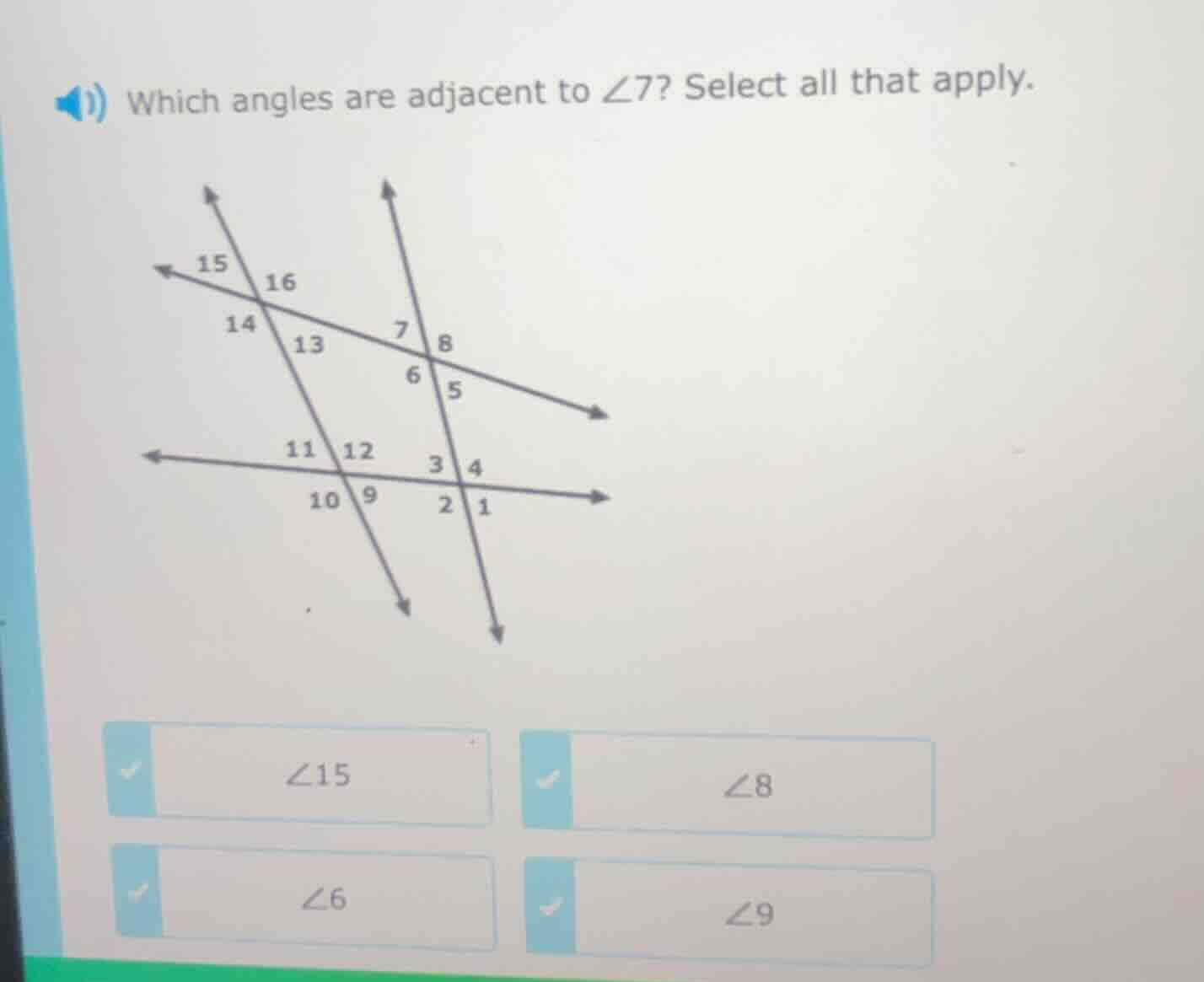
which angles are adjacent to $\angle 7$? select all that apply.
To determine adjacent angles to \( \angle 7 \), we use the definition of adjacent angles: two angles are adjacent if they share a common side and a common vertex, and their non - common sides form a linear pair (or they are next to each other).
Step 1: Analyze \( \angle 8 \)
\( \angle 7 \) and \( \angle 8 \) share a common vertex (the intersection point of the two lines) and a common side. Their non - common sides form a linear pair (they are supplementary and adjacent), so \( \angle 8 \) is adjacent to \( \angle 7 \).
Step 2: Analyze \( \angle 6 \)
\( \angle 7 \) and \( \angle 6 \) share a common vertex and a common side. The non - common sides of these two angles are on a straight line (linear pair), so \( \angle 6 \) is adjacent to \( \angle 7 \).
Step 3: Analyze \( \angle 13 \) (Wait, original options: Let's re - check the options. Wait the options are \( \angle 15 \), \( \angle 8 \), \( \angle 6 \), \( \angle 9 \). Wait, maybe a mis - label. Wait, looking at the diagram, the angle adjacent to \( \angle 7 \) should be angles that share a side and vertex. \( \angle 8 \) (shares a side and vertex, linear pair), \( \angle 6 \) (shares a side and vertex, linear pair), and also the angle above? Wait no, the correct adjacent angles to \( \angle 7 \) are \( \angle 8 \) (vertical adjacent, linear pair), \( \angle 6 \) (vertical adjacent, linear pair), and the angle formed by the other line. Wait, maybe the initial check was wrong. Wait, adjacent angles must share a common side and vertex.
Wait, let's re - define: Adjacent angles are two angles that have a common vertex and a common side, and do not overlap.
For \( \angle 7 \):
- \( \angle 8 \): Shares the common vertex (the intersection of the two lines) and a common side. The two angles are adjacent (form a linear pair, supplementary).
- \( \angle 6 \): Shares the common vertex and a common side. The two angles are adjacent (form a linear pair, supplementary).
- \( \angle 13 \): Wait, in the diagram, the angle labeled 7 is between two lines. The line that makes \( \angle 7 \) and \( \angle 8 \) is one line, and the line that makes \( \angle 7 \) and \( \angle 6 \) is another line. The other angle: Wait, maybe the options have a mistake, but according to the definition, \( \angle 8 \) and \( \angle 6 \) are adjacent to \( \angle 7 \). Wait, the initial check in the image has some wrong checks. Let's correct:
Adjacent angles to \( \angle 7 \):
- \( \angle 8 \): Common vertex, common side, adjacent (linear pair).
- \( \angle 6 \): Common vertex, common side, adjacent (linear pair).
- The angle above \( \angle 7 \) (like \( \angle 16 \)? No, \( \angle 16 \) is not adjacent. Wait, maybe the diagram is of multiple intersecting lines. Let's assume the correct adjacent angles are \( \angle 8 \) and \( \angle 6 \), and maybe \( \angle 13 \) but it's not in the options. Wait, the options given are \( \angle 15 \), \( \angle 8 \), \( \angle 6 \), \( \angle 9 \).
Wait, \( \angle 9 \): Does \( \angle 9 \) share a common side or vertex with \( \angle 7 \)? No, because \( \angle 9 \) is at a different intersection. \( \angle 15 \): Also at a different intersection. So the correct adjacent angles are \( \angle 8 \) and \( \angle 6 \).

Snap & solve any problem in the app
Get step-by-step solutions on Sovi AI
Photo-based solutions with guided steps
Explore more problems and detailed explanations
The angles adjacent to \( \angle 7 \) are \( \angle 8 \) and \( \angle 6 \). So the correct options are:
B. \( \angle 8 \)
C. \( \angle 6 \)
(Assuming the options are labeled as A. \( \angle 15 \), B. \( \angle 8 \), C. \( \angle 6 \), D. \( \angle 9 \))