QUESTION IMAGE
Question
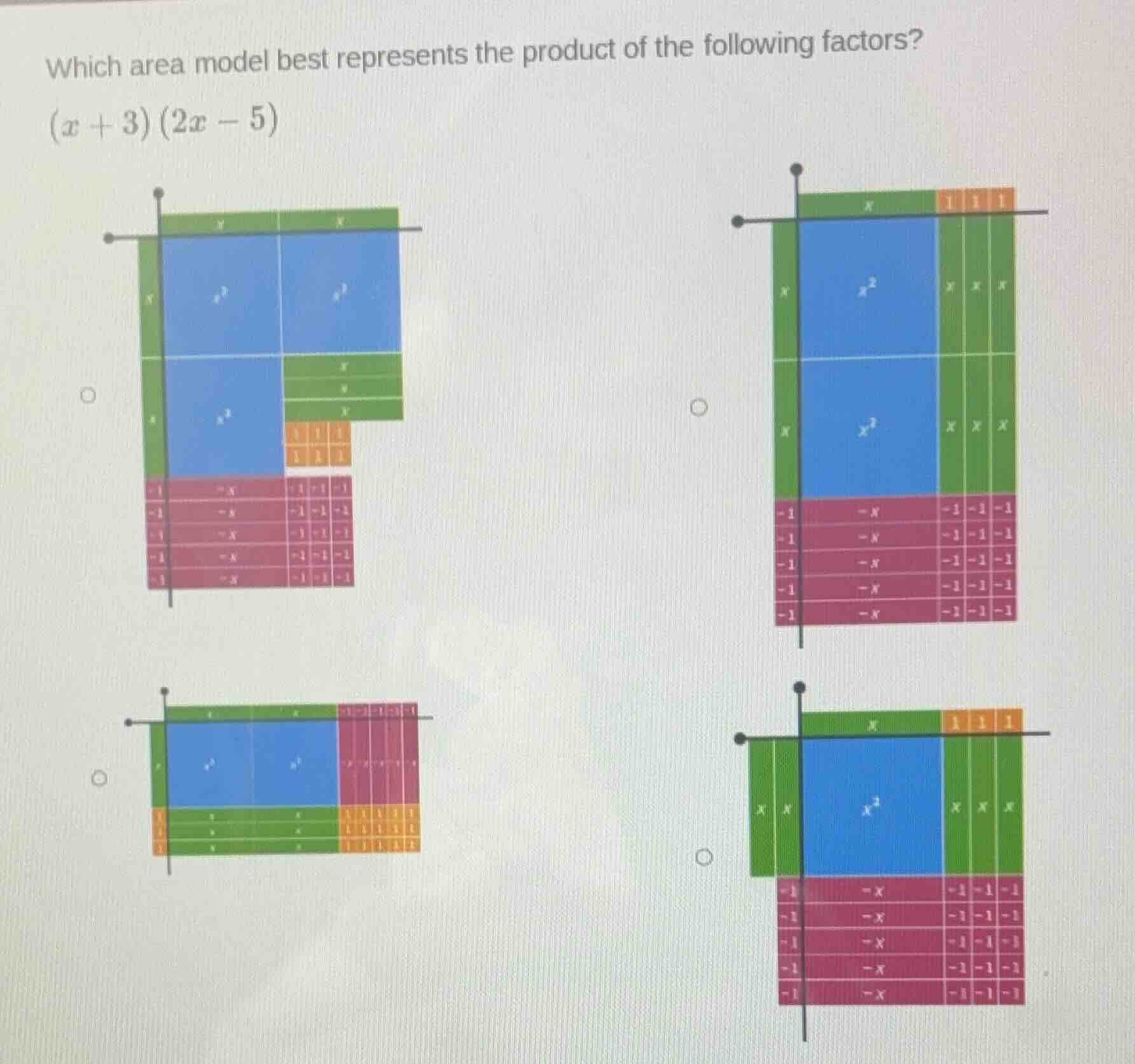
which area model best represents the product of the following factors?
$(x + 3)(2x - 5)$
Step1: Expand the expression
To determine the area model, first expand \((x + 3)(2x - 5)\) using the distributive property (FOIL method).
\[
\]
Step2: Analyze the area model components
An area model for \((a + b)(c + d)\) is a rectangle with length \((a + b)\) and width \((c + d)\), divided into four sub - rectangles with areas \(ac\), \(ad\), \(bc\), and \(bd\). For \((x + 3)(2x - 5)\), the length can be considered as \((2x-5)\) (which has terms \(2x\) and \(- 5\)) and the width as \((x + 3)\) (which has terms \(x\) and \(3\)) or vice - versa.
- The term \(2x^2\) comes from \(x\times2x\).
- The term \(-5x\) comes from \(x\times(-5)\).
- The term \(6x\) comes from \(3\times2x\).
- The term \(-15\) comes from \(3\times(-5)\).
Looking at the area models, we need to find the one where:
- The number of \(x^2\) terms is \(2\) (since the coefficient of \(x^2\) is \(2\)).
- The number of \(x\) terms: we have \(-5x+6x = x\), so the net number of \(x\) terms should be such that the positive \(x\) terms (from \(3\times2x\)) and negative \(x\) terms (from \(x\times(-5)\)) are represented correctly.
- The constant term is \(- 15\) (from \(3\times(-5)\)).
The correct area model should have:
- Two regions with area \(x^2\) (for the \(2x^2\) term, since \(x\times2x\) can be thought of as two rectangles each with area \(x^2\) if we consider the \(2x\) as two \(x\) terms).
- For the linear term: we have \(-5x\) (from \(x\times(-5)\)) and \(6x\) (from \(3\times2x\)). The \(-5x\) would be represented as 5 regions with area \(-x\) and \(6x\) would be represented as 6 regions with area \(x\), and the net is \(x\) (6x - 5x=x).
- The constant term \(-15\) would be represented as 15 regions with area \(-1\) (since \(3\times(-5)=-15\)).
After analyzing the given area models (by looking at the number of \(x^2\) blocks, \(x\) blocks, and constant blocks), the correct area model is the one where:
- The part corresponding to \(2x^2\) has two \(x^2\) blocks.
- The part corresponding to the \(x\) terms has a net of one \(x\) (after combining positive and negative \(x\) terms).
- The constant term is \(-15\).
Among the given options, the fourth option (the one at the bottom right) has:
- Two \(x\) terms in the length (for the \(2x\) part) and one \(x\) term in the width (for the \(x\) part) to get \(2x^2\) (by multiplying the \(x\) in the width with the two \(x\)s in the length).
- The positive \(x\) terms (from the \(3\) in the width and \(2x\) in the length) and negative \(x\) terms (from the \(x\) in the width and \(-5\) in the length) are represented correctly to give a net of \(x\).
- The constant term (from \(3\) in the width and \(-5\) in the length) is \(-15\).

Snap & solve any problem in the app
Get step-by-step solutions on Sovi AI
Photo-based solutions with guided steps
Explore more problems and detailed explanations
The bottom - right area model (the fourth one) best represents the product \((x + 3)(2x - 5)\).