QUESTION IMAGE
Question
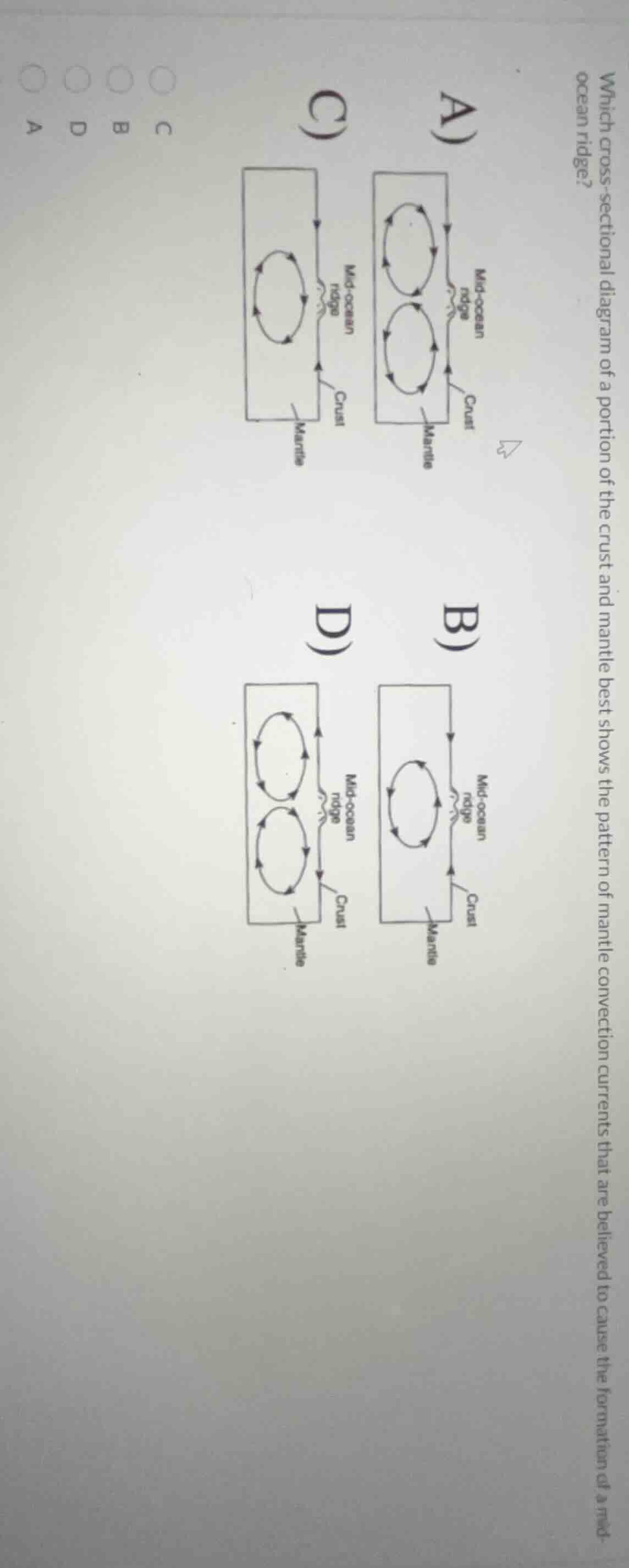
which cross - sectional diagram of a portion of the crust and mantle best shows the pattern of mantle convection currents that are believed to cause the formation of a mid - ocean ridge? (there are four diagrams labeled a, b, c, d with mantle convection current patterns and mid - ocean ridge, crust, mantle labels. there are also four option circles labeled a, b, c, d.)
To determine the correct diagram for mantle convection at a mid - ocean ridge, we use the concept of mantle convection currents. At a mid - ocean ridge, mantle material rises (due to heat from the Earth's interior) at the ridge, then moves laterally away from the ridge, and finally sinks back down into the mantle.
- In option A: There are two convection cells. The rising parts of the cells are at the mid - ocean ridge. As the mantle material rises at the ridge, it spreads out laterally (moving away from the ridge) and then sinks. This matches the expected pattern of mantle convection that causes the formation of a mid - ocean ridge.
- In option B: The convection cell's rising and sinking pattern does not align with the mid - ocean ridge formation process. The direction of the current does not show the correct spreading away from the ridge.
- In option C: The convection cell is not arranged in a way that the rising occurs at the ridge. The pattern of movement is inconsistent with the process of mid - ocean ridge formation.
- In option D: The convection cells' orientation and the direction of movement do not match the expected mantle convection pattern for a mid - ocean ridge. The rising and spreading directions are incorrect.

Snap & solve any problem in the app
Get step-by-step solutions on Sovi AI
Photo-based solutions with guided steps
Explore more problems and detailed explanations
A. The diagram with two convection cells where the rising parts of the cells are at the mid - ocean ridge, showing mantle material rising at the ridge, moving laterally away, and then sinking.