QUESTION IMAGE
Question
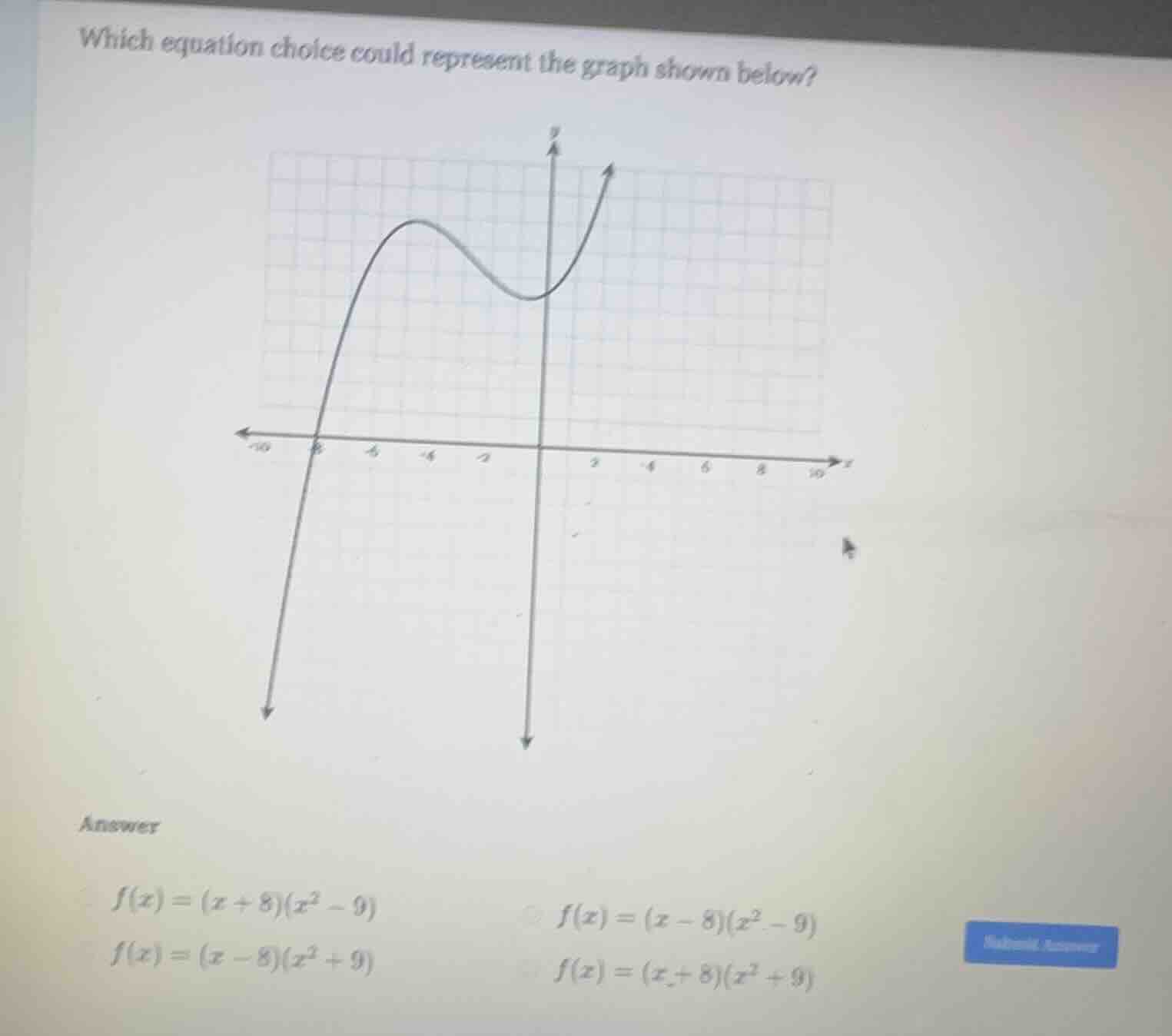
which equation choice could represent the graph shown below?
answer
$f(x) = (x + 8)(x^2 - 9)$
$f(x) = (x - 8)(x^2 - 9)$
$f(x) = (x - 8)(x^2 + 9)$
$f(x) = (x + 8)(x^2 + 9)$
Step1: Find x - intercept
The graph intersects the x - axis at \(x=-8\) (since it crosses the x - axis at \(x = - 8\)). For a function \(f(x)\) in factored form, if \(x = a\) is an x - intercept, then \((x - a)\) is a factor. So when \(x=-8\), \(x + 8=0\), so \((x + 8)\) should be a factor. This eliminates the options \(f(x)=(x - 8)(x^{2}-9)\) and \(f(x)=(x - 8)(x^{2}+9)\) because they have \((x - 8)\) as a factor (which would correspond to an x - intercept at \(x = 8\), but our graph has an x - intercept at \(x=-8\)).
Step2: Analyze the quadratic factor
Now we have two remaining options: \(f(x)=(x + 8)(x^{2}-9)\) and \(f(x)=(x + 8)(x^{2}+9)\). Let's analyze the quadratic part. The quadratic \(x^{2}+9\) has discriminant \(\Delta=0^{2}-4\times1\times9=- 36<0\), so it has no real roots. The quadratic \(x^{2}-9=(x - 3)(x + 3)\) has real roots \(x = 3\) and \(x=-3\). But our graph only has one x - intercept (at \(x=-8\)), which means the other factor should not have real roots? Wait, no, wait. Wait, the graph shown has only one x - intercept? Wait, no, looking at the graph, it crosses the x - axis at \(x=-8\) and maybe the other factor? Wait, no, the graph as shown: let's check the end behavior. The leading term of \(f(x)=(x + 8)(x^{2}-9)=x^{3}+8x^{2}-9x - 72\), the leading term is \(x^{3}\), so as \(x
ightarrow\infty\), \(f(x)
ightarrow\infty\) and as \(x
ightarrow-\infty\), \(f(x)
ightarrow-\infty\), which matches the graph. For \(f(x)=(x + 8)(x^{2}+9)=x^{3}+8x^{2}+9x + 72\), leading term \(x^{3}\), but the quadratic \(x^{2}+9\) has no real roots, so the only x - intercept would be at \(x=-8\). But wait, the graph in the picture: let's see the y - intercept. Let's compute the y - intercept for \(f(x)=(x + 8)(x^{2}-9)\): when \(x = 0\), \(f(0)=(0 + 8)(0 - 9)=8\times(-9)=-72\)? Wait, no, the graph in the picture crosses the y - axis at positive y? Wait, maybe I made a mistake. Wait, no, let's re - check. Wait, \(x^{2}-9=(x - 3)(x + 3)\), so \(f(x)=(x + 8)(x - 3)(x + 3)\). The roots are \(x=-8\), \(x = 3\), \(x=-3\). But the graph shown has only one x - intercept? Wait, maybe the graph is drawn in a way that the other intercepts are not visible? Wait, no, the x - axis is from - 10 to 10. The graph crosses the x - axis at \(x=-8\) and maybe the other roots are outside? Wait, no, \(x = 3\) and \(x=-3\) are within - 10 to 10. Wait, maybe the graph is a cubic with one real root? Wait, no, a cubic must have at least one real root. Wait, the function \(f(x)=(x + 8)(x^{2}+9)\) has one real root at \(x=-8\) and two complex roots. The function \(f(x)=(x + 8)(x^{2}-9)\) has three real roots. But the graph shown has only one x - intercept (at \(x=-8\)). So that would mean the other factor has no real roots. So \(x^{2}+9\) has no real roots, so the function \(f(x)=(x + 8)(x^{2}+9)\) has only one real root at \(x=-8\). But wait, the end behavior: for \(f(x)=(x + 8)(x^{2}+9)=x^{3}+8x^{2}+9x + 72\), as \(x
ightarrow\infty\), \(f(x)
ightarrow\infty\) and as \(x
ightarrow-\infty\), \(f(x)
ightarrow-\infty\), which matches the graph. For \(f(x)=(x + 8)(x^{2}-9)\), as \(x
ightarrow\infty\), \(f(x)
ightarrow\infty\) and as \(x
ightarrow-\infty\), \(f(x)
ightarrow-\infty\) (same end behavior). But the graph has only one x - intercept, so the correct function should be the one with only one real root. So \(f(x)=(x + 8)(x^{2}+9)\)? Wait, no, wait, maybe I misread the graph. Wait, the original graph: let's check the y - intercept. For \(f(x)=(x + 8)(x^{2}+9)\), when \(x = 0\), \(f(0)=(0 + 8)(0 + 9)=72\), which is positive. For \(f(x)=(x + 8)(x^{2}-9)\), w…

Snap & solve any problem in the app
Get step-by-step solutions on Sovi AI
Photo-based solutions with guided steps
Explore more problems and detailed explanations
\(f(x)=(x + 8)(x^{2}+9)\)