QUESTION IMAGE
Question
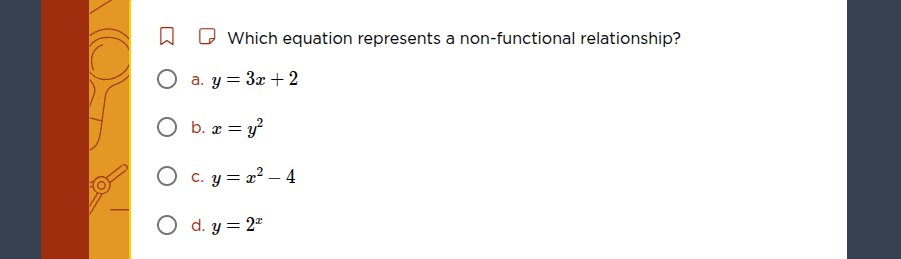
which equation represents a non - functional relationship?
a. $y = 3x + 2$
b. $x = y^2$
c. $y = x^2 - 4$
d. $y = 2^x$
To determine which equation is not a function, we use the vertical line test: a relation is a function if every vertical line intersects its graph at most once. Alternatively, for a relation in terms of \(x\) and \(y\), it is a function if for each input \(x\), there is exactly one output \(y\). We analyze each option:
Step 1: Analyze Option a (\(y = 3x + 2\))
This is a linear equation in slope - intercept form (\(y=mx + b\), where \(m = 3\) and \(b = 2\)). For any value of \(x\), we can calculate exactly one value of \(y\) by substituting \(x\) into the equation. For example, if \(x = 0\), \(y=3(0)+2 = 2\); if \(x = 1\), \(y=3(1)+2=5\). So, it is a function.
Step 2: Analyze Option b (\(x = y^{2}\))
Let's solve for \(y\) in terms of \(x\). We get \(y=\pm\sqrt{x}\) (for \(x\geq0\)). If we take \(x = 4\), then \(y=\pm\sqrt{4}=\pm2\). This means that for the input \(x = 4\), we have two outputs (\(y = 2\) and \(y=- 2\)). So, it fails the vertical line test (if we consider \(x\) as the independent variable and \(y\) as the dependent variable, a vertical line \(x = 4\) would intersect the graph at two points \((4,2)\) and \((4, - 2)\)). Thus, it is not a function.
Step 3: Analyze Option c (\(y=x^{2}-4\))
For any real number \(x\), when we substitute \(x\) into the equation \(y=x^{2}-4\), we get exactly one value of \(y\). For example, if \(x = 0\), \(y=0^{2}-4=-4\); if \(x = 2\), \(y=2^{2}-4 = 0\). So, it is a function.
Step 4: Analyze Option d (\(y = 2^{x}\))
This is an exponential function. For any real number \(x\), we can calculate exactly one value of \(y\) by using the exponential operation. For example, if \(x = 0\), \(y = 2^{0}=1\); if \(x = 1\), \(y=2^{1}=2\); if \(x=- 1\), \(y = 2^{-1}=\frac{1}{2}\). So, it is a function.

Snap & solve any problem in the app
Get step-by-step solutions on Sovi AI
Photo-based solutions with guided steps
Explore more problems and detailed explanations
b. \(x = y^{2}\)