QUESTION IMAGE
Question
- a. which expression best describes the model below?
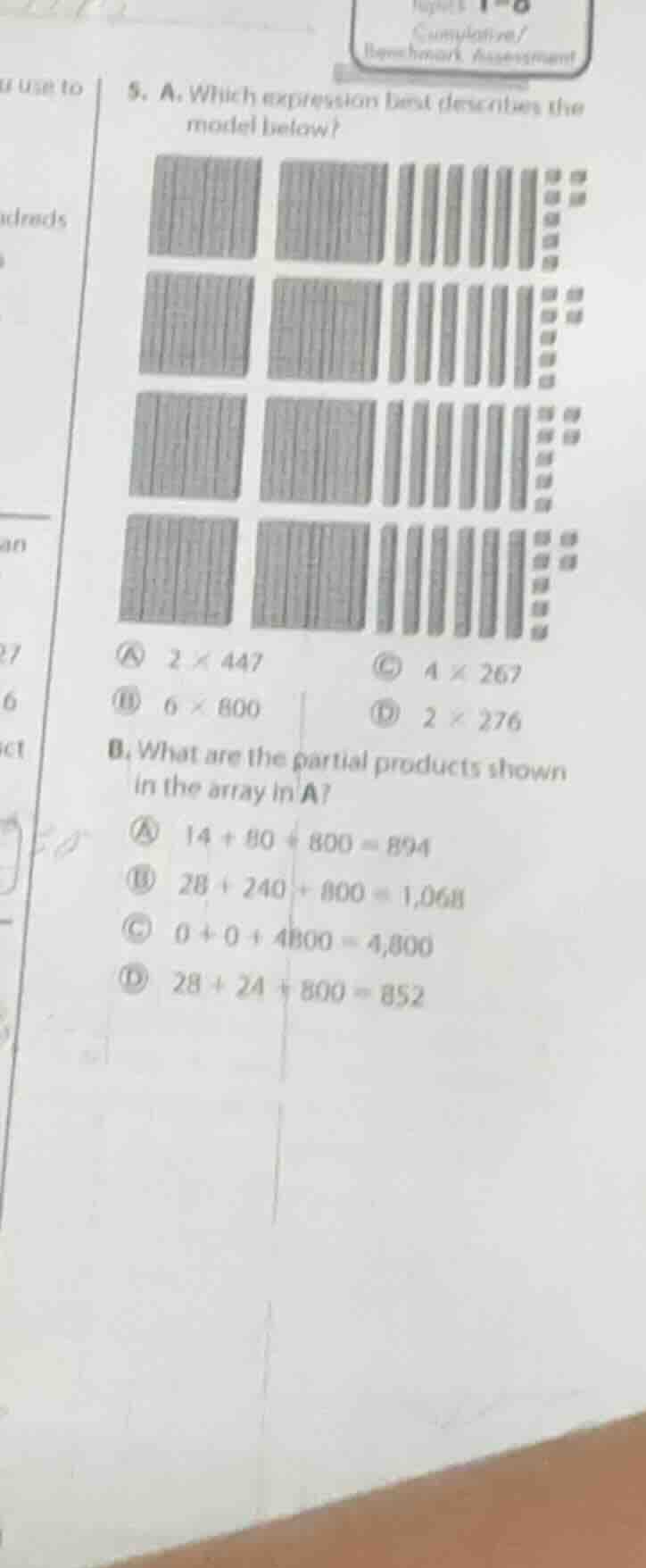
image of an array model
a ( 2 \times 447 )
c ( 4 \times 267 )
b ( 6 \times 800 )
d ( 2 \times 276 )
b. what are the partial products shown in the array in a?
a ( 14 + 80 + 800 = 894 )
b ( 28 + 240 + 800 = 1,068 )
c ( 0 + 0 + 4800 = 4,800 )
d ( 28 + 24 + 800 = 852 )
Part A
Step1: Analyze the model's structure
Looking at the model, we can see there are 4 rows? Wait, no, let's check the columns. Wait, actually, looking at the groups: each "block" seems to be composed of hundreds, tens, and ones. Let's count the number of each place value. Alternatively, let's check the options. Let's calculate each option:
- Option A: \(2\times447 = 894\)
- Option B: \(6\times800 = 4800\)
- Option C: \(4\times267 = 1068\)
- Option D: \(2\times276 = 552\)
Wait, maybe the model has 4 groups? Wait, looking at the image, there are 4 rows? Wait, no, the first part (A) has a model with, let's see, the number of large squares (hundreds), tens, and ones. Let's re-express:
Wait, maybe the model is 4 times 267? Wait, 267 is 200 + 60 + 7. Let's check \(4\times267 = 4\times(200 + 60 + 7)= 800 + 240 + 28 = 1068\). Let's check the other options:
- \(2\times447 = 894\), \(447 = 400 + 40 + 7\), \(2\times447 = 800 + 80 + 14 = 894\)
- \(6\times800 = 4800\)
- \(2\times276 = 552\)
Wait, maybe the model has 4 groups, each with 2 hundreds, 6 tens, and 7 ones? So 267 per group, 4 groups. So \(4\times267\) is option C. Wait, but let's check the partial products later. Wait, maybe I made a mistake. Wait, let's look at the model again. The model has, in each row, 2 large squares (hundreds), 6 tens, and 7 ones? Wait, no, the first row: 2 large squares (hundreds), 6 tens, and 7 ones? Wait, the first row: 2 hundreds, 6 tens, 7 ones. Then how many rows? There are 4 rows? Wait, the image shows 4 rows? Wait, the problem is part A: which expression best describes the model. Let's count the number of each place:
- Hundreds: Let's see, each large square is 100. How many large squares? 2 per "group" and 4 groups? Wait, 24=8 hundreds? No, 800. Tens: 6 per group, 4 groups: 24 tens = 240. Ones: 7 per group, 4 groups: 28 ones. So total is 800 + 240 + 28 = 1068, which is \(4\times267\) (since 267 = 200 + 60 + 7, 4200=800, 460=240, 47=28). So option C: \(4\times267\).
Step2: Verify with partial products (for part B, but part A is about the expression)
Wait, part A: the model is 4 groups of 267, so \(4\times267\), which is option C.
Step1: Recall partial products for \(4\times267\)
\(267 = 200 + 60 + 7\). So partial products are \(4\times200 = 800\), \(4\times60 = 240\), \(4\times7 = 28\).
Step2: Sum the partial products
\(800 + 240 + 28 = 1068\). Now check the options:
- Option A: \(14 + 80 + 800 = 894\) (wrong, ones should be 28, tens 240)
- Option B: \(28 + 240 + 800 = 1068\) (correct, 28 is \(4\times7\), 240 is \(4\times60\), 800 is \(4\times200\))
- Option C: \(0 + 0 + 4800 = 4800\) (wrong)
- Option D: \(28 + 24 + 800 = 852\) (wrong, tens should be 240, not 24)
So the correct partial products are \(28 + 240 + 800 = 1068\), which is option B.

Snap & solve any problem in the app
Get step-by-step solutions on Sovi AI
Photo-based solutions with guided steps
Explore more problems and detailed explanations
C. \(4 \times 267\)