QUESTION IMAGE
Question
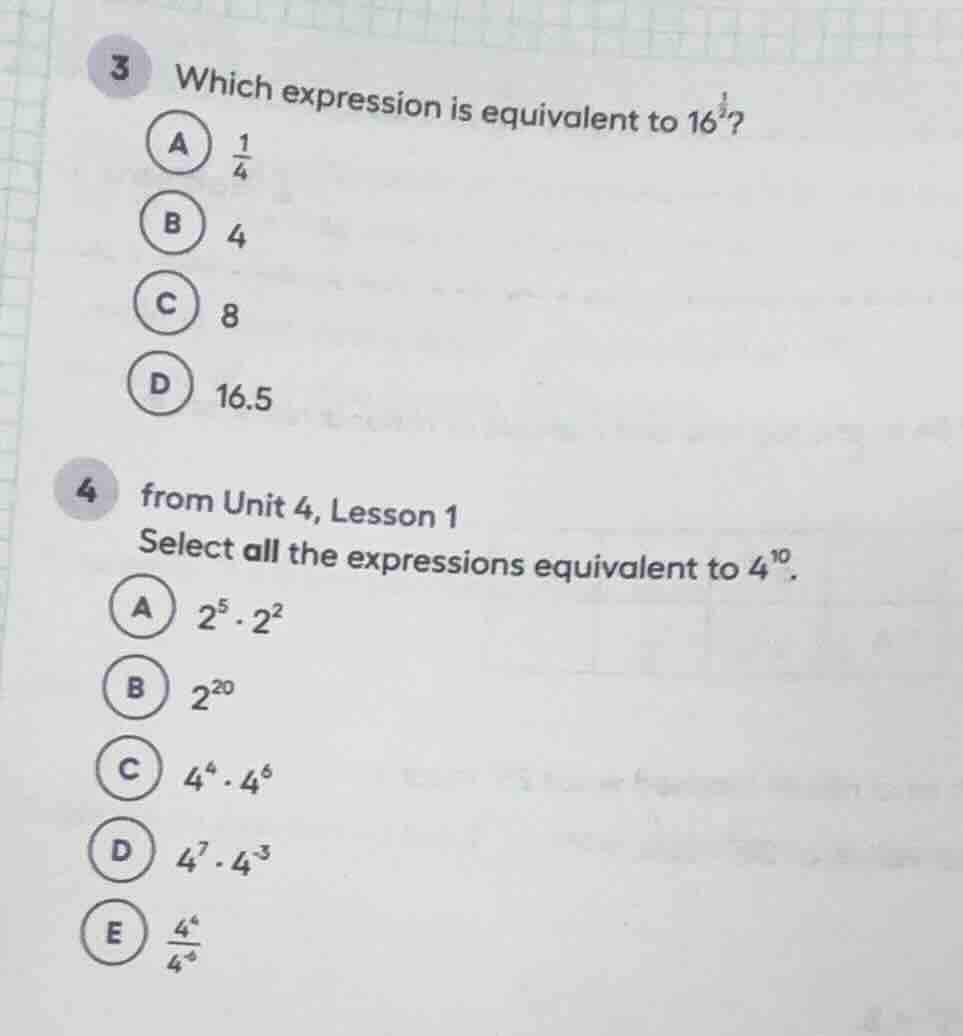
3 which expression is equivalent to $16^{\frac{1}{2}}$?
a $\frac{1}{4}$
b 4
c 8
d 16.5
4 from unit 4, lesson 1
select all the expressions equivalent to $4^{10}$.
a $2^5 \cdot 2^2$
b $2^{20}$
c $4^4 \cdot 4^6$
d $4^7 \cdot 4^{-3}$
e $\frac{4^6}{4^{-5}}$
Question 3
Step1: Recall the exponent rule for fractional exponents
The formula for \( a^{\frac{1}{n}} \) is the \( n \)-th root of \( a \), i.e., \( a^{\frac{1}{n}}=\sqrt[n]{a} \). So for \( 16^{\frac{1}{2}} \), we need to find the square root of 16.
Step2: Calculate the square root of 16
We know that \( \sqrt{16} = 4 \) because \( 4\times4 = 16 \).
We will check each option by using exponent rules. The exponent rules we'll use are: \( a^m\times a^n=a^{m + n} \), \( (a^m)^n=a^{m\times n} \), and \( \frac{a^m}{a^n}=a^{m - n} \). Also, note that \( 4 = 2^2 \), so \( 4^{10}=(2^2)^{10} \).
Step1: Analyze Option A
First, calculate \( 2^5\cdot2^2 \). Using the rule \( a^m\times a^n=a^{m + n} \), we get \( 2^{5 + 2}=2^7 \). Now, \( 4^{10}=(2^2)^{10}=2^{20} \) (using \( (a^m)^n=a^{m\times n} \)). Since \( 2^7
eq2^{20} \), Option A is not equivalent.
Step2: Analyze Option B
We know that \( 4 = 2^2 \), so \( 4^{10}=(2^2)^{10} \). Using the exponent rule \( (a^m)^n=a^{m\times n} \), we have \( (2^2)^{10}=2^{2\times10}=2^{20} \). So Option B is equivalent.
Step3: Analyze Option C
Calculate \( 4^4\cdot4^6 \). Using the rule \( a^m\times a^n=a^{m + n} \), we get \( 4^{4 + 6}=4^{10} \). So Option C is equivalent.
Step4: Analyze Option D
Calculate \( 4^7\cdot4^{-3} \). Using the rule \( a^m\times a^n=a^{m + n} \), we get \( 4^{7+( - 3)}=4^{4} \). Since \( 4^4
eq4^{10} \), Option D is not equivalent.
Step5: Analyze Option E
Calculate \( \frac{4^6}{4^{-5}} \). Using the rule \( \frac{a^m}{a^n}=a^{m - n} \), we get \( 4^{6-( - 5)}=4^{6 + 5}=4^{11} \). Since \( 4^{11}
eq4^{10} \), Option E is not equivalent.

Snap & solve any problem in the app
Get step-by-step solutions on Sovi AI
Photo-based solutions with guided steps
Explore more problems and detailed explanations
B. 4