QUESTION IMAGE
Question
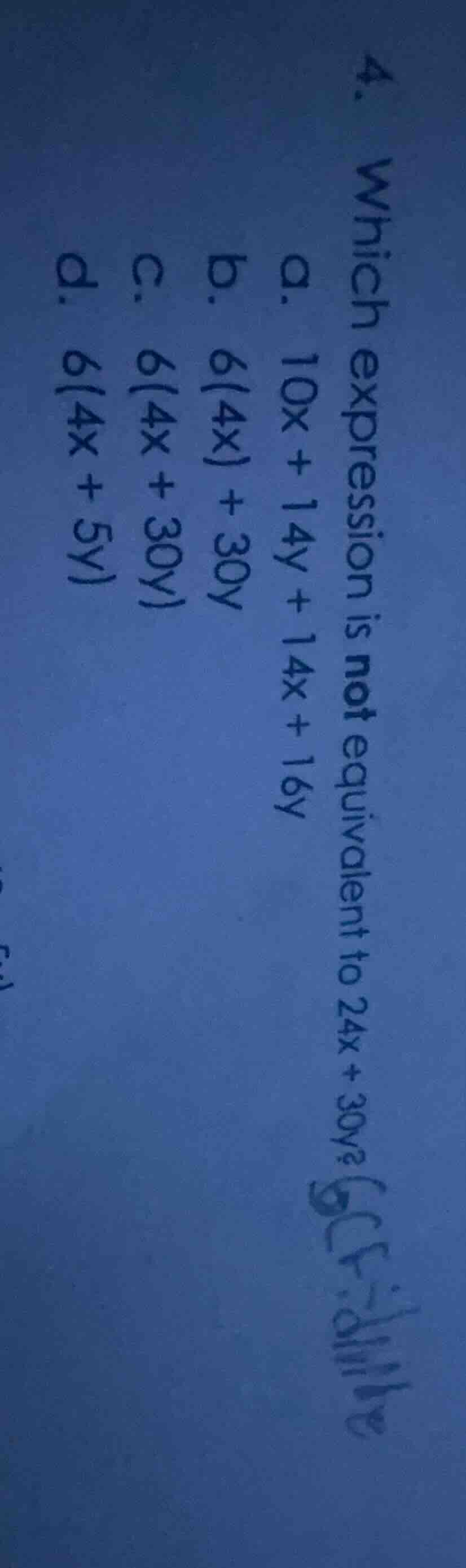
- which expression is not equivalent to 24x + 30y?
a. 10x + 14y + 14x + 16y
b. 6(4x) + 30y
c. 6(4x + 30y)
d. 6(4x + 5y)
Step1: Simplify Option a
Combine like terms: \(10x + 14y + 14x + 16y=(10x + 14x)+(14y + 16y)=24x + 30y\)
Step2: Simplify Option b
Use distributive property: \(6(4x)+30y = 24x+30y\)
Step3: Simplify Option c
Use distributive property: \(6(4x + 30y)=24x+180y\) (Wait, no, wait. Wait, original expression is \(24x + 30y\). Wait, let's recalculate Option c: \(6(4x + 30y)=6\times4x+6\times30y = 24x+180y\)? No, that can't be. Wait, no, the target is \(24x + 30y\). Wait, maybe I misread. Wait, the options:
Wait, the original problem is "Which expression is not equivalent to \(24x + 30y\)?"
Let's re-express each option:
Option a: \(10x + 14y + 14x + 16y\). Combine \(x\) terms: \(10x+14x = 24x\). Combine \(y\) terms: \(14y + 16y=30y\). So \(24x + 30y\). Equivalent.
Option b: \(6(4x)+30y\). \(6\times4x = 24x\), so \(24x+30y\). Equivalent.
Option c: \(6(4x + 30y)\). Distribute: \(6\times4x+6\times30y=24x + 180y\). Not equivalent to \(24x + 30y\). Wait, but maybe I misread the option. Wait, the option c is \(6(4x + 30y)\)? Or is it \(6(4x + 5y)\)? Wait, no, the user's image:
Looking at the image:
a. \(10x + 14y + 14x + 16y\)
b. \(6(4x)+30y\)
c. \(6(4x + 30y)\)
d. \(6(4x + 5y)\)
Wait, let's check d: \(6(4x + 5y)=24x+30y\). So equivalent.
So option c: \(6(4x + 30y)=24x + 180y\), which is not equivalent to \(24x + 30y\). Wait, but that seems odd. Wait, maybe the option c was a typo? Wait, no, maybe I misread. Wait, the user's image:
Looking at the image again:
c. \(6(4x + 30y)\)
d. \(6(4x + 5y)\)
Wait, d: \(6(4x + 5y)=24x + 30y\). Correct.
c: \(6(4x + 30y)=24x + 180y\). So that's not equivalent. But wait, the original problem's target is \(24x + 30y\). So option c is \(24x + 180y\), which is not equivalent. But wait, maybe I made a mistake. Wait, no, let's check again.
Wait, the options:
a. \(10x + 14y + 14x + 16y\) → \(24x + 30y\) (equivalent)
b. \(6(4x)+30y = 24x + 30y\) (equivalent)
c. \(6(4x + 30y)=24x + 180y\) (not equivalent)
d. \(6(4x + 5y)=24x + 30y\) (equivalent)
So the expression not equivalent is option c? Wait, but maybe the option c was supposed to be \(6(4x + 5y)\)? No, the image shows c as \(6(4x + 30y)\). So the answer is c? Wait, but let's confirm.
Wait, the problem is "Which expression is not equivalent to \(24x + 30y\)?"
So:
a: \(10x +14y +14x +16y = (10x+14x)+(14y+16y)=24x+30y\) → equivalent.
b: \(6(4x)+30y =24x +30y\) → equivalent.
c: \(6(4x +30y)=24x + 180y\) → not equivalent.
d: \(6(4x +5y)=24x +30y\) → equivalent.
So the answer is option c. Wait, but maybe I misread the option. Wait, the user's image:
Looking at the image again, the options are:
a. \(10x + 14y + 14x + 16y\)
b. \(6(4x) + 30y\)
c. \(6(4x + 30y)\)
d. \(6(4x + 5y)\)
Yes. So when we expand c: \(6\times4x =24x\), \(6\times30y=180y\), so \(24x + 180y\), which is not equal to \(24x + 30y\). So the expression not equivalent is option c.
Wait, but let's check again. Maybe the original problem's target is different? No, the target is \(24x + 30y\). So:
Option a: combines to \(24x + 30y\).
Option b: \(24x + 30y\).
Option c: \(24x + 180y\) (not equivalent).
Option d: \(24x + 30y\).
So the answer is c.

Snap & solve any problem in the app
Get step-by-step solutions on Sovi AI
Photo-based solutions with guided steps
Explore more problems and detailed explanations
c. \(6(4x + 30y)\)