QUESTION IMAGE
Question
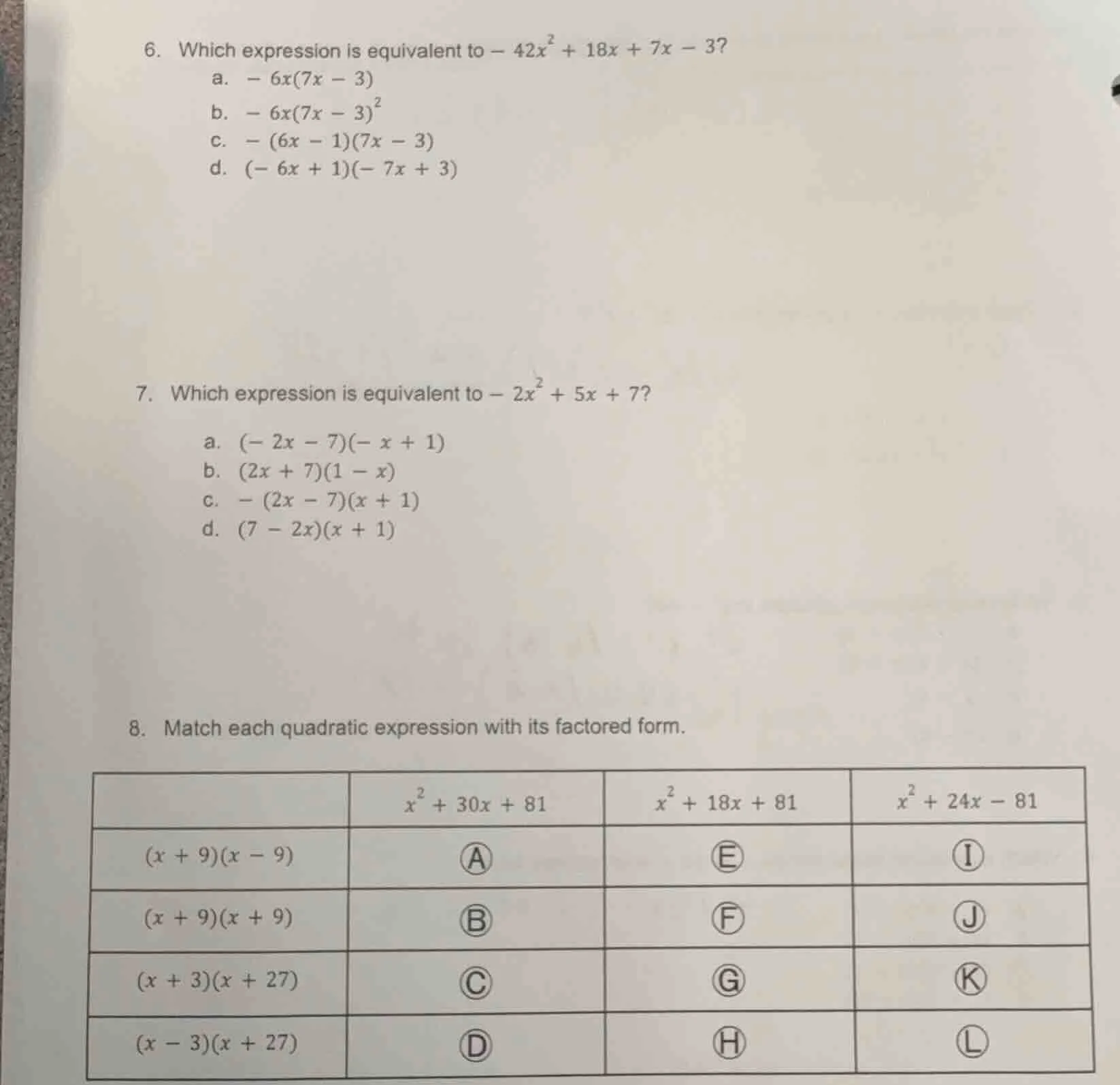
- which expression is equivalent to $-42x^2 + 18x + 7x - 3$?
a. $-6x(7x - 3)$
b. $-6x(7x - 3)^2$
c. $-(6x - 1)(7x - 3)$
d. $(-6x + 1)(-7x + 3)$
- which expression is equivalent to $-2x^2 + 5x + 7$?
a. $(-2x - 7)(-x + 1)$
b. $(2x + 7)(1 - x)$
c. $-(2x - 7)(x + 1)$
d. $(7 - 2x)(x + 1)$
- match each quadratic expression with its factored form.
| $x^2 + 30x + 81$ | $x^2 + 18x + 81$ | $x^2 + 24x - 81$ | |
| $(x + 9)(x - 9)$ | ⓐ | ⓔ | ⓘ |
| $(x + 9)(x + 9)$ | ⓑ | ⓕ | ⓙ |
| $(x + 3)(x + 27)$ | ⓒ | ⓖ | ⓚ |
| $(x - 3)(x + 27)$ | ⓓ | ⓗ | ⓛ |
Question 6
Step1: Simplify the original expression
First, combine like terms in \(-42x^2 + 18x + 7x - 3\). The like terms \(18x\) and \(7x\) can be combined:
\(-42x^2 + (18x + 7x) - 3 = -42x^2 + 25x - 3\).
Step2: Factor the simplified expression
We can factor by grouping or by testing the options. Let's test option c: \(-(6x - 1)(7x - 3)\).
First, expand \((6x - 1)(7x - 3)\):
\(6x \cdot 7x + 6x \cdot (-3) - 1 \cdot 7x + (-1) \cdot (-3) = 42x^2 - 18x - 7x + 3 = 42x^2 - 25x + 3\).
Now apply the negative sign: \(-(42x^2 - 25x + 3) = -42x^2 + 25x - 3\), which matches the simplified original expression.
Question 7
Step1: Analyze the original expression
The original expression is \(-2x^2 + 5x + 7\). Let's test each option by expanding.
Step2: Test option b: \((2x + 7)(1 - x)\)
Expand \((2x + 7)(1 - x)\):
\(2x \cdot 1 + 2x \cdot (-x) + 7 \cdot 1 + 7 \cdot (-x) = 2x - 2x^2 + 7 - 7x\).
Combine like terms: \(-2x^2 + (2x - 7x) + 7 = -2x^2 - 5x + 7\). Wait, that's not matching. Wait, maybe I made a mistake. Wait, let's test option b again. Wait, no, let's test option b: \((2x + 7)(1 - x)\). Wait, maybe I miscalculated. Wait, \(2x(1) = 2x\), \(2x(-x) = -2x^2\), \(7(1) = 7\), \(7(-x) = -7x\). So combining: \( -2x^2 + 2x -7x +7 = -2x^2 -5x +7\). Hmm, not matching. Wait, let's test option b again. Wait, maybe the original expression is \(-2x^2 +5x +7\). Let's test option b: \((2x +7)(1 -x)\). Wait, maybe I messed up. Wait, let's test option b: \((2x +7)(1 -x) = 2x(1) + 2x(-x) +7(1) +7(-x) = 2x -2x^2 +7 -7x = -2x^2 -5x +7\). Not matching. Wait, let's test option d: \((7 - 2x)(x + 1)\). Expand: \(7x +7 -2x^2 -2x = -2x^2 +5x +7\). Yes! Wait, option d: \((7 - 2x)(x + 1)\) expands to \(-2x^2 +5x +7\). Wait, but let's check again. Wait, \((7 - 2x)(x + 1) = 7(x) + 7(1) -2x(x) -2x(1) = 7x +7 -2x^2 -2x = -2x^2 +5x +7\), which matches the original expression. Wait, but earlier I thought option b, but no, option d is correct? Wait, no, let's check the options again. Wait, the options are:
a. \((-2x -7)(-x +1)\)
b. \((2x +7)(1 -x)\)
c. \(-(2x -7)(x +1)\)
d. \((7 - 2x)(x +1)\)
Wait, let's expand option d: \((7 - 2x)(x + 1) = 7x +7 -2x^2 -2x = -2x^2 +5x +7\), which matches. So option d is correct? Wait, but let's check option b again. Wait, \((2x +7)(1 -x) = 2x -2x^2 +7 -7x = -2x^2 -5x +7\), which is not matching. So option d is correct.
Question 8
Step1: Factor each quadratic
- For \(x^2 + 30x + 81\):
We need two numbers that multiply to \(81\) and add to \(30\). The numbers are \(3\) and \(27\) (since \(3 \times 27 = 81\) and \(3 + 27 = 30\)). So \(x^2 + 30x + 81 = (x + 3)(x + 27)\).
- For \(x^2 + 18x + 81\):
This is a perfect square trinomial, since \(18x = 2 \times x \times 9\) and \(81 = 9^2\). So \(x^2 + 18x + 81 = (x + 9)(x + 9)\).
- For \(x^2 + 24x - 81\):
We need two numbers that multiply to \(-81\) and add to \(24\). The numbers are \(-3\) and \(27\) (since \(-3 \times 27 = -81\) and \(-3 + 27 = 24\)). So \(x^2 + 24x - 81 = (x - 3)(x + 27)\).

Snap & solve any problem in the app
Get step-by-step solutions on Sovi AI
Photo-based solutions with guided steps
Explore more problems and detailed explanations
s:
- c. \(- (6x - 1)(7x - 3)\)
- d. \((7 - 2x)(x + 1)\)
8.
- \(x^2 + 30x + 81\) matches \((x + 3)(x + 27)\) (so column 1, row 3: C)
- \(x^2 + 18x + 81\) matches \((x + 9)(x + 9)\) (so column 2, row 2: F)
- \(x^2 + 24x - 81\) matches \((x - 3)(x + 27)\) (so column 3, row 4: L)
(Note: For question 8, the table matching is:
- \(x^2 + 30x + 81\) → \((x + 3)(x + 27)\) → C
- \(x^2 + 18x + 81\) → \((x + 9)(x + 9)\) → F
- \(x^2 + 24x - 81\) → \((x - 3)(x + 27)\) → L)