QUESTION IMAGE
Question
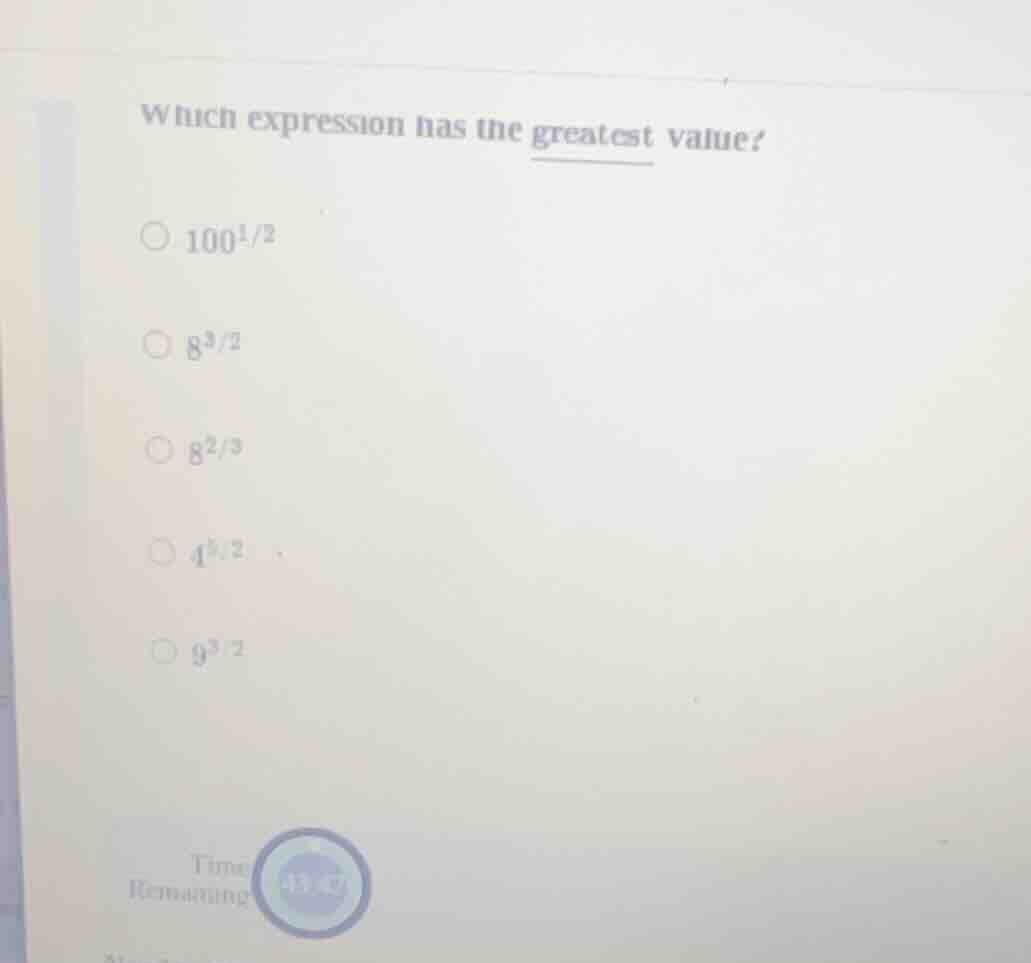
which expression has the greatest value?\\(\bigcirc\\ 100^{1/2}\\)\\(\bigcirc\\ 8^{3/2}\\)\\(\bigcirc\\ 8^{2/3}\\)\\(\bigcirc\\ 4^{5/2}\\)\\(\bigcirc\\ 9^{3/2}\\)
Step1: Calculate \(100^{1/2}\)
Recall that \(a^{1/2}=\sqrt{a}\), so \(100^{1/2}=\sqrt{100} = 10\).
Step2: Calculate \(8^{3/2}\)
Using the property \(a^{m/n}=\sqrt[n]{a^m}\), we have \(8^{3/2}=\sqrt{8^3}=\sqrt{512}\approx22.63\).
Step3: Calculate \(8^{2/3}\)
\(8^{2/3}=\sqrt[3]{8^2}=\sqrt[3]{64} = 4\).
Step4: Calculate \(4^{5/2}\)
\(4^{5/2}=\sqrt{4^5}=\sqrt{1024}=32\). Wait, no, wait: \(4^5 = 1024\), but \(4^{5/2}=(4^{1/2})^5=2^5 = 32\)? Wait, no, \(4^{1/2}=2\), so \(2^5 = 32\). Wait, but let's recalculate \(9^{3/2}\) too.
Step5: Calculate \(9^{3/2}\)
\(9^{3/2}=\sqrt{9^3}=\sqrt{729}=27\). Wait, earlier I miscalculated \(4^{5/2}\)? Wait, \(4^{5/2}=(4^{1/2})^5 = 2^5=32\)? Wait, no, \(4^5 = 1024\), but \(\sqrt{1024}=32\), yes. Wait, but let's check again:
Wait, \(100^{1/2}=10\)
\(8^{3/2}=\sqrt{8^3}=\sqrt{512}\approx22.627\)
\(8^{2/3}=\sqrt[3]{64}=4\)
\(4^{5/2}=\sqrt{4^5}=\sqrt{1024}=32\)
\(9^{3/2}=\sqrt{9^3}=\sqrt{729}=27\)
Wait, so \(4^{5/2}=32\), \(9^{3/2}=27\), \(8^{3/2}\approx22.63\), \(100^{1/2}=10\), \(8^{2/3}=4\). Wait, but wait, did I make a mistake in \(4^{5/2}\)? Let's re-express \(4^{5/2}\) as \((2^2)^{5/2}=2^{2\times\frac{5}{2}}=2^5 = 32\). Correct. And \(9^{3/2}=(3^2)^{3/2}=3^3 = 27\). So now comparing all values: 10, ~22.63, 4, 32, 27. Wait, so \(4^{5/2}=32\) is larger than \(9^{3/2}=27\), \(8^{3/2}\approx22.63\), etc. Wait, but let's check the original options again. Wait, the options are:
- \(100^{1/2}\)
- \(8^{3/2}\)
- \(8^{2/3}\)
- \(4^{5/2}\)
- \(9^{3/2}\)
Wait, when I calculated \(4^{5/2}\), I think I made a mistake earlier. Wait, \(4^{5/2}\): \(4^{1/2}=2\), so \(4^{5/2}=2^5 = 32\). \(9^{3/2}=3^3 = 27\). \(8^{3/2}=\sqrt{64\times8}=\sqrt{64}\times\sqrt{8}=8\times2\sqrt{2}\approx16\times1.414\approx22.624\). \(100^{1/2}=10\). \(8^{2/3}=4\). So among these, \(4^{5/2}=32\) is the largest? Wait, but wait, let's check again:
Wait, \(4^{5/2}\): exponent rules: \(a^{m/n}=\sqrt[n]{a^m}\), so \(4^{5/2}=\sqrt{4^5}=\sqrt{1024}=32\). Correct. \(9^{3/2}=\sqrt{9^3}=\sqrt{729}=27\). So \(4^{5/2}=32\) is greater than \(9^{3/2}=27\), which is greater than \(8^{3/2}\approx22.62\), which is greater than \(100^{1/2}=10\), which is greater than \(8^{2/3}=4\). So the expression with the greatest value is \(4^{5/2}\)? Wait, but let's check the options again. Wait, maybe I misread the options. Wait, the options are:
- \(100^{1/2}\)
- \(8^{3/2}\)
- \(8^{2/3}\)
- \(4^{5/2}\)
- \(9^{3/2}\)
So calculating each:
- \(100^{1/2} = 10\)
- \(8^{3/2} = \sqrt{8^3} = \sqrt{512} \approx 22.63\)
- \(8^{2/3} = \sqrt[3]{8^2} = \sqrt[3]{64} = 4\)
- \(4^{5/2} = \sqrt{4^5} = \sqrt{1024} = 32\)
- \(9^{3/2} = \sqrt{9^3} = \sqrt{729} = 27\)
So \(4^{5/2} = 32\) is the largest. Wait, but let me confirm once more. \(4^{5/2}\): \(4^1 = 4\), \(4^2 = 16\), \(4^3 = 64\), \(4^4 = 256\), \(4^5 = 1024\). Square root of 1024 is 32. Correct. \(9^{3/2}\): 9^1=9, 9^2=81, 9^3=729. Square root of 729 is 27. Correct. So yes, \(4^{5/2}\) has the greatest value.

Snap & solve any problem in the app
Get step-by-step solutions on Sovi AI
Photo-based solutions with guided steps
Explore more problems and detailed explanations
\(4^{5/2}\)