QUESTION IMAGE
Question
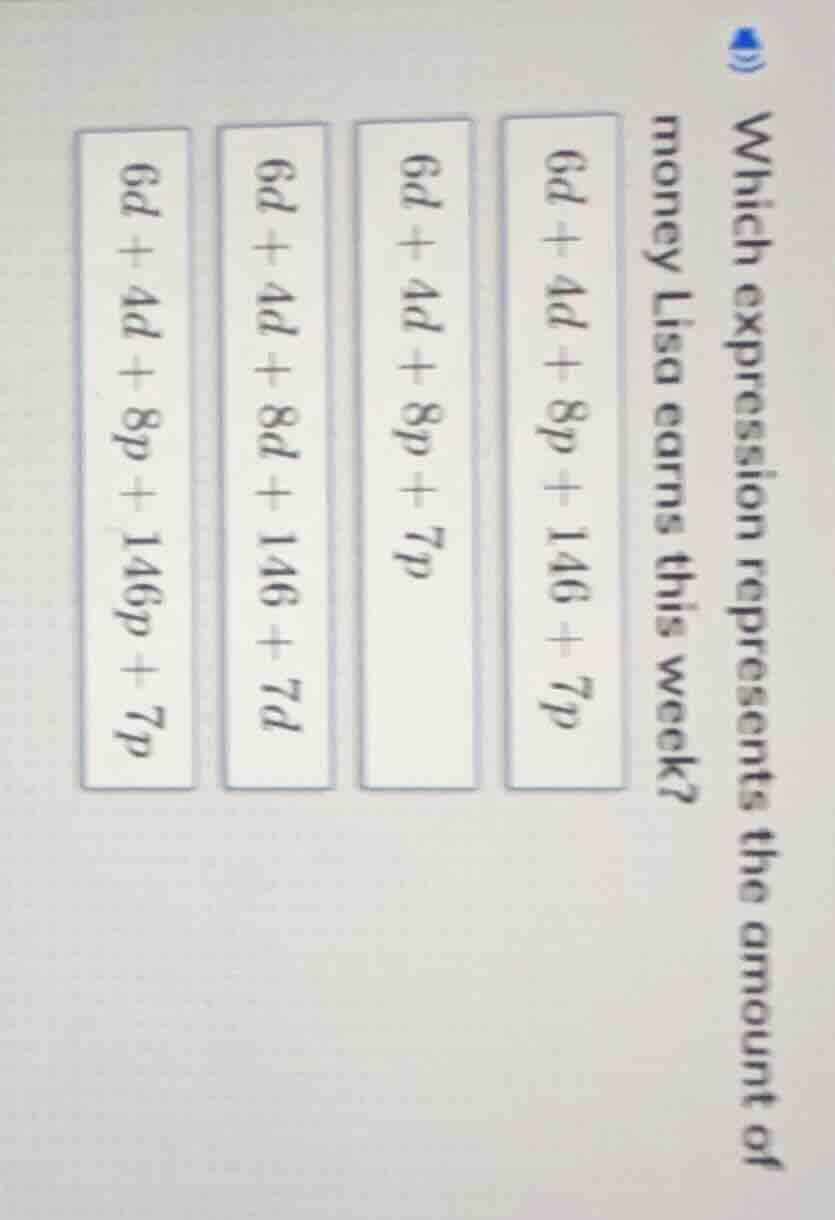
which expression represents the amount of money lisa earns this week? 6d + 4d + 8p + 146 + 7p; 6d + 4d + 8p + 7p; 6d + 4d + 8d + 146 + 7d; 6d + 4d + 8p + 146p + 7p
To solve this, we need to combine like terms. Like terms are terms with the same variable (or constant terms). Let's assume \( d \) and \( p \) represent different types of earnings (e.g., from different jobs or tasks).
Step 1: Identify like terms for \( d \) and \( p \)
- For terms with \( d \): We look at coefficients of \( d \).
- For terms with \( p \): We look at coefficients of \( p \).
- Constant terms (if any) are also like terms, but here we have \( 146 \) (a constant) and terms with \( d \) or \( p \).
Step 2: Analyze each option (by combining like terms)
Let’s assume the original earnings (before combining) have:
- Terms with \( d \): \( 6d, 4d, \) (maybe others)
- Terms with \( p \): \( 8p, 7p, \) (maybe others)
- Constant term: \( 146 \)
Option 1: \( 6d + 4d + 8p + 146 + 7p \)
- Combine \( d \)-terms: \( 6d + 4d = 10d \) (but wait, maybe there are more \( d \)-terms? Wait, no—wait, maybe the problem is about combining like terms. Wait, let's re-express:
Wait, maybe the original problem (not fully shown) has:
- \( d \)-terms: \( 6d, 4d, \) (and maybe \( 8d \) or \( 7d \)? No, let's check the options. Wait, the first option is \( 6d + 4d + 8p + 146 + 7p \). Let's combine like terms:
- \( d \)-terms: \( 6d + 4d = 10d \) (but if there are no other \( d \)-terms, this is correct for \( d \)-terms).
- \( p \)-terms: \( 8p + 7p = 15p \) (wait, no—wait, maybe the original has \( 8p \) and \( 7p \), so \( 8p + 7p = 15p \), and \( 6d + 4d = 10d \), plus \( 146 \). But let's check the other options:
Option 2: \( 6d + 4d + 8d + 146 + 7d \)
- \( d \)-terms: \( 6d + 4d + 8d + 7d = (6+4+8+7)d = 25d \), and no \( p \)-terms. But the problem mentions \( p \) (since other options have \( p \)), so this is wrong (no \( p \)-terms).
Option 3: \( 6d + 4d + 8p + 7p \)
- No constant term (\( 146 \) is missing), so this is wrong.
Option 4: \( 6d + 4d + 8p + 146p + 7p \)
- \( p \)-terms: \( 8p + 146p + 7p = 161p \), which is unlikely (too large).
Wait, maybe the correct approach is to combine like terms:
- Terms with \( d \): \( 6d + 4d \) (sum to \( 10d \), but if there are no other \( d \)-terms)
- Terms with \( p \): \( 8p + 7p \) (sum to \( 15p \))
- Constant term: \( 146 \)
Thus, the expression \( 6d + 4d + 8p + 146 + 7p \) combines \( d \)-terms, \( p \)-terms, and the constant. Let's verify:
- \( 6d + 4d = 10d \) (like terms for \( d \))
- \( 8p + 7p = 15p \) (like terms for \( p \))
- Constant: \( 146 \)
So the expression \( 6d + 4d + 8p + 146 + 7p \) (first option) is correct because it combines all like terms: \( d \)-terms, \( p \)-terms, and the constant \( 146 \).

Snap & solve any problem in the app
Get step-by-step solutions on Sovi AI
Photo-based solutions with guided steps
Explore more problems and detailed explanations
The expression \( 6d + 4d + 8p + 146 + 7p \) (first option) represents Lisa’s earnings by combining like terms for \( d \) and \( p \), and including the constant \( 146 \).