QUESTION IMAGE
Question
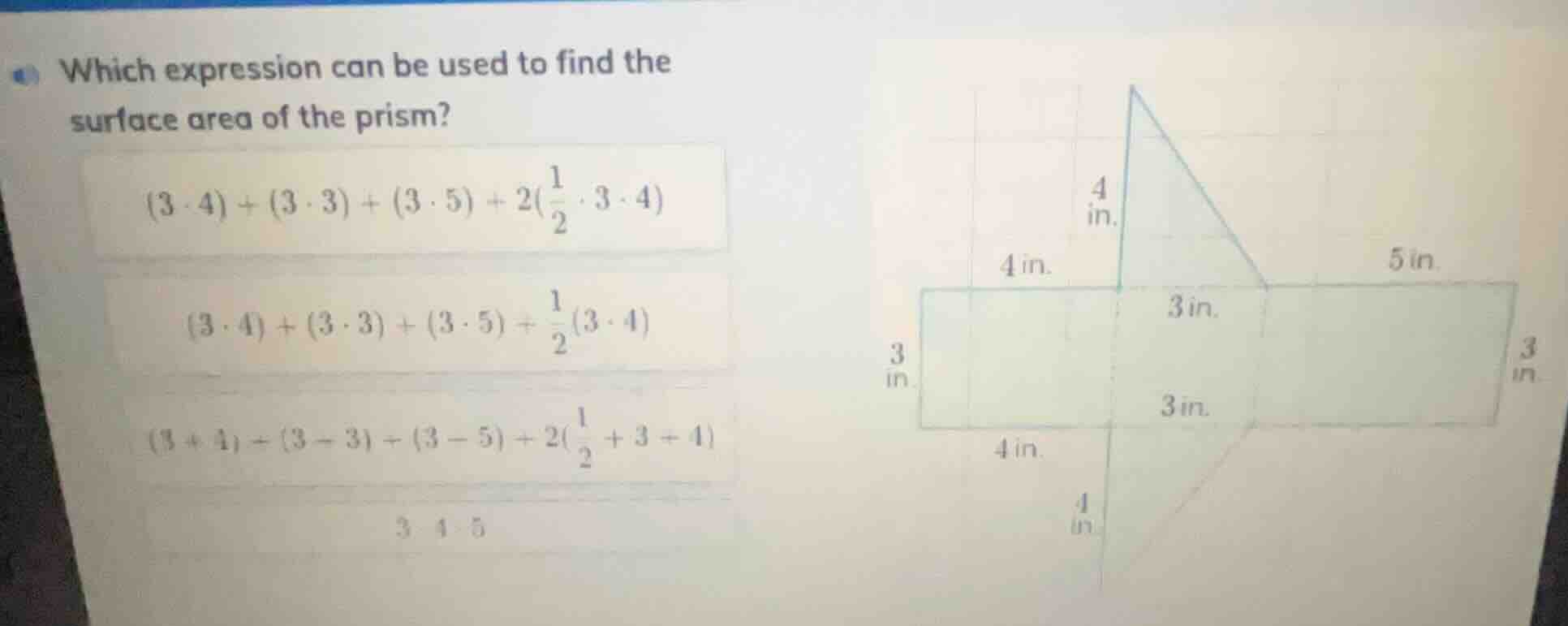
which expression can be used to find the surface area of the prism?
$(3 \cdot 4) + (3 \cdot 3) + (3 \cdot 5) + 2(\frac{1}{2} \cdot 3 \cdot 4)$
$(3 \cdot 4) + (3 \cdot 3) + (3 \cdot 5) + \frac{1}{2}(3 \cdot 4)$
$(3 + 4) + (3 + 3) + (3 + 5) + 2(\frac{1}{2} + 3 + 4)$
$3 \cdot 4 \cdot 5$
Step1: Recall Surface Area of Triangular Prism
The surface area of a triangular prism is the sum of the areas of all its faces. A triangular prism has two triangular bases and three rectangular lateral faces. The formula for the area of a triangle is $\frac{1}{2} \times base \times height$, and for a rectangle is $length \times width$.
Step2: Identify the Faces
- Triangular Bases: The triangular face has a base of 3 in and height of 4 in. Since there are two triangular bases, their combined area is $2 \times (\frac{1}{2} \times 3 \times 4)$.
- Rectangular Lateral Faces:
- One rectangle with dimensions $3 \times 4$ (area: $3 \times 4$).
- One rectangle with dimensions $3 \times 3$ (area: $3 \times 3$).
- One rectangle with dimensions $3 \times 5$ (area: $3 \times 5$).
Step3: Sum the Areas
Adding the areas of the two triangular bases and the three rectangular faces gives the expression: $(3 \cdot 4) + (3 \cdot 3) + (3 \cdot 5) + 2(\frac{1}{2} \cdot 3 \cdot 4)$.

Snap & solve any problem in the app
Get step-by-step solutions on Sovi AI
Photo-based solutions with guided steps
Explore more problems and detailed explanations
$(3 \cdot 4) + (3 \cdot 3) + (3 \cdot 5) + 2(\frac{1}{2} \cdot 3 \cdot 4)$ (the first expression)