QUESTION IMAGE
Question
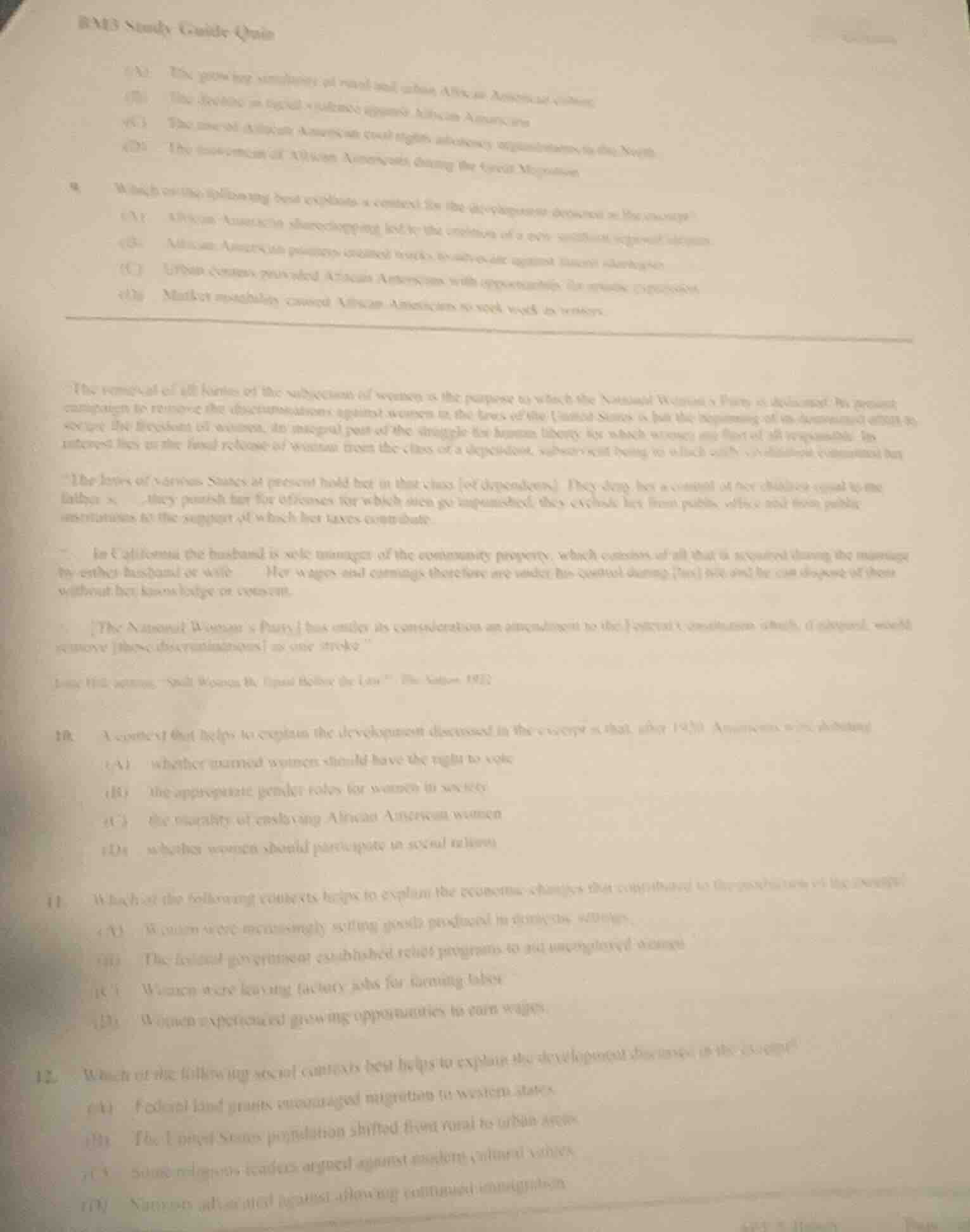
- which of the following best explains a context for the development discussed in the excerpt?
(a) african american sharecropping led to the creation of a new southern regional identity.
(b) african american painters created works to advocate against lynching.
(c) urban centers provided african americans with opportunities for artistic expression.
(d) market instability caused african americans to seek work in factories.
the removal of all forms of the subjection of women is the purpose to which the national woman’s party is dedicated. its present campaign to remove the discriminations against women in the laws of the united states is but the beginning of its determined effort to secure the freedom of women, an integral part of the struggle for human liberty for which women are first of all responsible. its interest lies in the final release of women from the class of dependents, subject only to such obligations as should be
the laws of various states at present hold her in this class of dependents. they deny her a control of her children equal to the father’s; they punish her for offenses for which men go unpunished; they exclude her from public office and from public
occupations at the support of which her taxes contribute.
in california the husband is sole manager of the community property, which consists of all that is acquired during the marriage by either husband or wife. her wages and earnings therefore are under his control during her life and he can dispose of them without her knowledge or consent.
the national woman’s party has under its consideration an amendment to the united states constitution which, if adopted, would remove these discriminations in one stroke.
jane h. addams, “such women do not believe in law,” the nation, 1912
- a context that helps to explain the development discussed in the excerpt is that, after 1900, americans were debating
(a) whether married women should have the right to vote
(b) the appropriate gender roles for women in society
(c) the morality of employing african american women
(d) whether women should participate in social reform
- which of the following contexts helps to explain the economic changes that contributed to the development in the excerpt?
(a) women were increasingly setting goods produced in domestic settings.
(b) the federal government established relief programs to aid unemployed women.
(c) women were leaving factory jobs for farming jobs.
(d) women experienced growing opportunities to earn wages.
- which of the following social contexts best helps to explain the development discussed in the excerpt?
(a) federal land grants encouraged migration to western states.
(b) the united states population shifted from rural to urban areas.
(c) some religious leaders argued against modern cultural values.
(d) nativists advocated against allowing immigrant assimilation
To solve these questions, we analyze each one based on the provided text and historical context:
Question 10 (assuming it's about women's rights and the National Woman's Party)
The excerpt focuses on women's subjugation and the fight for their rights, including economic and legal equality. After 1920, the debate shifted to women's roles in society (e.g., legal, economic, social). Option B ("the appropriate gender roles for women in society") aligns with this, as the text discusses women's dependent status and the need for liberation from that, which relates to defining their roles. Option A is incorrect because women gained the right to vote (19th Amendment) by 1920, so the debate wasn't about unmarried women's voting rights. Option C is off - topic (focus is on all women, not just African American women). Option D is incorrect as the text is about women's rights, not their social participation in the sense of social unions.
The text mentions women's wages being controlled by husbands (e.g., in California, husband manages community property including wife's earnings). The economic change that contributed to the movement was women having more wage - earning opportunities (Option D). As women worked more, they sought economic independence, fueling the rights movement. Option A is incorrect (text doesn't mention women setting prices). Option B: There's no mention of federal relief programs for unemployed women in the context. Option C is incorrect (text doesn't talk about women leaving factory jobs for farming).
The women's rights movement was part of a broader social change. The shift of the US population from rural to urban areas (Option B) brought more women into urban jobs and public life, increasing their demand for rights. Option A: Federal land grants for western migration are not directly related to women's rights in the text. Option C: Religious leaders' views on cultural values are not mentioned. Option D: Nativist attitudes towards immigrants are off - topic.

Snap & solve any problem in the app
Get step-by-step solutions on Sovi AI
Photo-based solutions with guided steps
Explore more problems and detailed explanations
B. the appropriate gender roles for women in society