QUESTION IMAGE
Question
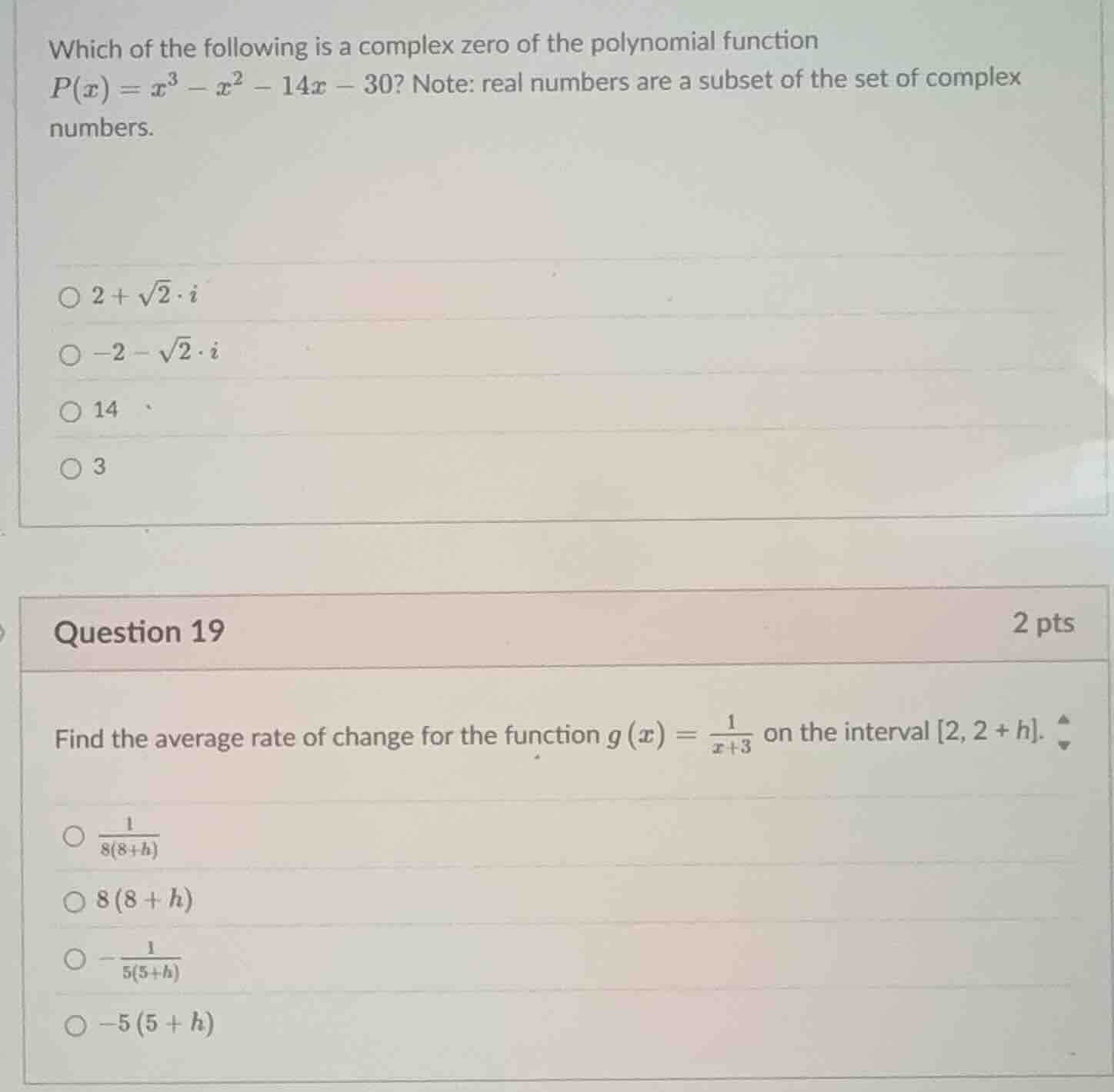
which of the following is a complex zero of the polynomial function $p(x) = x^3 - x^2 - 14x - 30$? note: real numbers are a subset of the set of complex numbers. $2 + sqrt{2} cdot i$ $-2 - sqrt{2} cdot i$ $14$ $3$ question 19 2 pts find the average rate of change for the function $g(x) = \frac{1}{x + 3}$ on the interval $2, 2 + h$. $\frac{1}{8(8 + h)}$ $8(8 + h)$ $-\frac{1}{5(5 + h)}$ $-5(5 + h)$
---
First Question (Polynomial Zero)
Step1: Test real zero candidate 3
$P(3) = 3^3 - 3^2 - 14(3) - 30 = 27 - 9 - 42 - 30 = -54
eq 0$
Step2: Test real zero candidate 14
$P(14) = 14^3 - 14^2 - 14(14) - 30 = 2744 - 196 - 196 - 30 = 2322
eq 0$
Step3: Factor polynomial via rational root test
Test $x=5$: $P(5)=125-25-70-30=0$. Factor as $(x-5)(x^2+4x+6)$
Step4: Solve quadratic for complex roots
Use quadratic formula: $x=\frac{-4\pm\sqrt{16-24}}{2}=\frac{-4\pm\sqrt{-8}}{2}=-2\pm\sqrt{2}i$
Step1: Recall average rate of change formula
$\text{Average rate} = \frac{g(2+h)-g(2)}{(2+h)-2}$
Step2: Compute $g(2+h)$ and $g(2)$
$g(2+h)=\frac{1}{(2+h)+3}=\frac{1}{5+h}$, $g(2)=\frac{1}{2+3}=\frac{1}{5}$
Step3: Substitute into the formula
$\frac{\frac{1}{5+h}-\frac{1}{5}}{h} = \frac{\frac{5-(5+h)}{5(5+h)}}{h}$
Step4: Simplify the expression
$\frac{\frac{-h}{5(5+h)}}{h} = -\frac{1}{5(5+h)}$

Snap & solve any problem in the app
Get step-by-step solutions on Sovi AI
Photo-based solutions with guided steps
Explore more problems and detailed explanations
$-2 - \sqrt{2} \cdot i$
---