QUESTION IMAGE
Question
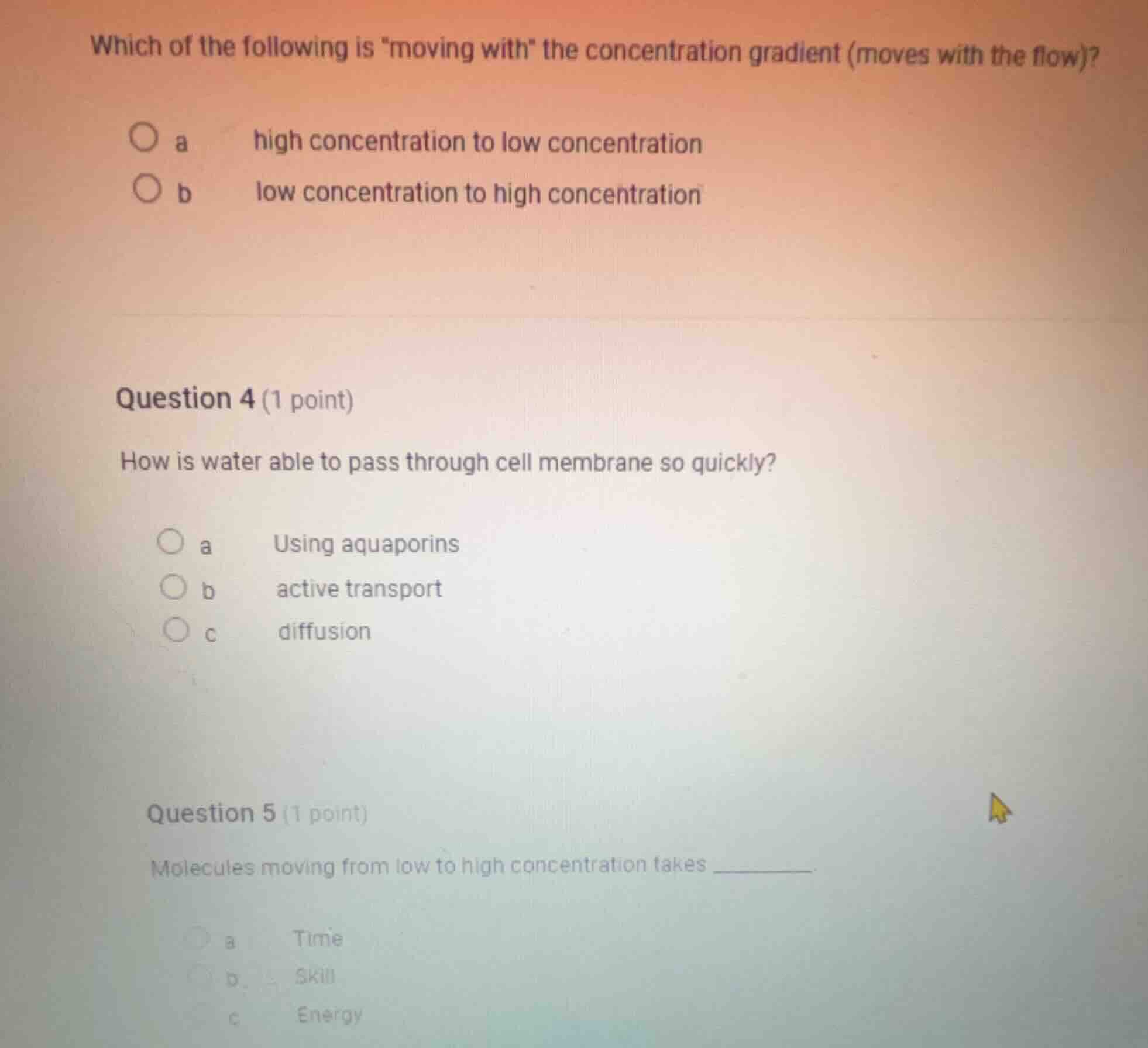
which of the following is \moving with\ the concentration gradient (moves with the flow)?
a high concentration to low concentration
b low concentration to high concentration
question 4 (1 point)
how is water able to pass through cell membrane so quickly?
a using aquaporins
b active transport
c diffusion
question 5 (1 point)
molecules moving from low to high concentration takes ______.
a time
b skill
c energy
Question 1 (Which of the following is "moving with" the concentration gradient (moves with the flow)?)
The concentration gradient is the difference in concentration between two areas. Moving with the concentration gradient means moving from an area of higher concentration to an area of lower concentration (this is passive transport, like diffusion). Moving from low to high concentration is against the gradient and requires energy (active transport). So option a is correct.
Water can pass through the cell membrane quickly via aquaporins, which are channel proteins specifically for water. Active transport is for moving substances against the gradient and requires energy, and water movement is usually passive. Diffusion of water (osmosis) can happen, but aquaporins facilitate rapid water movement. So option a is correct.
Moving molecules from low to high concentration is active transport, which requires energy (ATP). Time is not a specific requirement for this process in the context of what's needed (skill is irrelevant here). So the correct answer is energy, which is option c.

Snap & solve any problem in the app
Get step-by-step solutions on Sovi AI
Photo-based solutions with guided steps
Explore more problems and detailed explanations
a. high concentration to low concentration