QUESTION IMAGE
Question
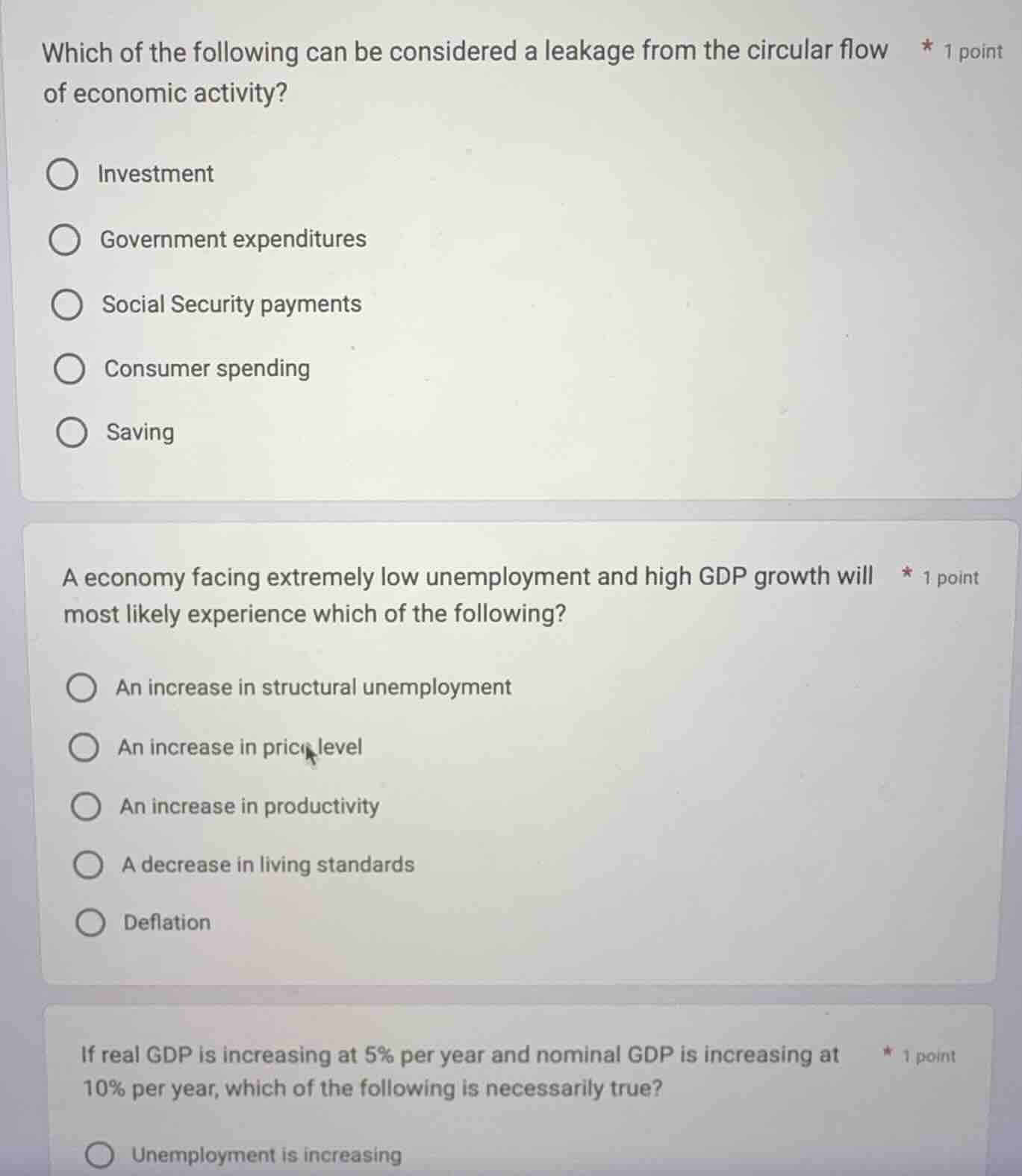
which of the following can be considered a leakage from the circular flow of economic activity? 1 point investment government expenditures social security payments consumer spending saving a economy facing extremely low unemployment and high gdp growth will 1 point most likely experience which of the following? an increase in structural unemployment an increase in price level an increase in productivity a decrease in living standards deflation if real gdp is increasing at 5% per year and nominal gdp is increasing at 10% per year, which of the following is necessarily true? 1 point unemployment is increasing
- For the first question: Leakages remove funds from the circular flow. Saving is income not spent on domestic goods/services, so it is a leakage. Investment, government expenditures, consumer spending are injections; Social Security is a transfer payment not a leakage.
- For the second question: Low unemployment and high GDP growth mean the economy is operating near or beyond full capacity, leading to higher demand for goods and labor, which drives up the overall price level. Structural unemployment is unrelated to this cycle, productivity growth is not guaranteed, living standards tend to rise, and deflation is the opposite of the expected effect.
- For the third question (partial): The relationship between nominal GDP, real GDP, and inflation is given by $\text{Nominal GDP growth} = \text{Real GDP growth} + \text{Inflation rate}$. Calculating, $10\% = 5\% + \text{Inflation rate}$, so inflation is 5%. The listed option (unemployment increasing) is false; rising real GDP typically lowers unemployment.

Snap & solve any problem in the app
Get step-by-step solutions on Sovi AI
Photo-based solutions with guided steps
Explore more problems and detailed explanations
- Saving
- An increase in price level
- (The listed option "Unemployment is increasing" is incorrect; the necessarily true statement is that the inflation rate is 5% annually, as $\text{Inflation rate} = 10\% - 5\% = 5\%$)